
Penny Dreadfuls, 1901 · page 9 of 37
The Golden Harpoon — page 9: what you’re looking at
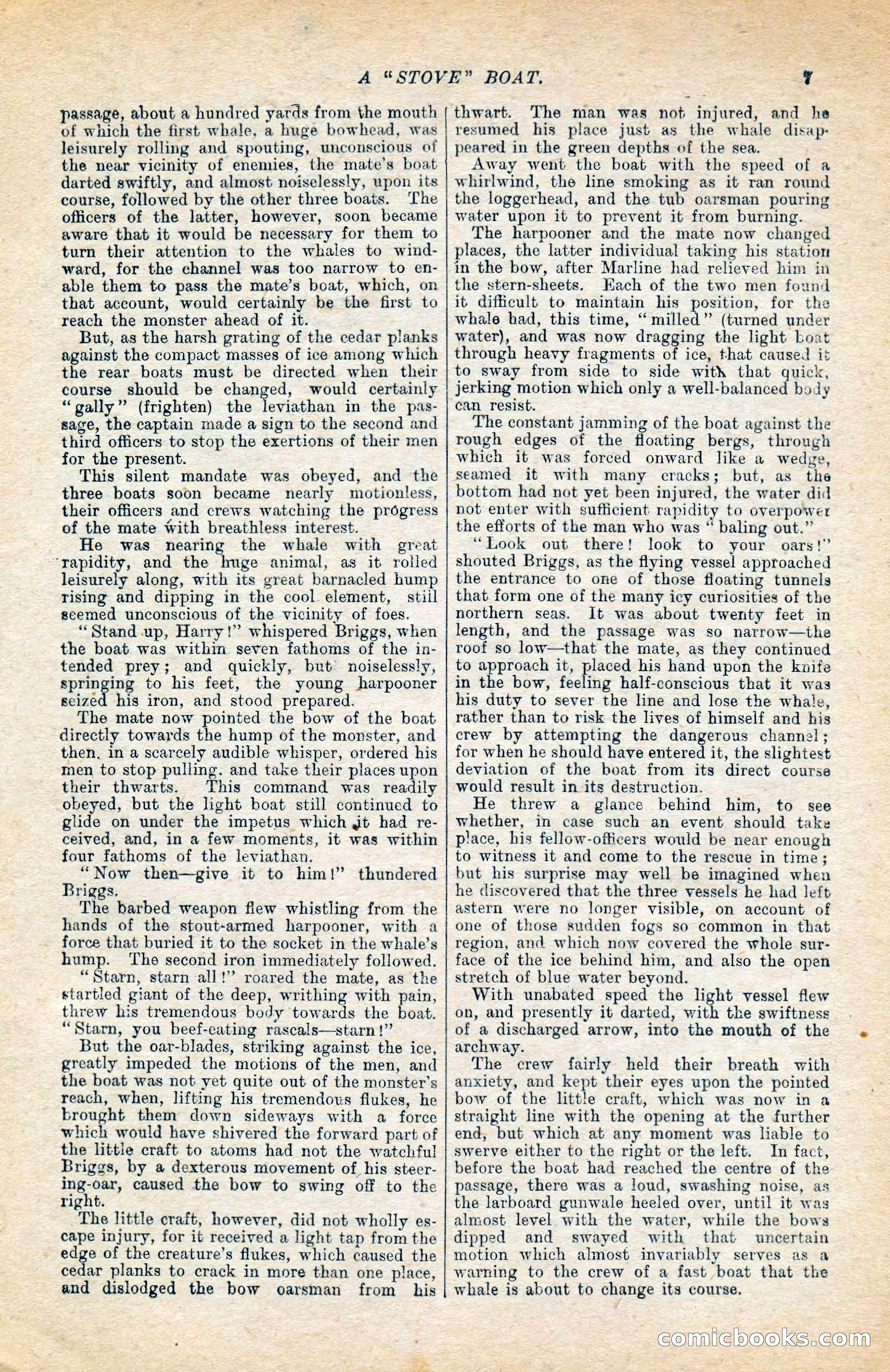
A restored page from Penny Dreadfuls, 1901. Page through the whole issue in the reader above.
📄 Transcribed text from this page (OCR, searchable)
Machine-transcribed from the original scan — historical spelling and the odd misread are preserved.
A “STOVE” BOAT, 7 passage, about a hundred yards from the mouth of which the first whale, a huge bowhead, was leisurely rolling and spouting, unconscious of the near vicinity of enemies, the mate’s boat darted swiftly, and almost noiselessly, upon its course, followed by the other three boats. The officers of the latter, however, soon became aware that it would be necessary for them to turn their attention to the whales to wind- ward, for the channel was too narrow to en- able them to pass the mate’s boat, which, on that account, would certainly be the first to reach the monster ahead of it. But, as the harsh grating of the cedar planks against the compact masses of ice among which the rear boats must be directed when their course should be changed, would certainly “gally” (frighten) the Ta Hiehihs in the pas- sage, the captain made a sign to the second and third officers to stop the exertions of their men for the present. This silent mandate was obeyed, and the three boats soon became nearly motionless, their officers and crews watching the progress of the mate with breathless interest. He was nearing the whale with great ‘rapidity, and the huge animal, as it rolled leisurely along, with its great barnacled hump rising and dipping in the cool element, stiil seemed unconscious of the vicinity of foes. “Stand up, Harry!” whispered Briggs, when the boat was within seven fathoms of the in- tended prey; and quickly, but’ noiselessly, springing to his feet, the young harpooner seized his iron, and stood prepared. The mate now pointed the bow of the boat directly towards the hump of the monster, and then, in a scarcely audible whisper, ordered his men to stop pulling. and take their places upon their thwarts. This command was readily obeyed, but the light boat still continued to glide on under the impetus which jt had re- ceived, and, in a few moments, it was within four fathoms of the leviathan. “Now then—give it to him!” thundered Briggs. The barbed weapon fiew whistling from the hands of the stout-armed harpooner, with a force that buried it to the socket in the whale’s hump. The second iron immediately followed. “Starn, starn all!” roared the mate, as the startled giant of the deep, writhing with pain, threw his tremendous body towards the boat. “Starn, you beef-eating rascals—starn!”’ But the oar-blades, striking against the ice, greatly impeded the motions of the men, and the boat was not yet quite out of the monster's reach, when, lifting his tremendous flukes, he brought them down sideways with a force which would have shivered the forward part of the littie craft to atoms had not the watchful Briggs, by a dexterous movement of his steer- ing-oar, caused the bow to swing off to the right. The little craft, however, did not wholly es- cape injury, for it received a light tap from the edge of the creature’s flukes, which caused the cedar planks to crack in more than one place, and dislodged the bow oarsman from his thwart. The man was not injured, and he resumed his place just as the whale disap- peared in the green depths of the sea. Away went the boat with the speed of a whirlwind, the line smoking as it ran round the loggerhead, and the tub oarsman pouring water upon it to prevent it from burning. The harpooner and the mate now changed places, the latter individual taking his station in the bow, after Marline had relieved him in the stern-sheets. Each of the two men found it difficult to maintain his position, for the whale had, this time, « milled (turned under water), and was now dragging the light boat through heavy fragments of ice, that caused it to sway from side to side with that quick, jerking motion which only a well-balanced body can resist. The constant jamming of the boat against the rough edges of the floating bergs, through which it was forced onward like a wedge, seamed it with many cracks; but, as the bottom had not yet been injured, the water did not enter with sufficient rapidity to overpower the efforts of the man who was “ baling out.” “Look out there! look to your oars!” shouted Briggs, as the flying vessel approached the entrance to one of those floating tunnels that form one of the many icy curiosities of the northern seas. It was about twenty feet in length, and the passage was so narrow—the roof so low—that the mate, as they continued to approach it, placed his hand upon the knife in the bow, feeling half-conscious that it was his duty to sever the line and lose the whale, rather than to risk the lives of himself and his crew by attempting the dangerous channel; for when he should have entered it, the slightest deviation of the boat from its direct course would result in its destruction. He threw a glance behind him, to see whether, in case such an event should take piace, his fellow-ofticers would be near enough to witness it and come to the rescue in time; but his surprise may well be imagined when he discovered that the three vessels he had left astern were no longer visible, on account of one of those sudden fogs so common in that region, and which now covered the whole sur- face of the ice behind him, and also the open stretch of blue water beyond. With unabated speed the light vessel flew on, and presently it darted, with the swiftness of a discharged arrow, into the mouth of the archway. The crew fairly held their breath with anxiety, and kept their eyes upon the pointed bow of the little craft, which was now in a straight line with the opening at the further end, but which at any moment was liable to swerve either to the right or the left. In fact, before the boat had reached the centre of the passage, there was a loud, swashing noise, as the larboard gunwale heeled over, until it was almost level with the water, while the bows dipped and swayed with that uncertain motion which almost invariably serves as a warning to the crew of a fast boat that the whale is about to change its course. Comichboo S (cO)