
Penny Dreadfuls, 1901 · page 32 of 37
The Boy Captain of the Black Swallow — page 32: what you’re looking at
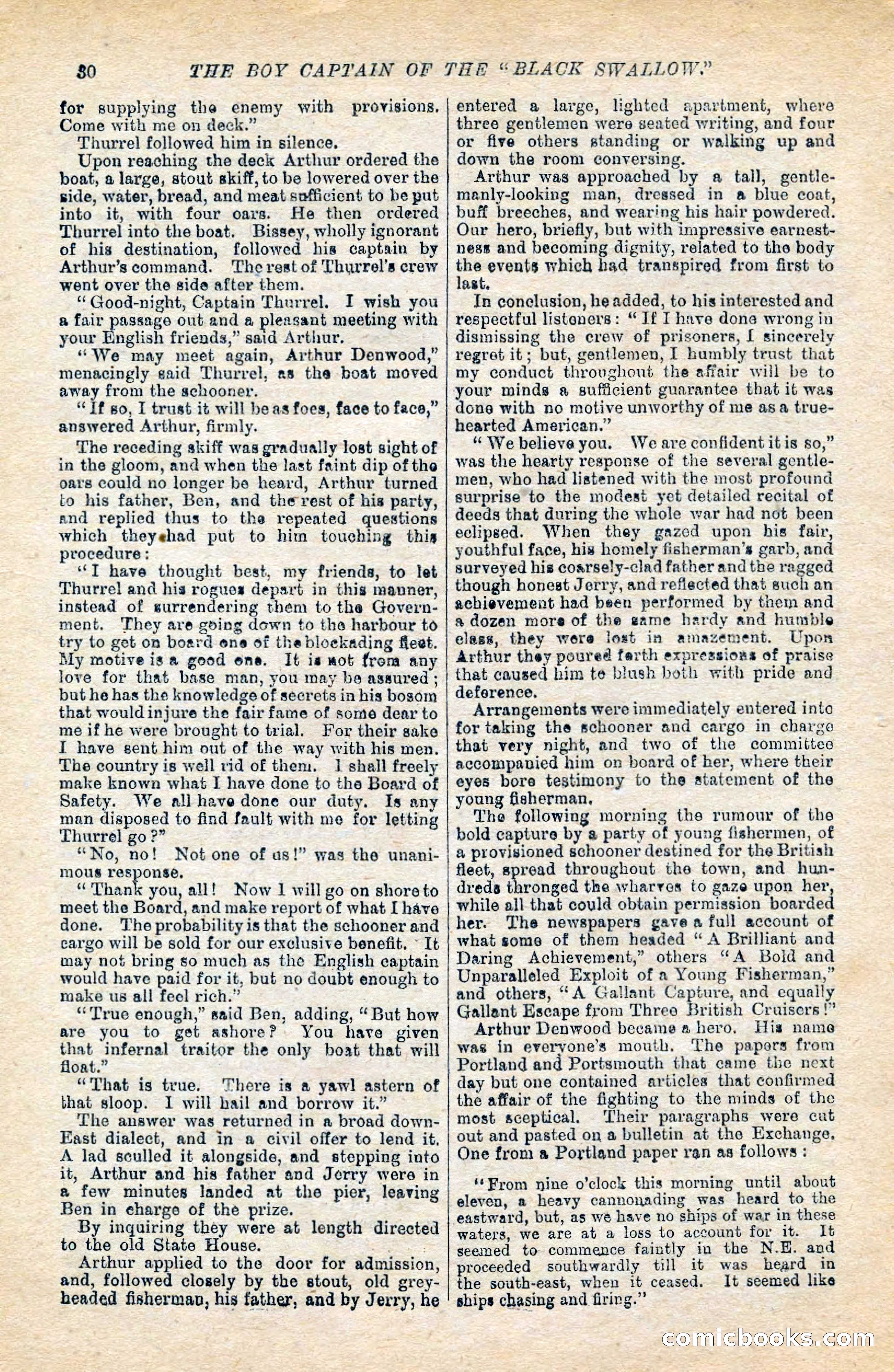
A restored page from Penny Dreadfuls, 1901. Page through the whole issue in the reader above.
📄 Transcribed text from this page (OCR, searchable)
Machine-transcribed from the original scan — historical spelling and the odd misread are preserved.
80 for supplying the enemy with provisions. Come with me on deck.” Thurrel followed him in silence. Upon reaching the deck Arthur ordered the boat, a large, stout skiff, to be lowered over the side, water, bread, and meat sufficient to be put into it, with four oars. He then ordered Thurrel into the boat. Bissey, wholly ignorant of his destination, followed his captain by Arthur’s command. Therest of Thurrel’s crew went over the side after them. “ Good-night, Captain Thurrel. I wish you a fair passage out and a pleasant meeting with your English friends,” said Arthur. “We may meet again, Arthur Denwood,” menacingly said Thurrel, as the boat moved away from the schooner. “Tf go, I trust it will beas foes, face to face,” answered Arthur, firmly. The receding skiff was gradually lost sight of in the gloom, and when the last faint dip of the oars could no longer be heard, Arthur turned to his father, Ben, and the rest of his party, and replied thus to the repeated questions which theyehad put to him touching this procedure ; “JT have thought best, my friends, to let Thurrel and his rogues depart in this manner, instead of surrendering them to the Govern- ment. They are going down to the harbour to try to get on board one of the blockading fleet. My motive isa good one. It is wot from any love for that base man, you may be assured ; but he has the knowledge of secrets in his bosom that would injure the fair fame of some dear to me if he were brought to trial. For their sake I have sent him out of the way with his men. The country is well vid of them. 1 shall freely make known what I have done to the Board of Safety. We all have done our duty, Is any man disposed to find fault with me for letting Lhurrel go ?” *'No, no! mous response, “Thank you, all! Now 1 will go on shore to meet the Board, and make report of what I have done. The probability is that the schooner and cargo will be sold for our exclusive benefit, ~ It may not bring so much as the English eaptain would have paid for it, but no doubt enough to make us all feel rich.” “True enough,” said Ben, adding, “But how are you to get ashoreP You have given se infernal traitor the only boat that will oat.” “That is true. There is a yawl astern of that sloop. I will bail and borrow it.” The answer was returned in a broad down- East dialect, and in a civil offer to lend it, A lad seulled it alongside, and stepping into it, Arthur and his father and Jerry were in e few minutes landed at the pier, leaving Ben in eharge of the prize. By inquiring they were at length directed to the old State House. Tee Arthur applied to the door for admission, and, followed closely by the stout, old grey- headed fisherman, his father, and by Jerry, he Not one of as!” was the unani- her. THE BOY CAPTAIN OF THE “BLACK SWALLOW. entered a large, lighted apartment, where three gentlemen were seated writing, and four or five others standing or walking up and down the room conversing. Arthur was approached by a tall, gentle- manly-looking man, dressed in a blue coat, buff breeches, and wearing his hair powdered. Our hero, briefly, but with impressive earnest- ness and becoming dignity, related to the body os events which had transpired from first to ast. In conclusion, he added, to his interested and respectful listeners: “If I have done wrong in dismissing the crew of prisoners, I sincerely regret it; but, gentlemen, I humbly trust that my conduct throughout the affair will be to your minds a sufficient guarantee that ib was done with no motive unworthy of me asa true- hearted American.” “Webelieve you. Weare confident itis 80,” was the hearty response of the several gentle- men, who had listened with the most profound surprise to the modest yet detailed recital of deeds that during the whole war had not been eclipsed. When they gazed upon his fair, youthful face, his homely fisherman’s garb, and surveyed his coarsely-clad father and the ragged though honest Jerry, and refiected that such an achievement had been performed by them and a dozen more of the eame hardy and humble elass, they were lost in amazement. Upon Arthur they poured farth expressions of praise that caused him te blush both with pride and deference. Arrangements were immediately entered into for taking the schooner and cargo in charge that very night, and two of the committee accompanied him on board of her, where their eyes bore testimony to the statement of the young fisherman, The following morning the rumour of the bold capture by a party of young fishermen, of a provisioned schooner destined for the British fleet, spread throughout the town, and hun- dreds thronged the wharves to gaze upon her, while all that could obtain permission boarded The newspapers gave a full account of what some of them headed “ A Brilliant and Daring Achievement,” others “A Bold and Unparalleled Exploit of a Young Fisherman,” and others, “A Gallant Capture, and equally Gallant Escape from Three British Cruisers !” Arthur Denwood became a hero. His name was in everyone’s mouth, The papers from Portland and Portsmouth that came the next day but one contained articles that confirmed the affair of the fighting to the minds of the most sceptical. ‘Their paragraphs were cut out and pasted on a bulletin at the Exchange. One from a Portland paper ran as follows : ‘‘From nine o’clock this morning until about eleven, a heavy cannonading was heard to the eastward, but, as wé have no ships of war in these waters, we are at a loss to account for it. It seemed to commence faintly in the N.E. and proceeded southwardly till it was heard in the south-east, when it ceased. It seemed like ships chasing and firing.” im Comichoo S (©)