
Penny Dreadfuls, 1848 · page 151 of 398
The Mysteries of the Court of London by Pauline Clarendon — page 151: what you’re looking at
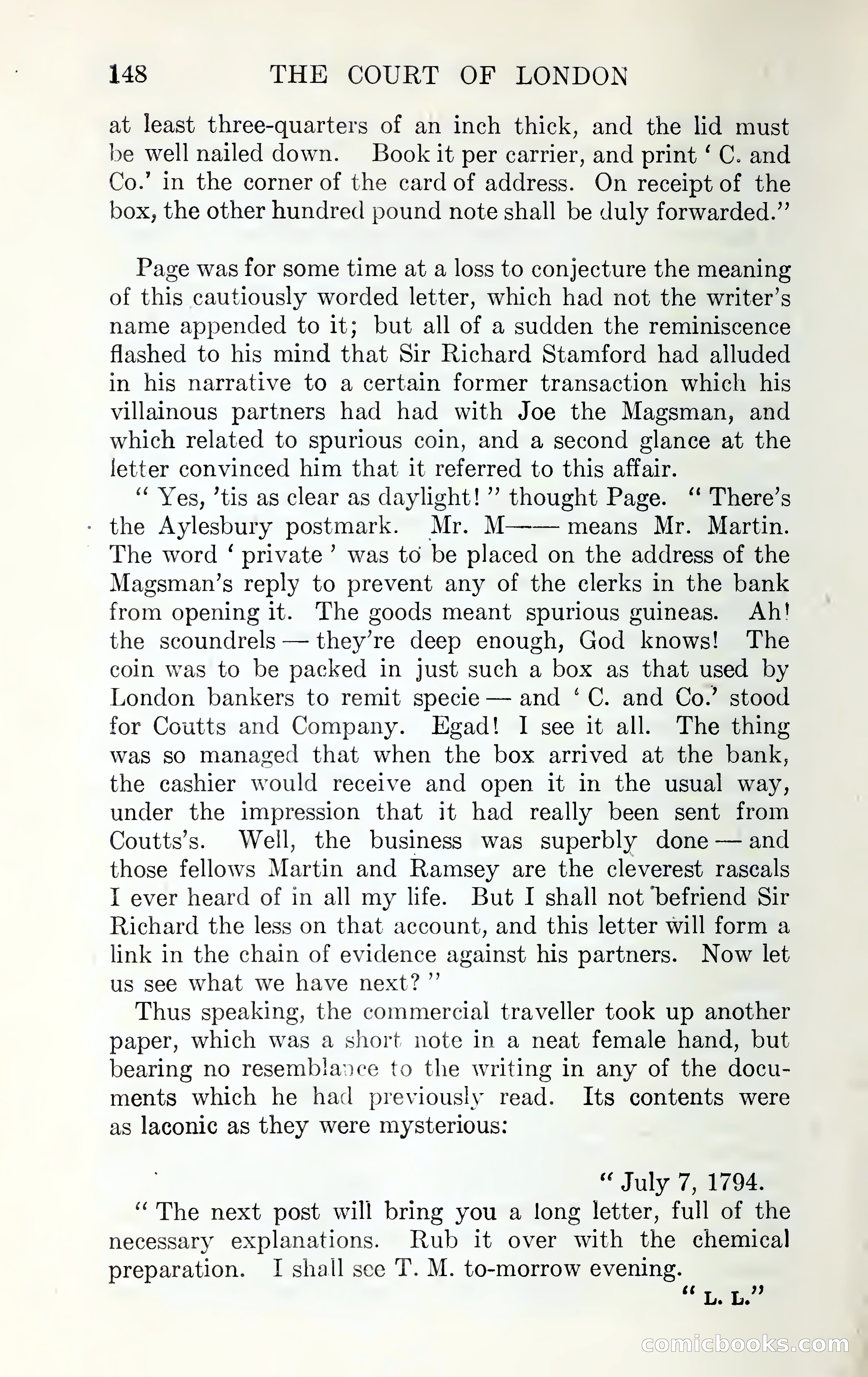
A restored page from Penny Dreadfuls, 1848. Page through the whole issue in the reader above.
📄 Transcribed text from this page (OCR, searchable)
Machine-transcribed from the original scan — historical spelling and the odd misread are preserved.
148 THE COURT OF LONDON at least three-quarters of an inch thick, and the lid must be well nailed down. Book it per carrier, and print ‘ C. and Co.’ in the corner of the card of address. On receipt of the box, the other hundred pound note shall be duly forwarded.” Page was for some time at a loss to conjecture the meaning of this cautiously worded letter, which had not the writer’s name appended to it; but all of a sudden the reminiscence flashed to his mind that Sir Richard Stamford had alluded in his narrative to a certain former transaction which his villainous partners had had with Joe the Magsman, and which related to spurious coin, and a second glance at the letter convinced him that it referred to this affair. “Yes, ’tis as clear as daylight!” thought Page. ‘“ There’s - the Aylesbury postmark. Mr. M—— means Mr. Martin. _ The word ‘ private’ was to be placed on the address of the Magsman’s reply to prevent any of the clerks in the bank from opening it. The goods meant spurious guineas. Ah! the scoundrels — they’re deep enough, God knows! The coin was to be packed in Just such a box as that used by London bankers to remit specie — and ‘C. and Co.’ stood for Coutts and Company. LEgad! I see it all. The thing was so managed that when the box arrived at the bank, the cashier would receive and open it in the usual way, under the impression that it had really been sent from Coutts’s. Well, the business was superbly done — and those fellows Martin and Ramsey are the cleverest rascals I ever heard of in all my life. But I shall not befriend Sir Richard the less on that account, and this letter will form a link 1n the chain of evidence against his partners. Now let us see what we have next? ”’ Thus speaking, the commercial traveller took up another paper, which was a short note in a neat female hand, but bearing no resemblance to the writing in any of the docu- ments which he had previousiy read. Its contents were as laconic as they were mysterious: July 7, 1794. “The next post will bring you a long letter, full of the necessary explanations. Rub it over with the chemical preparation. I shall see T. M. to-morrow evening. Lae ECORNIECLOOOKS (Elo) m