
Penny Dreadfuls, 1850 · page 105 of 400
The Gift of the Sailor: The String of Pearls & Sweeney Todd, the Demon Barber of Fleet Street — page 105: what you’re looking at
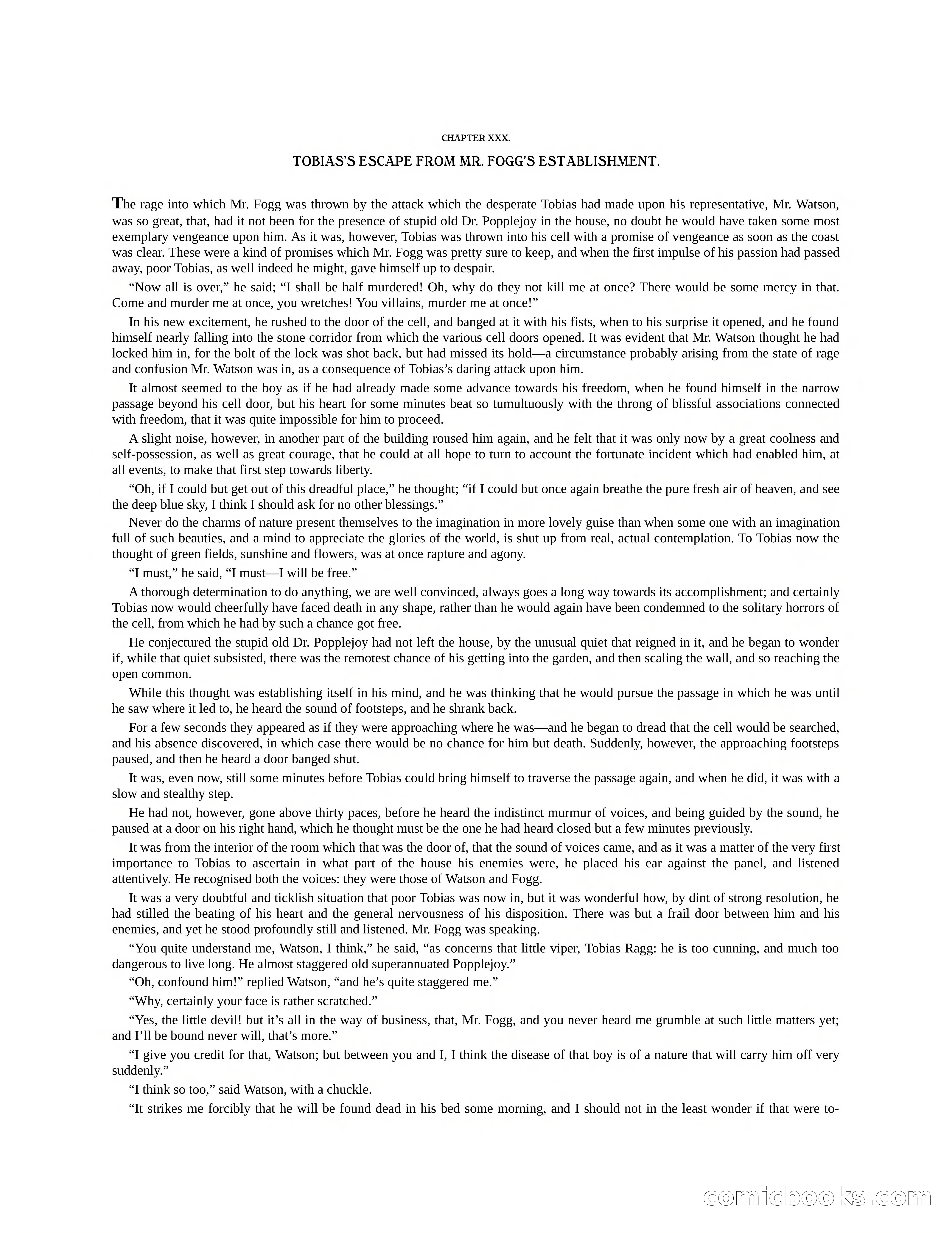
A restored page from Penny Dreadfuls, 1850. Page through the whole issue in the reader above.
📄 Transcribed text from this page (OCR, searchable)
Machine-transcribed from the original scan — historical spelling and the odd misread are preserved.
CHAPTER XXX. TOBIAS’S ESCAPE FROM MR. FOGG’S ESTABLISHMENT. The rage into which Mr. Fogg was thrown by the attack which the desperate Tobias had made upon his representative, Mr. Watson, was SO great, that, had it not been for the presence of stupid old Dr. Popplejoy in the house, no doubt he would have taken some most exemplary vengeance upon him. As it was, however, Tobias was thrown into his cell with a promise of vengeance as soon as the coast was Clear. These were a kind of promises which Mr. Fogg was pretty sure to keep, and when the first impulse of his passion had passed away, poor Tobias, as well indeed he might, gave himself up to despair. “Now all is over,” he said; “I shall be half murdered! Oh, why do they not kill me at once? There would be some mercy in that. Come and murder me at once, you wretches! You villains, murder me at once!” In his new excitement, he rushed to the door of the cell, and banged at it with his fists, when to his surprise it opened, and he found himself nearly falling into the stone corridor from which the various cell doors opened. It was evident that Mr. Watson thought he had locked him in, for the bolt of the lock was shot back, but had missed its hold—a circumstance probably arising from the state of rage and confusion Mr. Watson was in, as a consequence of Tobias’s daring attack upon him. It almost seemed to the boy as if he had already made some advance towards his freedom, when he found himself in the narrow passage beyond his cell door, but his heart for some minutes beat so tumultuously with the throng of blissful associations connected with freedom, that it was quite impossible for him to proceed. A slight noise, however, in another part of the building roused him again, and he felt that it was only now by a great coolness and self-possession, as well as great courage, that he could at all hope to turn to account the fortunate incident which had enabled him, at all events, to make that first step towards liberty. “Oh, if I could but get out of this dreadful place,” he thought; “if I could but once again breathe the pure fresh air of heaven, and see the deep blue sky, I think I should ask for no other blessings.” Never do the charms of nature present themselves to the imagination in more lovely guise than when some one with an imagination full of such beauties, and a mind to appreciate the glories of the world, is shut up from real, actual contemplation. To Tobias now the thought of green fields, sunshine and flowers, was at once rapture and agony. “T must,” he said, “I must—I will be free.” A thorough determination to do anything, we are well convinced, always goes a long way towards its accomplishment; and certainly Tobias now would cheerfully have faced death in any shape, rather than he would again have been condemned to the solitary horrors of the cell, from which he had by such a chance got free. He conjectured the stupid old Dr. Popplejoy had not left the house, by the unusual quiet that reigned in it, and he began to wonder if, while that quiet subsisted, there was the remotest chance of his getting into the garden, and then scaling the wall, and so reaching the open common. While this thought was establishing itself in his mind, and he was thinking that he would pursue the passage in which he was until he saw where it led to, he heard the sound of footsteps, and he shrank back. For a few seconds they appeared as if they were approaching where he was—and he began to dread that the cell would be searched, and his absence discovered, in which case there would be no chance for him but death. Suddenly, however, the approaching footsteps paused, and then he heard a door banged shut. It was, even now, still some minutes before Tobias could bring himself to traverse the passage again, and when he did, it was with a slow and stealthy step. He had not, however, gone above thirty paces, before he heard the indistinct murmur of voices, and being guided by the sound, he paused at a door on his right hand, which he thought must be the one he had heard closed but a few minutes previously. It was from the interior of the room which that was the door of, that the sound of voices came, and as it was a matter of the very first importance to Tobias to ascertain in what part of the house his enemies were, he placed his ear against the panel, and listened attentively. He recognised both the voices: they were those of Watson and Fogg. It was a very doubtful and ticklish situation that poor Tobias was now in, but it was wonderful how, by dint of strong resolution, he had stilled the beating of his heart and the general nervousness of his disposition. There was but a frail door between him and his enemies, and yet he stood profoundly still and listened. Mr. Fogg was speaking. “You quite understand me, Watson, I think,” he said, “as concerns that little viper, Tobias Ragg: he is too cunning, and much too dangerous to live long. He almost staggered old superannuated Popplejoy.” “Oh, confound him!” replied Watson, “and he’s quite staggered me.” “Why, certainly your face is rather scratched.” “Yes, the little devil! but it’s all in the way of business, that, Mr. Fogg, and you never heard me grumble at such little matters yet; and I’l be bound never will, that’s more.” “T give you credit for that, Watson; but between you and I, I think the disease of that boy is of a nature that will carry him off very suddenly.” “T think so too,” said Watson, with a chuckle. “Tt strikes me forcibly that he will be found dead in his bed some morning, and I should not in the least wonder if that were to- CORniclooo S CO)