
Penny Dreadfuls, 1850 · page 143 of 400
The Gift of the Sailor: The String of Pearls & Sweeney Todd, the Demon Barber of Fleet Street — page 143: what you’re looking at
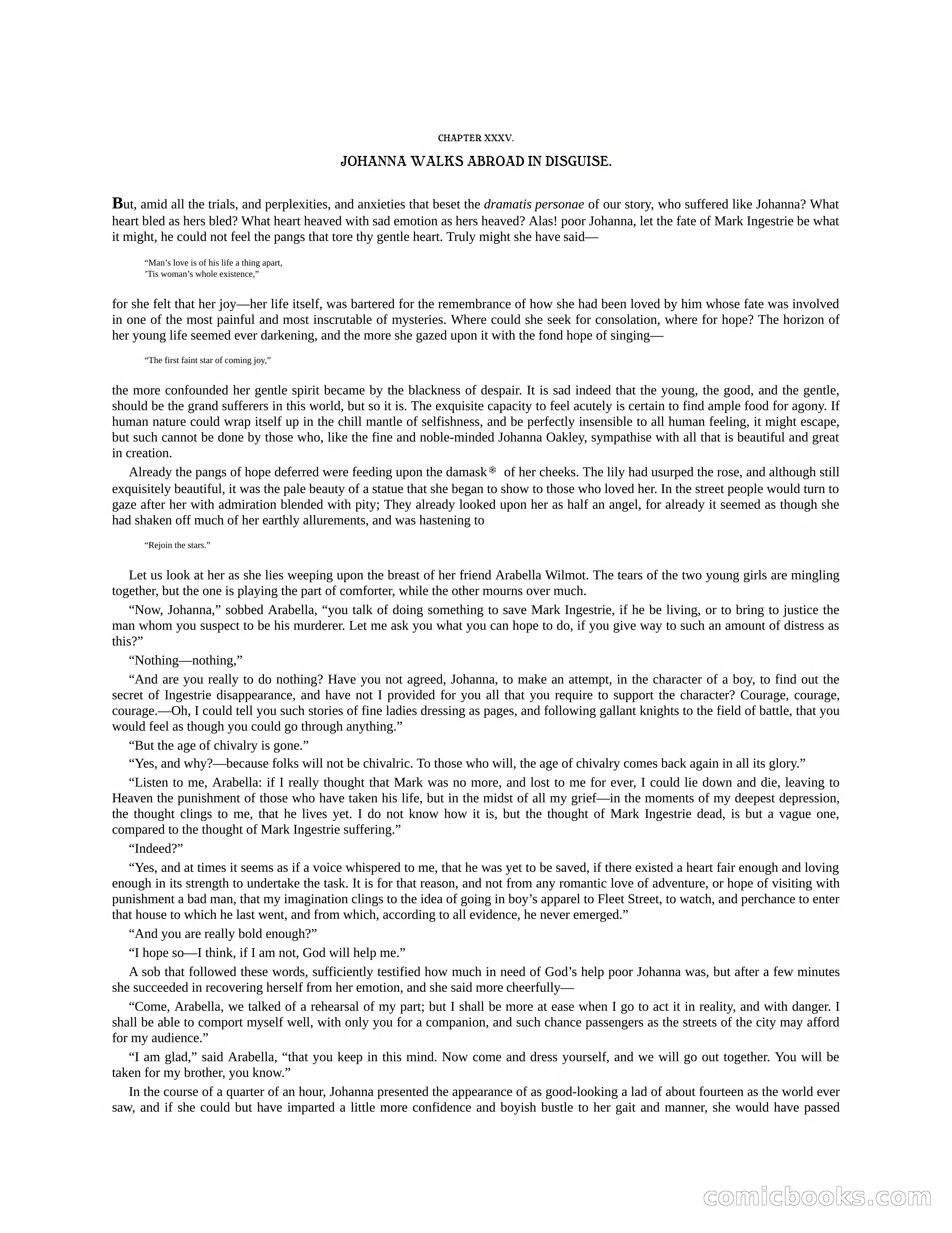
A restored page from Penny Dreadfuls, 1850. Page through the whole issue in the reader above.
📄 Transcribed text from this page (OCR, searchable)
Machine-transcribed from the original scan — historical spelling and the odd misread are preserved.
CHAPTER XXXV. JOHANNA WALKS ABROAD IN DISGUISE. But, amid all the trials, and perplexities, and anxieties that beset the dramatis personae of our story, who suffered like Johanna? What heart bled as hers bled? What heart heaved with sad emotion as hers heaved? Alas! poor Johanna, let the fate of Mark Ingestrie be what it might, he could not feel the pangs that tore thy gentle heart. Truly might she have said— “Man’s love is of his life a thing apart, *Tis woman’s whole existence,” for she felt that her joy—her life itself, was bartered for the remembrance of how she had been loved by him whose fate was involved in one of the most painful and most inscrutable of mysteries. Where could she seek for consolation, where for hope? The horizon of her young life seemed ever darkening, and the more she gazed upon it with the fond hope of singing— “The first faint star of coming joy,” the more confounded her gentle spirit became by the blackness of despair. It is sad indeed that the young, the good, and the gentle, should be the grand sufferers in this world, but so it is. The exquisite capacity to feel acutely is certain to find ample food for agony. If human nature could wrap itself up in the chill mantle of selfishness, and be perfectly insensible to all human feeling, it might escape, but such cannot be done by those who, like the fine and noble-minded Johanna Oakley, sympathise with all that is beautiful and great in creation. Already the pangs of hope deferred were feeding upon the damask® of her cheeks. The lily had usurped the rose, and although still exquisitely beautiful, it was the pale beauty of a statue that she began to show to those who loved her. In the street people would turn to gaze after her with admiration blended with pity; They already looked upon her as half an angel, for already it seemed as though she had shaken off much of her earthly allurements, and was hastening to “Rejoin the stars.” Let us look at her as she lies weeping upon the breast of her friend Arabella Wilmot. The tears of the two young girls are mingling together, but the one is playing the part of comforter, while the other mourns over much. “Now, Johanna,” sobbed Arabella, “you talk of doing something to save Mark Ingestrie, if he be living, or to bring to justice the man whom you suspect to be his murderer. Let me ask you what you can hope to do, if you give way to such an amount of distress as this?” “Nothing—nothing,” “And are you really to do nothing? Have you not agreed, Johanna, to make an attempt, in the character of a boy, to find out the secret of Ingestrie disappearance, and have not I provided for you all that you require to support the character? Courage, courage, courage.—Oh, I could tell you such stories of fine ladies dressing as pages, and following gallant knights to the field of battle, that you would feel as though you could go through anything.” “But the age of chivalry is gone.” “Yes, and why?—because folks will not be chivalric. To those who will, the age of chivalry comes back again in all its glory.” “Listen to me, Arabella: if I really thought that Mark was no more, and lost to me for ever, I could lie down and die, leaving to Heaven the punishment of those who have taken his life, but in the midst of all my grief—in the moments of my deepest depression, the thought clings to me, that he lives yet. I do not know how it is, but the thought of Mark Ingestrie dead, is but a vague one, compared to the thought of Mark Ingestrie suffering.” “Indeed?” “Yes, and at times it seems as if a voice whispered to me, that he was yet to be saved, if there existed a heart fair enough and loving enough in its strength to undertake the task. It is for that reason, and not from any romantic love of adventure, or hope of visiting with punishment a bad man, that my imagination clings to the idea of going in boy’s apparel to Fleet Street, to watch, and perchance to enter that house to which he last went, and from which, according to all evidence, he never emerged.” “And you are really bold enough?” “T hope so—I think, if I am not, God will help me.” A sob that followed these words, sufficiently testified how much in need of God’s help poor Johanna was, but after a few minutes she succeeded in recovering herself from her emotion, and she said more cheerfully— “Come, Arabella, we talked of a rehearsal of my part; but I shall be more at ease when I go to act it in reality, and with danger. I Shall be able to comport myself well, with only you for a companion, and such chance passengers as the streets of the city may afford for my audience.” “T am glad,” said Arabella, “that you keep in this mind. Now come and dress yourself, and we will go out together. You will be taken for my brother, you know.” In the course of a quarter of an hour, Johanna presented the appearance of as good-looking a lad of about fourteen as the world ever saw, and if she could but have imparted a little more confidence and boyish bustle to her gait and manner, she would have passed CORniclooo S CO)