
Penny Dreadfuls, 1850 · page 50 of 400
The Gift of the Sailor: The String of Pearls & Sweeney Todd, the Demon Barber of Fleet Street — page 50: what you’re looking at
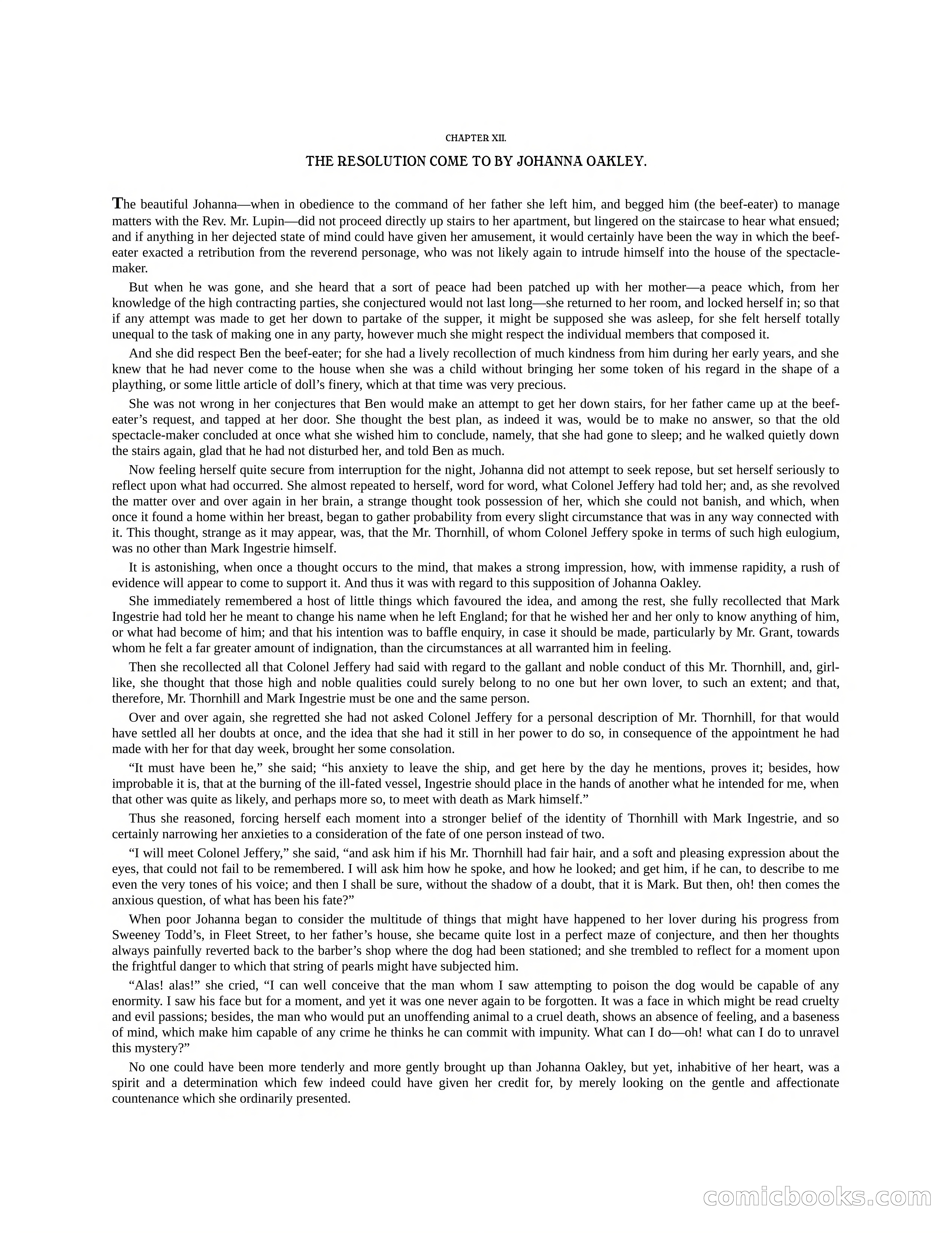
A restored page from Penny Dreadfuls, 1850. Page through the whole issue in the reader above.
📄 Transcribed text from this page (OCR, searchable)
Machine-transcribed from the original scan — historical spelling and the odd misread are preserved.
CHAPTER XII. THE RESOLUTION COME TO BY JOHANNA OAKLEY. The beautiful Johanna—when in obedience to the command of her father she left him, and begged him (the beef-eater) to manage matters with the Rev. Mr. Lupin—did not proceed directly up stairs to her apartment, but lingered on the staircase to hear what ensued; and if anything in her dejected state of mind could have given her amusement, it would certainly have been the way in which the beef- eater exacted a retribution from the reverend personage, who was not likely again to intrude himself into the house of the spectacle- maker. But when he was gone, and she heard that a sort of peace had been patched up with her mother—a peace which, from her knowledge of the high contracting parties, she conjectured would not last long—she returned to her room, and locked herself in; so that if any attempt was made to get her down to partake of the supper, it might be supposed she was asleep, for she felt herself totally unequal to the task of making one in any party, however much she might respect the individual members that composed it. And she did respect Ben the beef-eater; for she had a lively recollection of much kindness from him during her early years, and she knew that he had never come to the house when she was a child without bringing her some token of his regard in the shape of a plaything, or some little article of doll’s finery, which at that time was very precious. She was not wrong in her conjectures that Ben would make an attempt to get her down stairs, for her father came up at the beef- eater’s request, and tapped at her door. She thought the best plan, as indeed it was, would be to make no answer, so that the old spectacle-maker concluded at once what she wished him to conclude, namely, that she had gone to sleep; and he walked quietly down the stairs again, glad that he had not disturbed her, and told Ben as much. Now feeling herself quite secure from interruption for the night, Johanna did not attempt to seek repose, but set herself seriously to reflect upon what had occurred. She almost repeated to herself, word for word, what Colonel Jeffery had told her; and, as she revolved the matter over and over again in her brain, a strange thought took possession of her, which she could not banish, and which, when once it found a home within her breast, began to gather probability from every slight circumstance that was in any way connected with it. This thought, strange as it may appear, was, that the Mr. Thornhill, of whom Colonel Jeffery spoke in terms of such high eulogium, was no other than Mark Ingestrie himself. It is astonishing, when once a thought occurs to the mind, that makes a strong impression, how, with immense rapidity, a rush of evidence will appear to come to support it. And thus it was with regard to this supposition of Johanna Oakley. She immediately remembered a host of little things which favoured the idea, and among the rest, she fully recollected that Mark Ingestrie had told her he meant to change his name when he left England; for that he wished her and her only to know anything of him, or what had become of him; and that his intention was to baffle enquiry, in case it should be made, particularly by Mr. Grant, towards whom he felt a far greater amount of indignation, than the circumstances at all warranted him in feeling. Then she recollected all that Colonel Jeffery had said with regard to the gallant and noble conduct of this Mr. Thornhill, and, girl- like, she thought that those high and noble qualities could surely belong to no one but her own lover, to such an extent; and that, therefore, Mr. Thornhill and Mark Ingestrie must be one and the same person. Over and over again, she regretted she had not asked Colonel Jeffery for a personal description of Mr. Thornhill, for that would have settled all her doubts at once, and the idea that she had it still in her power to do so, in consequence of the appointment he had made with her for that day week, brought her some consolation. “Tt must have been he,” she said; “his anxiety to leave the ship, and get here by the day he mentions, proves it; besides, how improbable it is, that at the burning of the ill-fated vessel, Ingestrie should place in the hands of another what he intended for me, when that other was quite as likely, and perhaps more so, to meet with death as Mark himself.” Thus she reasoned, forcing herself each moment into a stronger belief of the identity of Thornhill with Mark Ingestrie, and so certainly narrowing her anxieties to a consideration of the fate of one person instead of two. “T will meet Colonel Jeffery,” she said, “and ask him if his Mr. Thornhill had fair hair, and a soft and pleasing expression about the eyes, that could not fail to be remembered. I will ask him how he spoke, and how he looked; and get him, if he can, to describe to me even the very tones of his voice; and then I shall be sure, without the shadow of a doubt, that it is Mark. But then, oh! then comes the anxious question, of what has been his fate?” When poor Johanna began to consider the multitude of things that might have happened to her lover during his progress from Sweeney Todd’s, in Fleet Street, to her father’s house, she became quite lost in a perfect maze of conjecture, and then her thoughts always painfully reverted back to the barber’s shop where the dog had been stationed; and she trembled to reflect for a moment upon the frightful danger to which that string of pearls might have subjected him. “Alas! alas!” she cried, “I can well conceive that the man whom I saw attempting to poison the dog would be capable of any enormity. I saw his face but for a moment, and yet it was one never again to be forgotten. It was a face in which might be read cruelty and evil passions; besides, the man who would put an unoffending animal to a cruel death, shows an absence of feeling, and a baseness of mind, which make him capable of any crime he thinks he can commit with impunity. What can I do—oh! what can I do to unravel this mystery?” No one could have been more tenderly and more gently brought up than Johanna Oakley, but yet, inhabitive of her heart, was a spirit and a determination which few indeed could have given her credit for, by merely looking on the gentle and affectionate countenance which she ordinarily presented. CORniclooo S CO)