
Penny Dreadfuls, 1898 · page 32 of 35
Frank Merriwell's Catch — page 32: what you’re looking at
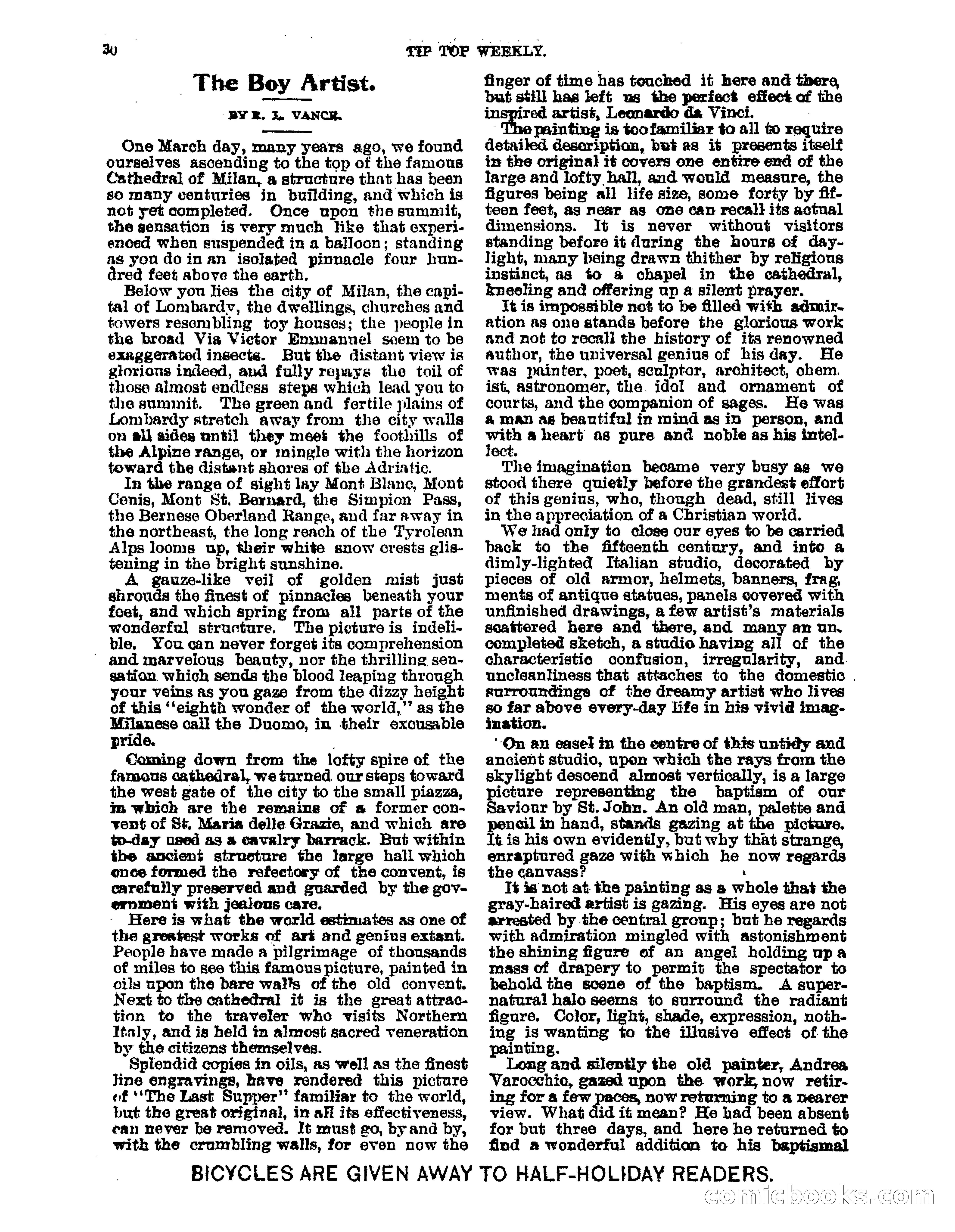
A restored page from Penny Dreadfuls, 1898. Page through the whole issue in the reader above.
📄 Transcribed text from this page (OCR, searchable)
Machine-transcribed from the original scan — historical spelling and the odd misread are preserved.
The Boy Artist. BYR. % VANCK. One March day, many years ago, we found ourselves ascending to the top of the famous Cathedral of Milan, a structure that has been so many centuries in building, and which is not yet completed. Once upon the summit, the sensation is very much like that experi- enced when suspended in a balloon; standing as you doin an isolated pinnacle four hun- dred feet above the earth. Below you lies the city of Milan, the capi- tal of Lombardv, the dwellings, churches and towers resombling toy honses; the people in the broad Via Vietor Emmannel seem to be exaggerated insecte. But the distant view is gioxrions indeed, and fully repays the toil of those almost endless steps which lead you to the summit. The green and fertile plains of Lombardy stretch away from the city walls on all sides until they meeét the foothills of the Alpine range, or mingle with the horizon toward the distant shores of the Adriatic. In the range of sight lay Mont Blanc, Mont Cenis, Mont St. Bernard, the Simpion Pass, the Bernese Oberland Range, and far away in the northeast, the long reach of the Tyrolean Alps looms up, their white snow crests glis- tening in the bright sunshine. A gauze-like veil of golden mist just shrouds the finest of pinnacies beneath your feet, and which spring from all parts of the wonderful structure. The picture is indeli- ble. You can never forget ita comprehension and marvelous beauty, nor the thrilling seu- sation which sends the blood leaping through your veins as you gaze from the dizzy height of this ‘‘eighth wonder of the world,”’’ as the Milanese call the Duomo, in their excusable pride. Coming down from the lofty spire of the famous cathedral, we turned our steps toward the west gate of the city to the small piazza, m which are the remains of a former con- vent of St. Maria delle Grazie, and which are to-day used as a cavalry barrack. But within the ancient structure the large hall which once formed the refectory of the convent, is carefully preserved and guarded by the gov- ernment with jealous care. Here is what the world estimates as one of the greatest works of art and gening extant. People have made a pilgrimage of thousands of miles to see this famous picture, painted in oils upon the bare walls of the old convent. Next to the cathedral it is the great attrac- tion to the traveler who visits Northern Italy, and is held in almost sacred veneration by the citizens themselves. Splendid copies in oils, as well as the finest line engravings, have rendered this picture of ‘The Last Supper” familiar to the world, but the great original, in all its effectiveness, can never be removed. It must go, by and by, with the crumbling walls, for even now the TIP TOP WEEKLY. finger of time has teuched it here and there, but still has left us the perfect effect of the inspired artist, Leonardo da Vinci. | ‘The painting ia toofamiliar to all to require detailed description, but ag if presents itself in the original it covers one entire end of the large and lofty hall, and would measure, the figures being all life size, some forty by fif- teen fect, as near as one can recall its actual dimensions. It is never without visitors standing before it during the hours of day- light, many being drawn thither by religious instinct, as to & chapel in the cathedral, kneeling and offering up a silent prayer. lt is impossible not to be filled with admir. ation as one stands before the glorious work and not to recall the history of its renowned author, the universal genius of his day. He was painter, poet, scalptor, architect, chem. ist, astronomer, the. idol and ornament of courts, and the companion of sages. He was aman as beautiful in mind as in person, and _ a heart as pure and noble as his intel- ect. The imagination became very busy as we stood there quietly before the grandest effort of this genius, who, though dead, still lives in the appreciation of a Christian world. We had only to close our eyes to be carried back to the fifteenth century, and into a dimly-lighted Italian studio, decorated by pieces of old armor, helmets, banners, frag, ments of antique atatues, panels covered with unfinished drawings, a few artist’s materials scattered here and there, and many an un. completed sketch, a studio having all of the characteristic confusion, irregularity, and. uncleantiness that attaches to the domestic . surroundings of the dreamy artist who lives so far above every-day life in his vivid imag- ination. On an easel m the centre of this untidy and ancient studio, upen which the rays from the skylight descend almost vertically, is a large icture representing the baptism of our viour by St. John. An old man, palette and pencil in hand, stands gazing at the picture. lt is his own evidently, but why that strange, enraptured gaze with which he now regards the canvass? ‘ It 38 not at the painting as a whole that the gray-haired artist is gazing. His eyes are not arrested by the central group; but he regards with admiration mingled with astonishment the shining figure ef an angel holding up a mass of drapery to permit the spectator to behold the scene of the baptism. A super- nafural halo seems to surround the radiant figure. Color, light, shade, expression, noth- ing is wanting to the illusive effect of the painting. Long and silently the old painter, Andrea Varocchio, gazed upon the work, now retir- ing for a few paces, now returning to a nearer view. What did it mean? He had been absent for but three days, and here he returned to find a wonderful addition to his baptismal BICYCLES ARE GIVEN AWAY TO HALF-HOLIDAY READERS. ECOMMICLOC SS (CO)