
Penny Dreadfuls, 1898 · page 32 of 35
Tip Top Weekly No. 118: Frank Merriwell, Engine Wiper — page 32: what you’re looking at
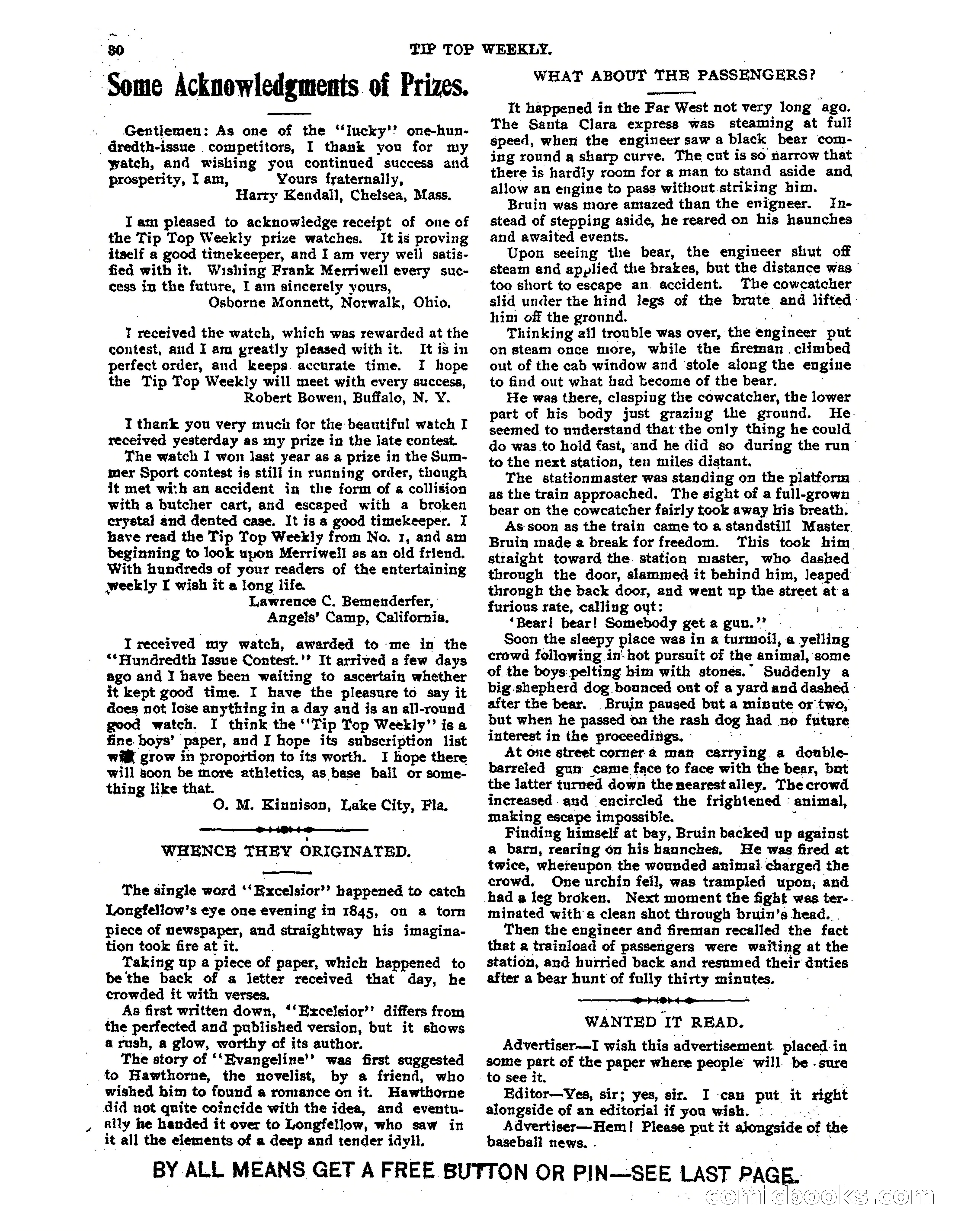
A restored page from Penny Dreadfuls, 1898. Page through the whole issue in the reader above.
📄 Transcribed text from this page (OCR, searchable)
Machine-transcribed from the original scan — historical spelling and the odd misread are preserved.
TIP TOP WEBKLY. 5 Some Acksewiedemeats of Prizes. . Gentlemen: As one of the ‘‘Incky’’ one-hun- _Gredth-issue competitors, I thank you for my yatch, and wishing you continued success and prosperity, I am, Yours fraternaily, Harry Kendall, Chelsea, Mass. Iam pleased to acknowledge receipt of one of the Tip Top Weekly prize watches, It is proving itself a good timekeeper, and I am very well satis- fied with it. Wishing Frank Merriwell every suc- cess in the future, I am sincerely yours, | Osborne Monnett, Norwalk, Ohio. T received the watch, which was rewarded at the contest, and J am yreatly pleased with it. It is in perfect order, and keeps. accurate time. I hope the Tip Top Weekly will meet with every success, Robert Bowen, Buffalo, N. Y. I thank you very mucu for the beautiful watch I received yesterday as my prize in the late contest. The watch I won last year as a prize in the Sum- mer Sport contest is still in running order, though it met with an accident in the form of a collision with a butcher cart, and escaped with a broken erystal and dented case. It is a good timekeeper. I have read the Tip Top Weekly from No. 1, and am beginning to look upon Merriwell as an old friend. With hundreds of your readers of the entertaining weekly I wish it a long life. Lawrence C. Bemenderfer, Angels’ Camp, California. I received my watch, awarded to me in the “*F¥undredth Issue Contest.’’ It arrived a few days ago and I have been waiting to ascertain whether it kept good time. I have the pleasure to say it does not lose anything in a day and is an all-round good watch. I think the ‘‘Tip Top Weekly” is a fine boys’ paper, and I hope its subscription list WK grow in proportion to its worth. I hope there will soon be more athletics, as base ball or somte- thing like that. O. M. Kinnison, Lake City, Fla. et WHENCE THEY ORIGINATED. The single word ‘‘Excelsior’’ happened to catch Longfellow’s eye one evening in 1845, on a torn piece of newspaper, and straightway his imagina- tion took fire at It. . Taking up a piece of paper, which happened to be'the back of a letter received that day, he crowded it with verses. _ As first written down, ‘‘Excelsior’’ differs from the perfected and published version, but it shows a rush, a glow, worthy of its author. The story of ‘‘Evangeline’? was first suggested to Hawthorne, the novelist, by a friend, who wished him to found a romance on it. Hawthorne did not quite coincide with the idea, and eventu- ally he handed it over to Longfellow, who saw in it all the elements of a deep and tender idyil. BY ALL MEANS. GET A FREE. BUTTON OR PIN—SEE LAST PAGE. NOOLKS WHAT ABOUT THE PASSENGERS? {gente i ES, It happened in the Far West not very long “ago. The Santa Clara express was steaming at full speed, when the engineer saw a black bear com- | ing round a sharp curve. The cut is so narrow that | there is hardly room for a man to stand aside and allow an engine to pass without. striking him. Bruin was more amazed than the enigneer. In- stead of stepping aside, he reared on his haunches — and awaited events. Upon seeing the bear, the engineer shut off steam and applied the brakes, but the distance was too short to escape an. accident. The cowcatcher slid under the hind legs of the brute and lifted - | him off the ground. Thinking all trouble was aver, the engineer put on steam once niore, while the fireman climbed out of the cab window and ‘stole along the engine | to find out what had become of the bear. He was there, clasping the cowcatcher, the lower part of his body just grazing the ground. He. seemed to nnderstand that the only thing he could do was to hold fast, and he did so during the run to the next station, ten miles distant. The stationmaster was standing on the platform . as the train approached. The sight of a full-grown bear on the coweatcher fairly took away bis breath. As soon as the train came to a standstill Master. Bruin made a break for freedom. This took him. straight toward the. station master, who dashed through the door, slammed it behind him, leaped through the back door, and went up the akreet ata furious rate, calling oyt: c ‘Bear! bear! Somebody get a gun.” Soon the sleepy place was in a turmoil, a 4 yelling | crowd following in: hot pursuit of the animal, some of the boys:pelting him with stones. Suddenly a big-shepherd dog bounced out of a yard and dashed after the bear. Bruin paused but a minute or two, but when he passed on the rash dog had no future interest in the proceedings. At one street corner a man carrying a double- barreled gun ceme face to face with the bear, bat the latter turned down the nearest alley. The crowd increased and encircled the frightened ‘ animal, making escape impossible. Finding himself at bay, Bruin backed up against a barn, rearing on his haunches. twice, whereupon the wounded animai charged the crowd. One urchin fell, was trampled upon; and had a leg broken. Next moment the fight was ter-. minated with a clean shot through bruin’s head... Then the engineer and fireman recalled the fact that a trainload of passengers were waiting at the station, and hurried back and resumed their duties after a bear hunt of fully thirty minutes. —_—_—_-?10-+-—__—_— WANTED ‘IT READ. Advertiser—I wish this advertisement placed it itt some part of the paper where people will. be. sure to see it. Editor—Yes, sir; yes, sir. I can put it right alongside of an editorial if you wish. — . Advertiser—Hem! Please put it slongside of the baseball news. He was fired at. COME (SO)