
Penny Dreadfuls, 1898 · page 12 of 35
Tip Top Weekly No. 139: Frank Merriwell's Father — page 12: what you’re looking at
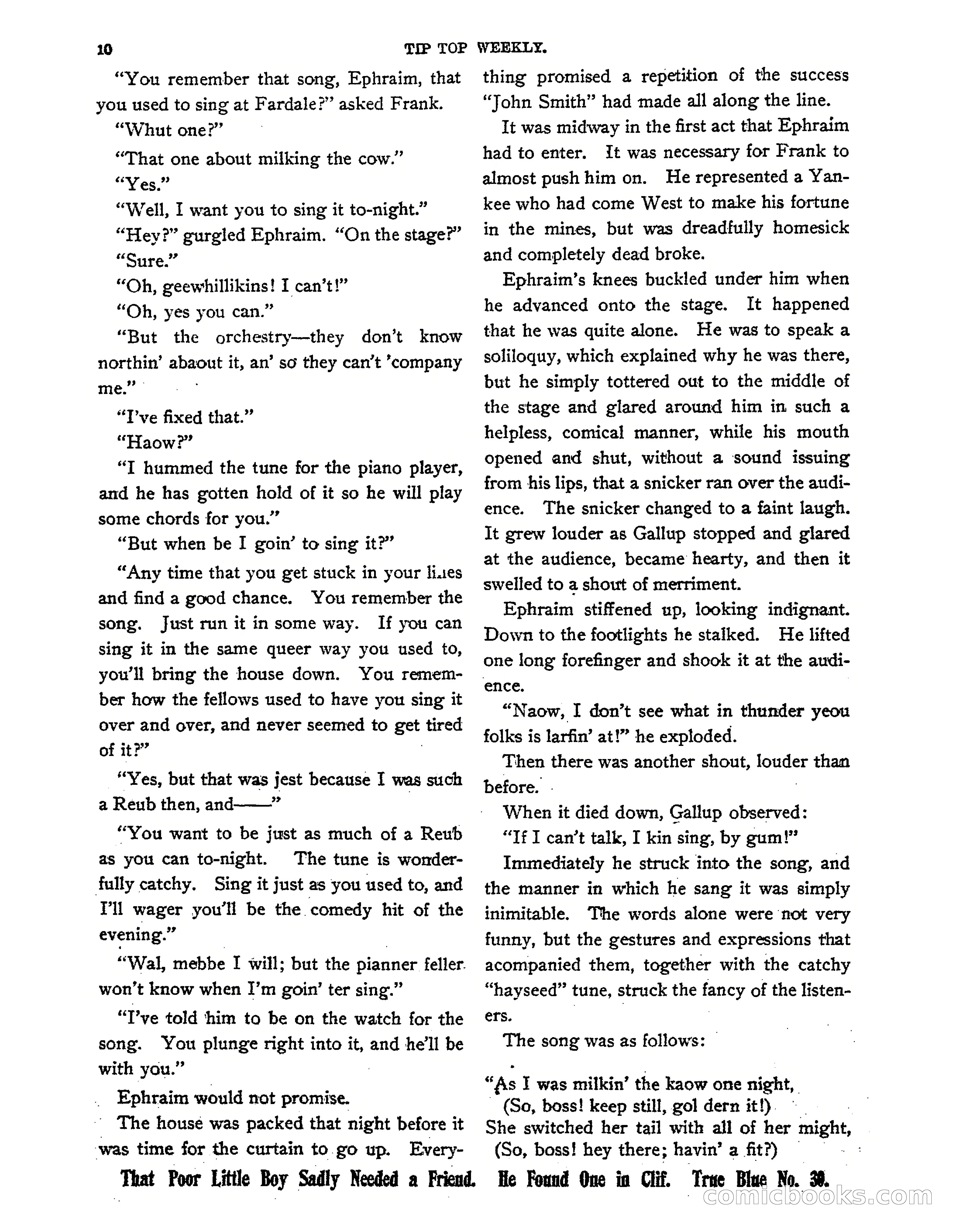
A restored page from Penny Dreadfuls, 1898. Page through the whole issue in the reader above.
📄 Transcribed text from this page (OCR, searchable)
Machine-transcribed from the original scan — historical spelling and the odd misread are preserved.
10 TIP TOP “You remember that song, Ephraim, that you used to sing at Fardale?” asked Frank. “Whut one?” “That one about milking the cow.” “Yes.” “Well, I want you to sing it to-night.” “Hey?” gurgled Ephraim. “On the stage?” “Sure.” “Oh, geewhillikins! I can’t!” “Oh, yes you can.” “But the orchestry—they don’t know northin’ abaout it, an’ so they can’t ’company 9? me. “I’ve fixed that.” “Haow?” “IT hummed the tune for the piano player, and he has gotten hold of it so he will play some chords for you.” “But when be I goin’ to sing it?” “Any time that you get stuck in your lies and find a good chance. You remember the song. Just run it in some way. If you can sing it in the same queer way you used to, you ll bring the house down. You remem- ber how the fellows used to have you sing it over and over, and never seemed to get tired of it?” “Yes, but that was jest because I was such a Reub then, and | “You want to be just as much of a Reub as you can to-night. The tune is wonder- fully catchy. Sing it just as you used to, and rll wager you'll be the comedy hit of the evening.” “Wal, mebbe I will; but the pianner feller. won’t know when I’m goin’ ter sing.” “I’ve told him to be on the watch for the song. bee plunge right into it, and he'll be with you.” Ephraim would not promise. | The house was packed that night before it ‘was time for the curtain to go up. Every- ‘That Poor Little Boy Sadly Neoded a Friend. He Found One in Clif. True Blue No. 0, : CLDDOKS WEEKLY. thing promised a repetition of the success “John Smith” had made all along the line. It was midway in the first act that Ephraim had to enter. It was necessary for Frank to almost push him on. He represented a Yan- kee who had come West to make his fortune in the mines, but was dreadfully homesick and completely dead broke. Ephraim’s knees buckled under him when he advanced onto the stage. It happened that he was quite alone. He was to speak a soliloquy, which explained why he was there, but he simply tottered out to the middle of the stage and glared around him in such a helpless, comical manner, while his mouth opened and shut, without a sound issuing from his lips, that a snicker ran over the audi- The snicker changed to a faint laugh. It grew louder as Gallup stopped and glared at the audience, became hearty, and then it swelled to a shout of merriment. Ephraim stiffened up, looking indignant. Down to the footlights he stalked. He lifted one long forefinger and shook it at the audi- ence. | “Naow, I don’t see what in thunder yeou folks is larfin’ at!” he exploded. Then there was another shout, louder than before. : When it died down, Gallup observed: “If I can’t talk, I kin sing, by gum!” Immediately he struck into the song, and the manner in which he sang it was simply inimitable. The words alone were not very funny, but the gestures and expressions that acompanied them, together with the catchy “hayseed” tune, struck the fancy of the listen- ers. | | : The song was as follows: ence. “fs I was milkin’ the kaow one night, (So, boss! keep still, gol dern it!). She switched her tail with all of her might, (So, boss! hey there; havin’ a fit?) COM (CO)