
Penny Dreadfuls, 1898 · page 30 of 35
Tip Top Weekly No. 139: Frank Merriwell's Father — page 30: what you’re looking at
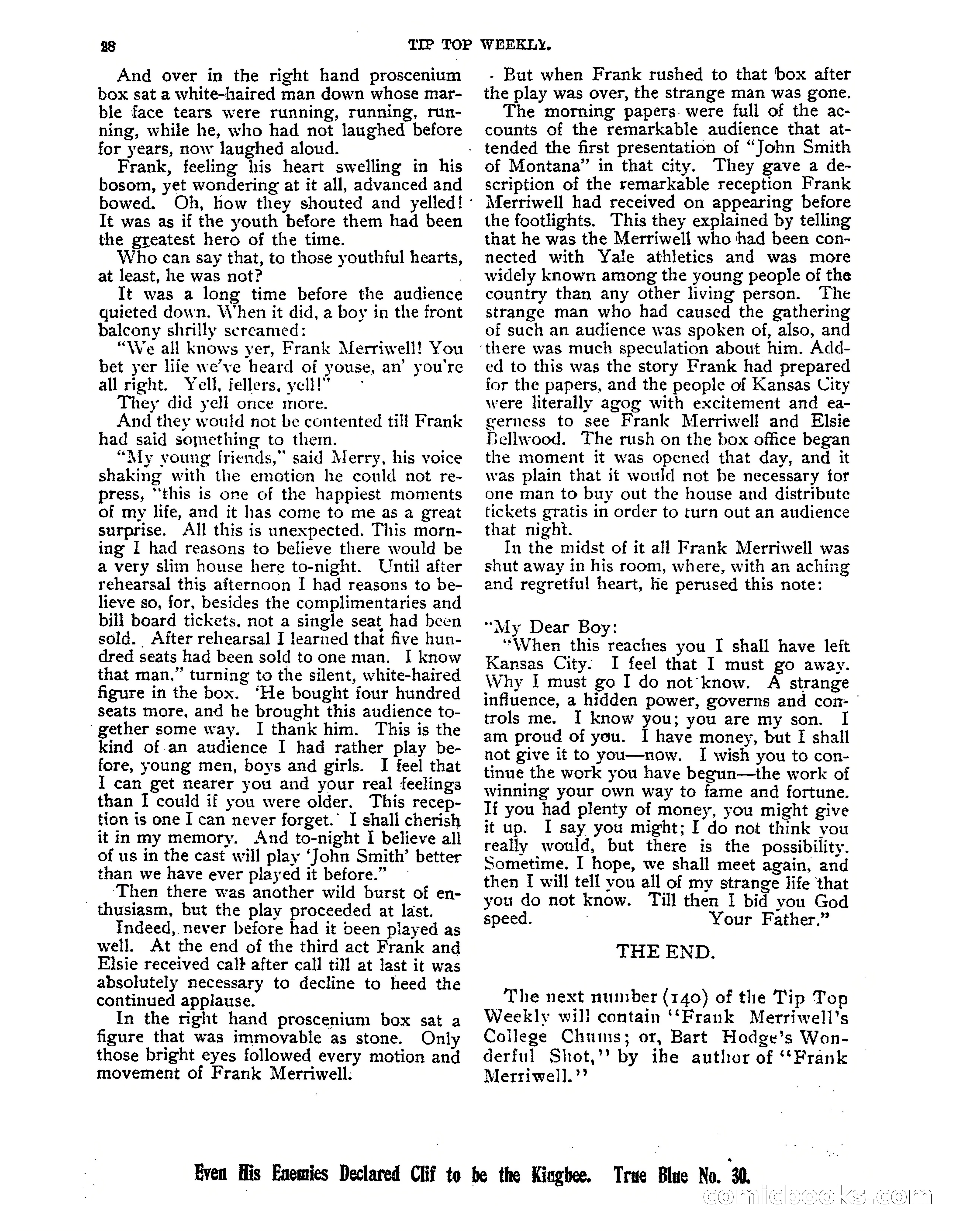
A restored page from Penny Dreadfuls, 1898. Page through the whole issue in the reader above.
📄 Transcribed text from this page (OCR, searchable)
Machine-transcribed from the original scan — historical spelling and the odd misread are preserved.
38 And over in the right hand proscenium box sat a white-haired man down whose mar- ble face tears were running, running, run- ning, while he, who had not laughed before for years, now laughed aloud. Frank, feeling his heart swelling in his bosom, yet wondering at it all, advanced and bowed. Oh, how they shouted and yelled! - Tt was as if the youth before them had been the greatest hero of the time. Who can say that, to those youthful hearts, at least, he was not? , It was a long time before the audience quieted down. When it did, a boy in the front balcony shrilly screamed: “We all knows yer, Frank Merriwell! You bet yer life we've heard of youse, an’ you're all right. Yell, fellers, yell!” They did yell once more. And they would not be contented till Frank had said something to them. “My young friends,” said Merry, his voice shaking with the emotion he could not re- press, “this is one of the happiest moments of my life, and it has come to me as a great surprise. All this is unexpected. This morn- ing I had reasons to believe there would be a very slim house here to-night. Until after rehearsal this afternoon I had reasons to be- lieve so, for, besides the complimentaries and bill board tickets, not a single seat had been sold. After rehearsal I learned that five hun- dred seats had been sold to one man. I know that man,” turning to the silent, white-haired figure in the box. “He bought jour hundred seats more, and he brought this audience to- ‘gether some way. |] thank him. This is the kind of an audience I had rather play be- fore, young men, boys and girls. I feel that I can get nearer you and your real feelings than I could if you were older. This recep- tion is one I can never forget.” I shall cherish itin my memory. And to-night I believe all of us in the cast will play ‘John Smith’ better than we have ever played it before.” _ Then there was another wild burst of en- thusiasm, but the play proceeded at last. Indeed, never before had it Deen played as well. At the end of the third act Frank and Elsie received calt after call till at last it was absolutely necessary to decline to heed the continued applause. In the mght hand proscenium box sat a figure that was immovable as stone. Only those bright eyes followed every motion and movement of Frank Merriwell: Even Hfis Enemies Declared Clif to be the Kisghee. True Blue No. 30. TIP TOP WEEKLY, - But when Frank rushed to that box after the play was over, the strange man was gone. The morning papers. were full of the ac- counts of the remarkable audience that at- - tended the first presentation of “John Smith of Montana” in that city. They gave a de- scription of the remarkable reception Frank Merriwell had received on appearing before the footlights. This they explained by telling that he was the Merriwell who ‘had been con- nected with Yale athletics and was more widely known among the young people of the country than any other living person. The strange man who had caused the gathering of such an audience was spoken of, also, and ‘there was much speculation about him. Add- ed to this was the story Frank had prepared ior the papers, and the people of Kansas City were literally agog with excitement and ea- cerness to see Frank Merriwell and Elsie Bellwood. The rush on the box office began the moment it was opened that day, and it was plain that it would not be necessary for one man to buy out the house and distribute tickets gratis in order to turn out an audience that night. In the midst of it all Frank Merriwell was shut away in his room, where, with an aching and regretiul heart, he perused this note: “My Dear Boy: “When this reaches you I shall have left Kansas City. I feel that I must go away. Why I must go I do not’know. A strange influence, a hidden power, governs and con: ' trols me. I know you; you are my son. [ am proud of yeu. I have money, but I shall not give it to you—now. I wish you to con- tinue the work you have begun—the work of winning your own way to fame and fortune. If you had plenty of money, you might give it up. I say you might; I do not think you really would, but there is the possibility. sometime, I hope, we shall meet again, and then [ will tell vou all of my strange life that you do not know. Till then I bid you God speed. : Your Father.” THE END. The next number (140) of the Tip Top Weekly will contain ‘Frank Merriwell’s College Chums; or, Bart Hodge's Won- derful Shot,’ by ihe author of ‘*Frank Merriwei].’? CONMUGC NOOLKS (C(O)