
Penny Dreadfuls, 1898 · page 5 of 35
Tip Top Weekly No. 139: Frank Merriwell's Father — page 5: what you’re looking at
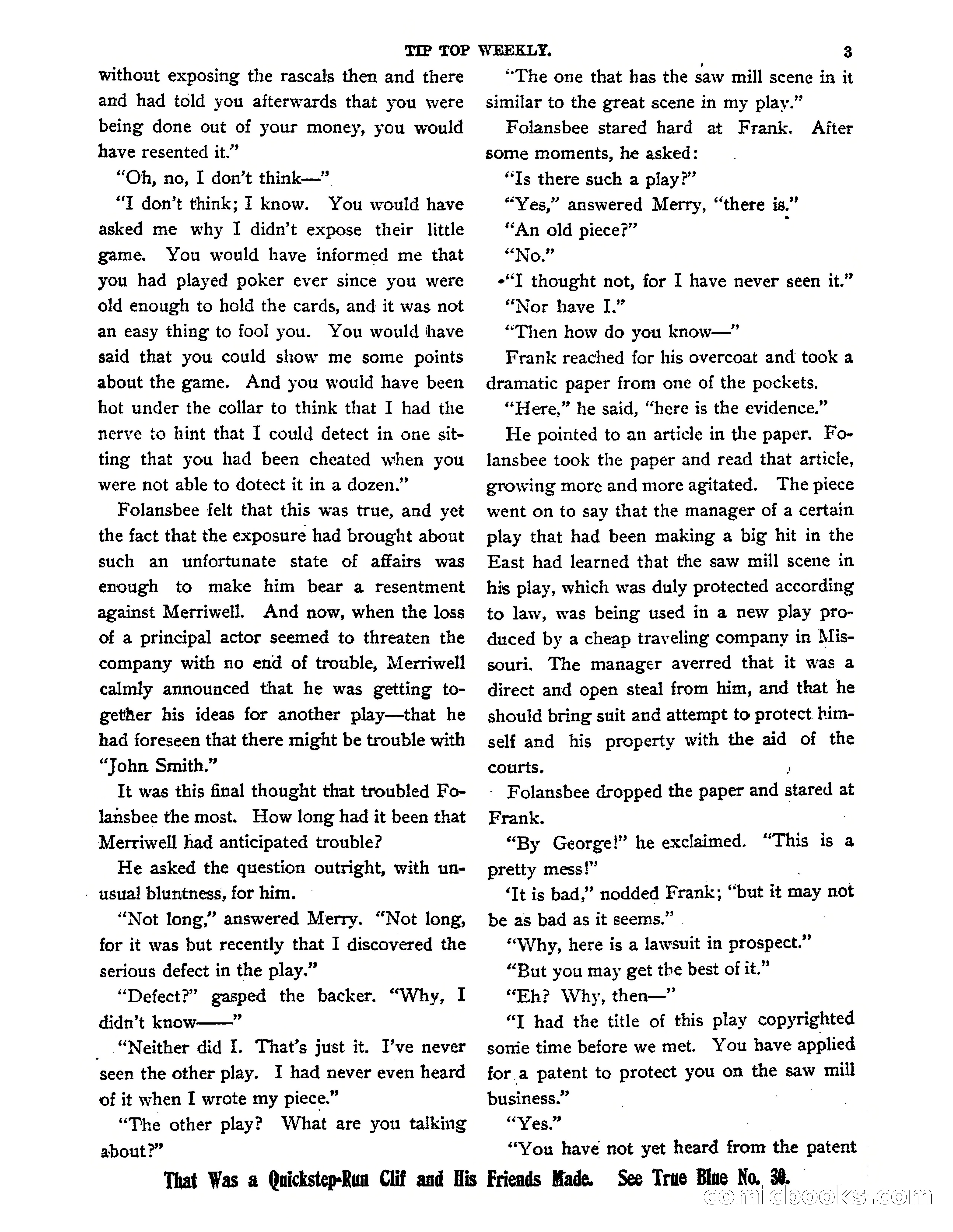
A restored page from Penny Dreadfuls, 1898. Page through the whole issue in the reader above.
📄 Transcribed text from this page (OCR, searchable)
Machine-transcribed from the original scan — historical spelling and the odd misread are preserved.
TIP TOP WEEELY. 3 without exposing the rascals then and there and had told you aiterwards that you were being done out of your money, you would have resented it.” “Oh, no, I don’t think—~” “I don’t think; I know. You would have asked me why I didn’t expose their little game. You would have informed me that you had played poker ever since you were old enough to hold the cards, and it was not an easy thing to fool you. You would have said that you could show me some points about the game. And you would have been hot under the collar to think that I had the nerye to hint that I could detect in one sit- ting that you had been cheated when you were not able to dotect it in a dozen.” Folansbee felt that this was true, and yet the fact that the exposure had brought about such an unfortunate state of affairs was enough to make him bear a resentment against Merriwell. And now, when the loss of a principal actor seemed to threaten the company with no end of trouble, Merriwell calmly announced that he was getting to- gether his ideas for another play—that he had foreseen that there might be trouble with “John Smith.” It was this final thought that troubled Fo- lansbee the most. How long had it been that Merriwell had anticipated trouble? He asked the question outright, with un- - usual bluntness, for him. “Not long,” answered Merry. “Not long, for it was but recently that I discovered the serious defect in the play.” “Defect?” gasped the backer. “Why, I didn’t know——” _ .“Neither did I. That’s just it. I’ve never seen the other play. I had never even heard of it when I wrote my piece.” “The other play? What are you talking about?” That Was a Quickstep-Run Clif and His Friends Made. See True Blue No. 38. “The one that has the saw mill scene in it similar to the great scene in my play.” Folansbee stared hard at Frank. After some moments, he asked: “Is there such a play?” “Yes,” answered Merry, “there is.” “An old piece?” “No.” -“T thought not, for I have never seen it.” “Nor have J.” “Then how do you know—” Frank reached for his overcoat and took a dramatic paper from one of the pockets. “Here,” he said, He pointed to an article in the paper. Fo- lansbee took the paper and read that article, growing more and more agitated. The piece went on to say that the manager of a certain play that had been making a big hit in the East had learned that the saw mill scene in his play, which was duly protected according to law, was being used in a new play pro- duced by a cheap traveling company in Mis- souri. The manager averred that it was a direct and open steal from him, and that he should bring suit and attempt to protect him- “here is the evidence.” self and his property with the aid of the courts. i - Folansbee dropped the paper and stared at Frank. “By George!” he exclaimed. pretty mess!” ‘It is bad,” nodded Frank; “but it may not be as bad as it seems.’ “Why, here is a lawsuit in arospect.” “But you may get the best of it.” “Eh? Why, then—” “I had the title of this play copyrighted sore time before we met. You have applied for a patent to protect you on the saw 7 mill business.” : “Yes.” “Vou have not yet heard from the Patent: “This is a GOMLeooOo (SO)