
Penny Dreadfuls, 1900 · page 11 of 32
Wildcat Bob, the Boss Bruiser — page 11: what you’re looking at
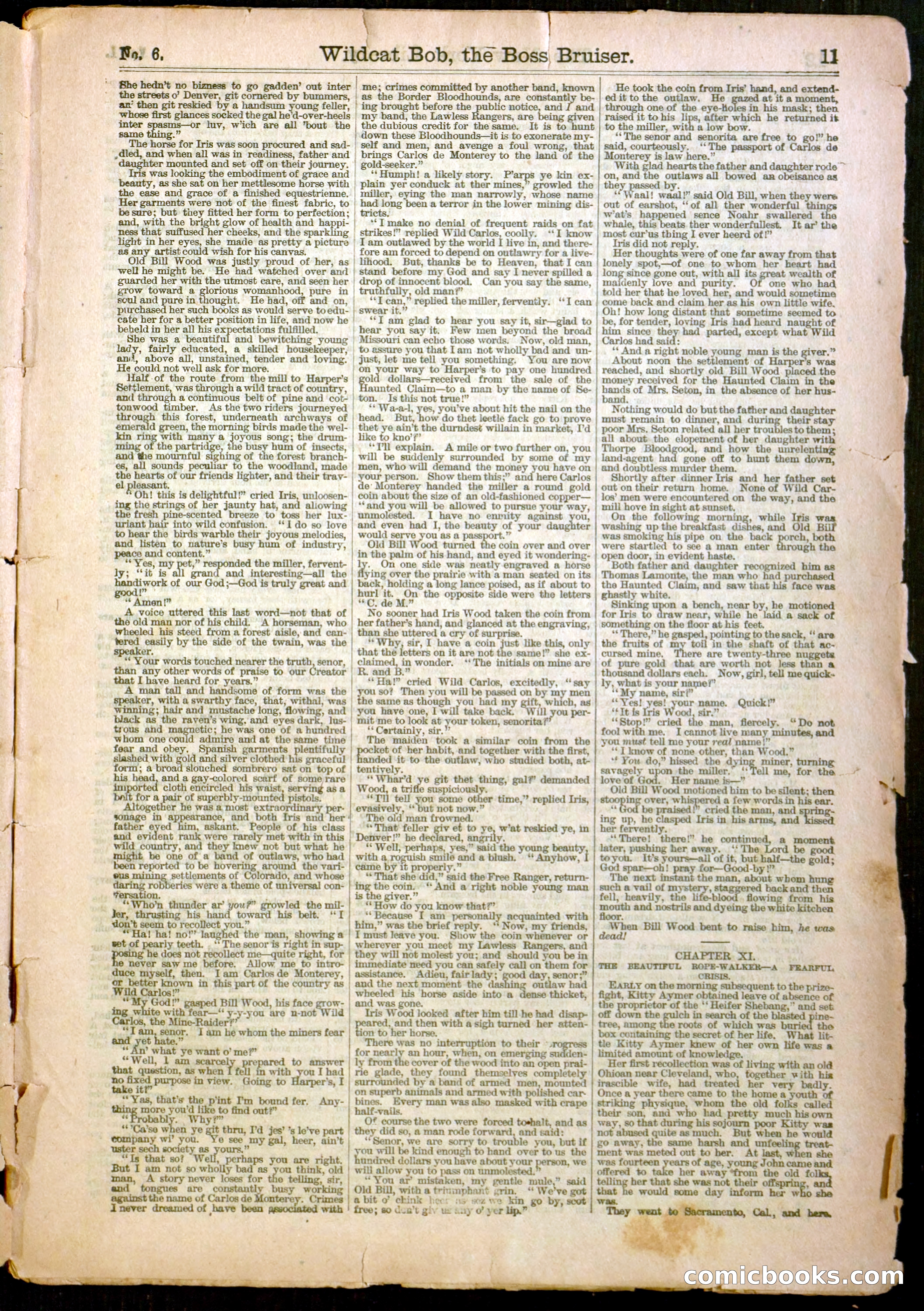
A restored page from Penny Dreadfuls, 1900. Page through the whole issue in the reader above.
📄 Transcribed text from this page (OCR, searchable)
Machine-transcribed from the original scan — historical spelling and the odd misread are preserved.
~ Wildcat Bob, the Boss, Bruiser. ae — : oF Co il Bhe hedn’t no bimess to go gadden’ out inter the streets o’ Denver, git cornered by bummers, an’ then git reskied by a handsum young feller, whose first glances socked the gal he’d-over-heels inter r Iny, w'ich are all "bout the same thing.” The horse for Iris was soon procured and sad- ,dled, and when all was in readiness, father and hter mounted and set off on their journey. Iris was looking the embodiment of grace and beanty, as she sat on her mettlesome horse with | the ease and grace of a finished equestrienne. Her garments were not of the finest fabric, to be sure; but tiey fitted her form to perfection; and, with the bright glow of health and pon High ness that suffused her cheeks, and the sparkling light in her eyes, she made as pretty a picture as any artist could wish for his canvas, Old Bill Wood was justly proud of her, as well he might be. He had watched over and guarded her with the utmost care, and seen her | grow toward a ae womanhood, pure in seul and pure in thought. piurchased her such books as would serve to edu- cate her for a better position in life, and now he bebeld in her all his expectations fulfilled. She was a beautiful and bewitching young lady, fairly educated, a skilled housekeeper, ana? above all, unstained, tender and loving. He could not well ask for more. Half-.of the route from the mill to Harper's Settlement, was throngh a wild tract of country, and through a continuous belt of pine and cot- | tonwood timber, As the two riders journeyed through this forest, underneath archways of | emerald green, the morning birds made the wel- kin ring with many a joyous song; the drum- ming of the partridge, the busy hum of insects, | and the mournful sighing of the forest branch- es, all sounds peculiar to the woodland, made the hearts of our friends lighter, and their tray- el pleasant. R Oh! this is delightful!” cried Iris, unloosen- ing the strings of her jaunty hat, and aliowing | the fresh pine-scented breeze to toss her lux- uriant hair into wild confusion. “Ido so love to hear the birds warble their joyous melodies, and listen to nature’s busy hum of industry, | peace and content.” “Yes, my pga nded the miller, fervent- ly; “it is all grand and interesting—all the handiwork of our God ;—God is truly great and ! ** Amen!” A voice uttered this last word—not that of the old man nor of his child. A horseman, who wheeled his steed from a forest aisle, and can- besa easily by the side of the twain, was the er. *“ Your words touched nearer the truth, senor, than any other words of praise to our Creator | that I have heard for years.” A man tall and handsome of form was the speaker, with a swarthy face, that; withal, was winning; hair and mustache long, flowing, and black as the rayen’s wing, and eyes dark, lus- | tyous ahd magnetic; he was one of a hundred bg aa se d admire and at sa eae ene ear and obey. Spanish garments plentifully slashed with gold and silver clothed nis graceful form; a broad slouched sombrero sat on top of his head, and a gay-colored scarf of some rare iniported cloth encircled his waist, serving as a t for a pair of superbly-mounted pistols. Altogether he was a most extraordinary per- sonage in appea father 6 od him. askant. and evident rank were rarely met with in this wild country, and they knew not but what he might be one of a band of outlaws, who had been reported to be hovering around the vari- eus mining settlements of Colorado, and whose oi, 3 robberies were a themic of universal con- Yersation. ; “Who'n thunder ar’ you?” growled the mil- ing his hand toward his belt. ‘TI don’t seem to recollect you.” : *“Ha! ha! no!’ laughed the man, showing a set of pearly teeth. g he does not recollect me—quite right, for never sawme before. Allow me to intro- duce myself, then. Iam Carlos de Monterey, or better known in this part of the country as Wild Carlos!” _ “My God!” Bill Wood, his face ing white with fear—“ y-y-you are n-not Wild Carlos, the Mine-Raider?’ senor. I am he whom the miners fear et hate.” ** An’ what ye want o’ me?” “Well, 1 am arercely re to answer that question, as when tell with you I had no ae purpose in view. Going to r’s, I “Yas, that's the pint I'm bound fer. Any- more you'd like to find out?” we Why?” bly. y **°Ca’se on) Ges ye git thru, I'd jes’ ’s le’ve part company wi’ you. Ye see my aor heer, ain’t uster sech ty as yours,” “Is that so? Well, perhaps you are right. But I am not so wholly bad as you think, old man, A story never loses for the , sir, and es are constantly busy working tongu against the name of Carlos de . Crimes i never dreamed of have been deat Wik He had, off and on, | rance, and both Tris and her’ People of his class | | Denver!” | I must leave you. “The senor is right in sup- | OW- | me; crimes committed by another band, known ' as the Border Bloodhounds, are constantly be- } ing brought before the public notice, and J and my band, the Lawless ancl are being given | the dubious credit for the same. It is to hunt | down these Bloodhounds—it is to exonerate my- self and men, and avenge a foul wrong, that brings Carlos de Monterey to the land of the | gold-seeker.” **Humph! a likely story. Parps ye kin ex- plain yer conduck at ther mines,” growled the | miller, eying the man narrowly, whose name | had long been a terror in the lower mining dis- | tricts. | “T make no denial of frequent raids on fat strikes!” replied Wild Carlos, coolly. “‘I know I am outlawed by the world I live in, and there- fore am forced to depend on outlawry for a live- lihood. But, thanks be to Heaven, that I can | stand before my God and say I never spilled a drop of innocent blood. Can you say the same, truthfully, old man?’ **I can,” replied the miller, fervently. ‘I can | | Oh! how long distant that sometime seemed to } swear it.” **T am glad to hear you say it, sir—glad to | hear you say it. Few men beyond the broad Missouri can echo those words. Now, old man, to assure you that Lam not wholly bad and un- just, let me tell you something. You are now on your way to Harper's to pay one hundred old dollars—received from the sale of the Jaunted Claim—to a man by the name of Se- ton. Is this not true!” ** Wa-a-l, yes, you’ve about hit the nail on the | head. But, how do thet leetle fack go to prove | thet ye ain't the durndest willain in market, I'd | like to kno’?’ *Tll explain. A mile or two further on, you will be suddenly surrounded by some of my men, who will demand the money you have on your person. Show them this;” and here Carlos | de’ Monterey handed the miller a round gold coin about the size of an old-fashioned copper— “and you will be allowed to pursue your way, unmolested. I have no enmity against you, and even had I, the beauty of your daughter would serve you as a passport.” Old Bill Wood turned the coin over and over in the palm of his hand, and eyed it wondering- a On one side was neatly engraved a horse _ flying over the prairie with a man seated on its | back, holding a long lance poised, as if about to | hurl it. On the opposite side were the letters | *C. de M.” |. No sooner had Iris Wood taken the coin from _ her father’s hand, and glanced at the engraving, , than she uttered a cry of surprise. ** Why, sir, I have a coin just like this, only that the letters on it are not the same!” she ex- claimed, in wonder. ‘The initials on mine are R. and B.” ‘** Hal” cried Wild Carlos, excitedly, “say you so? Then you will be passed on by my men the same as though you had my gift, which, as you have one, I will take back. Will you per- mit me to look at your token, senorita? ‘* Certainly, sir.” The maiden took a similar coin from the sien of her habit, and together with the first, anded it to the outlaw, who studied both, at- tentively. | _ **Whar'd ye git thet thing, gal?’ demanded | Wood, a trifie suspiciously. “TH tell you some other time,” replied Iris, evasively, “ but not now.” The old man frowned. “That feller giv et to ye, w’at reskied ye, in he declared, angrily. ** Well, perhaps, yes,” said the young beauty. with a roguish smilé and a blush,” “ Anyhow, | came by it properly.” “ That she did,” said the Free Ranger, return- ing the coin. “ And a right noble young man is the giver.” *'How do you know that?’ ** Because I am personally acquainted with him,” was the brief reply. ‘* Now, my friends, Show the coin whenever or wherever you meet my Lawless Rangers, and | they will not molest you; and should you be in | immediate need you can safely call on them for assistance. Adieu, fair lady; day, senor ;” | and the next moment the dashing outlaw had | wheeled his horse aside into a dense thicket, and was gone. | Iris Wood looked after him till he had disap- | peared, and then with a sigh turned her atten- | tion to her horse. There was no interruption to their fobs a for nearly an hour, when, on emerging sudden- ly from the cover of the wood into an open prai- | rie glade, they found themselves completely ; | surrounded by a band of armed men, mounted on superb animals and armed with polished car. | bines. Every man was also masked with crape half-vails. Of course the two were forced toshalt, and as they did so, a man rode forward, and said: ‘“*Senor, we are sorry to trouble you, but if you will be kind enough to hand over to us the _ hundred dollars you have about your person, we | will allow you to pass on unmolested,’ “You ar’ mistaken, my gentle mule,” said Old Bill, with a triumphant grin. “ We've got a bit o’ chink heer ss sez we kin go by, scot free; so dia’t giv us Auy o’ yer lip.” | i nn He took the coin from Iris’ hand, and extend- edit tothe outlaw. He amg at it a moment, through one of the eye-Holes in his mask; then raised it to his lips, after which he returned it to the miller, with a low bow. ‘* The senor and senorita are free to go!” he said, courteously. ‘‘The passport of Carlos de Monterey is law here.” With glad hearts the father and danghter rode™ on, and the outlaws all bowed ar obeisance as they passed by. ** Waal! waal!” said Old Bill, when they were out of earshot, ‘‘of all ther wonderful thin w’at’s happened sence Noahr swallered the whale, this beats. ther wonderfullest. It ar’ the most cur’us thing I ever heerd of!” Iris did not reply. Her thoughts were of one far away from that lonely spot,—of one to whom her heart had | long since gone out, with all its = wealth of ; | | poor Mrs. Seton related all her trou maidenly love and purity. Of one who had told her that he loved her, and would sometime come back and claim her as his own little wife. be, for tender, loving Iris had heard naught of him sinee they had parted, except what Wild Carlos had said: ** And a right noble young man is the giver.” About noon the settlement of H rs was reached, and shortly old Bill Wood. placed the | money received for the Haunted Claim in the panes of Mrs, Seton, in the absence of her hus- a. Nothing would do but the father and daughter must remain to dinner, and gate. their stay les to them ; all about the elopement of her daughter with Thorpe Bloodgood, and how the unrelenting land-agent had gone off to hunt them down, and doubtless murder them, Shortly after dinner Iris and her father set out on their return home. None of Wild Car- los’ men were encountered on the way, and the mili hove in sight at sunset. On the following morning, while Iris was washing up the breakfast dishes, and Old Biif was smoking his pipe on the back porch, both were startled to see a man enter ugh the open door, in evident haste, Both father and daughter recognized him as Thomas Lamonte, the man who had purchased the Haunted Claim, and saw that his face was ghastly white. Sinking upon a bench, near by, he motioned for Iris to draw near, while he laid a sack of | something on the floor at his feet. ; | ‘“‘ There,” he gasped, pointing to the sack, “ are the fruits of my toil in the shaft of that ac- cursed mine, ere are twenty-three nuggets of pure gold that are worth not less than a thousand dollars each. Now, girl, tell me quick. ly, what is your name?” ‘*My name, sirf” “Yes! yes! your name. ‘*¥t is Iris Wood, sir.” “Stop!” cried the man, fiercely, “Do not fool with me, I cannot live many minutes, and you must tell me your real name)” ‘**] know of none other, than Wood.” ‘“* You do,” hissed the dying miner, turn Quick!” savagely upon the miller.” ‘‘Tell me, for the . love of God. Her name is—” Old Bill Wood motioned him to be silent; then ; we. fochbeellery pba wr na words - his — “* God be cried the man, an - ing up, he clasped Iris in his arms, and kimet her fervently. ‘There! there!” he continued, a moment later, pushing her away. ‘‘ The Lord be good toyou. It’s yours—all of it, but half—the gold; God spar—oh! pray for— -by!” The next instant the man, about whom hung such a vail of mystery, staggered back and then fell, heavily, the life-bl flowing from his mouth and nostrils and dyeing the white kitchen floor. When Bill Wood bent to raise him, he was dead! CHAPTER. XI. THE BEAUTIFUL ROPE-WALKER—A FEARFUL CRISIS. EARLY on the morning subsequent, to the prize-~ fight, Kitty Aymer obtained leave of absence of the proprietor of the ‘‘ Heifer Shebang,” and set off down the gulch in search of the blasted pine- tree, among the roots of which was ied the box containing the secret of her life. What lit- tle Kitty Aymer knew of her own life was a limited amount of knowledge. Her first recollection was of living with an old Ohioan near Cleveland, who, together vith his irascible wife, had treated her very badly. Once a year there came to the home a youth of striking physique, whom the old folks called their son, and who had pretty much his own way, so that during his sojourn poor Kitty was not abused quite as much. But when he would go away, the same harsh and unfee treat- ment was meted out to her. At last, w she was fourteen years of age, young John came and. offered to t telling her that she was not their that he would some day inform her who she They to, Cal, and hera Gbhoo her away “from the old — : ee as Us sa . Awe “4 Sa