
Penny Dreadfuls, 1870 · page 159 of 392
Penny Blood Serial Fiction — page 159: what you’re looking at
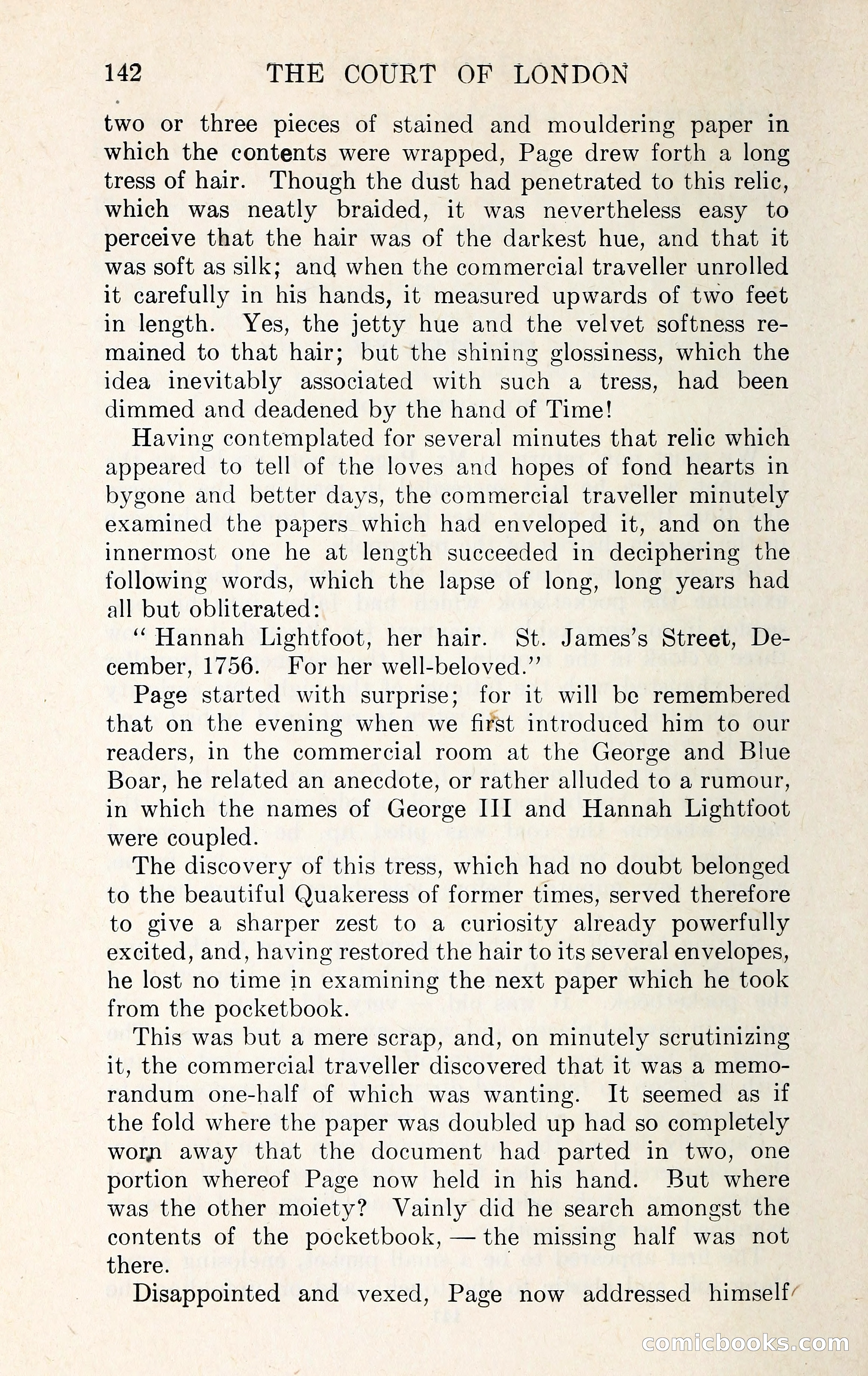
A restored page from Penny Dreadfuls, 1870. Page through the whole issue in the reader above.
📄 Transcribed text from this page (OCR, searchable)
Machine-transcribed from the original scan — historical spelling and the odd misread are preserved.
142 THE COURT OF LONDON two or three pieces of stained and mouldering paper in which the contents were wrapped, Page drew forth a long tress of hair. Though the dust had penetrated to this relic, which was neatly braided, it was nevertheless easy to perceive that the hair was of the darkest hue, and that it was soft as silk; and when the commercial traveller unrolled it carefully in his hands, it measured upwards of two feet in length. Yes, the jetty hue and the velvet softness re- mained to that hair; but the shining glossiness, which the idea inevitably associated with such a tress, had been dimmed and deadened by the hand of Time! Having contemplated for several minutes that relic which appeared to tell of the loves and hopes of fond hearts in bygone and better days, the commercial traveller minutely examined the papers which had enveloped it, and on the innermost one he at length succeeded in deciphering the following words, which the lapse of long, long years had all but obliterated: “Hannah Lightfoot, her hair. St. James’s Street, De- cember, 1756. For her well-beloved.”’ Page started with surprise; for it will be remembered that on the evening when we first introduced him to our readers, in the commercial room at the George and Blue Boar, he related an anecdote, or rather alluded to a rumour, in which the names of George III and Hannah Lighttoot were coupled. The discovery of this tress, which had no doubt belonged to the beautiful Quakeress of former times, served therefore to give a sharper zest to a curiosity already powerfully excited, and, having restored the hair to its several envelopes, he lost no time in examining the next paper which he took from the pocketbook. This was but a mere scrap, and, on minutely scrutinizing it, the commercial traveller discovered that it was a memo- randum one-half of which was wanting. It seemed as if the fold where the paper was doubled up had so completely worn away that the document had parted in two, one portion whereof Page now held in his hand. But where was the other moiety? Vainly did he search amongst the contents of the pocketbook, —the missing half was not there. Disappointed and vexed, Page now addressed himseltf/ GOMmiiGcdooks (E(0)