
Penny Dreadfuls, 1870 · page 164 of 392
Penny Blood Serial Fiction — page 164: what you’re looking at
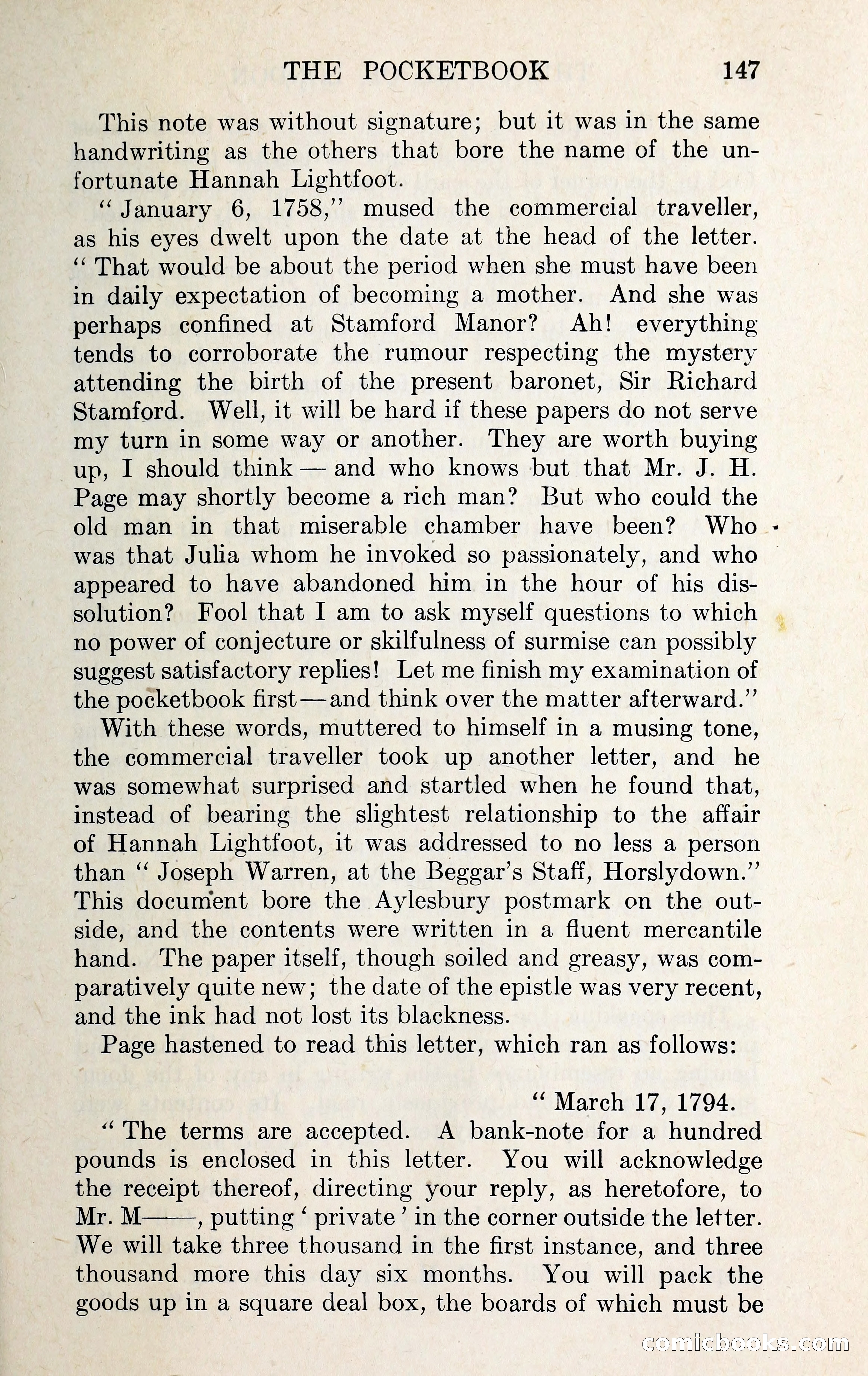
A restored page from Penny Dreadfuls, 1870. Page through the whole issue in the reader above.
📄 Transcribed text from this page (OCR, searchable)
Machine-transcribed from the original scan — historical spelling and the odd misread are preserved.
THE POCKETBOOK 147 This note was without signature; but it was in the same handwriting as the others that bore the name of the un- fortunate Hannah Lightfoot. “ January 6, 1758,’ mused the commercial traveller, as his eyes dwelt upon the date at the head of the letter. ‘“ That would be about the period when she must have been in daily expectation of becoming a mother. And she was perhaps confined at Stamford Manor? Ah! everything tends to corroborate the rumour respecting the mystery attending the birth of the present baronet, Sir Richard Stamford. Well, it will be hard if these papers do not serve my turn in some way or another. They are worth buying up, I should think — and who knows but that Mr. J. H. Page may shortly become a rich man? But who could the old man in that miserable chamber have been? Who was that Julia whom he invoked so passionately, and who appeared to have abandoned him in the hour of his dis- solution? Fool that I am to ask myself questions to which no power of conjecture or skilfulness of surmise can possibly suggest satisfactory replies! Let me finish my examination of the pocketbook first—and think over the matter afterward.” With these words, muttered to himself in a musing tone, the commercial traveller took up another letter, and he was somewhat surprised and startled when he found that, instead of bearing the slightest relationship to the affair of Hannah Lightfoot, it was addressed to no less a person than ‘‘ Joseph Warren, at the Beggar’s Staff, Horslydown.”’ This document bore the Aylesbury postmark on the out- side, and the contents were written in a fluent mercantile hand. The paper itself, though soiled and greasy, was com- paratively quite new; the date of the epistle was very recent, and the ink had not lost its blackness. Page hastened to read this letter, which ran as follows: “March 17, 1794. “The terms are accepted. A bank-note for a hundred pounds is enclosed in this letter. You will acknowledge the receipt thereof, directing your reply, as heretofore, to Mr. M , putting ‘ private’ in the corner outside the letter. We will take three thousand in the first instance, and three thousand more this day six months. You will pack the goods up in a square deal box, the boards of which must be ‘ a Gomicbdoo <S) (F(©)