
Penny Dreadfuls, 1870 · page 228 of 392
The Works of George W. M. Reynolds — page 228: what you’re looking at
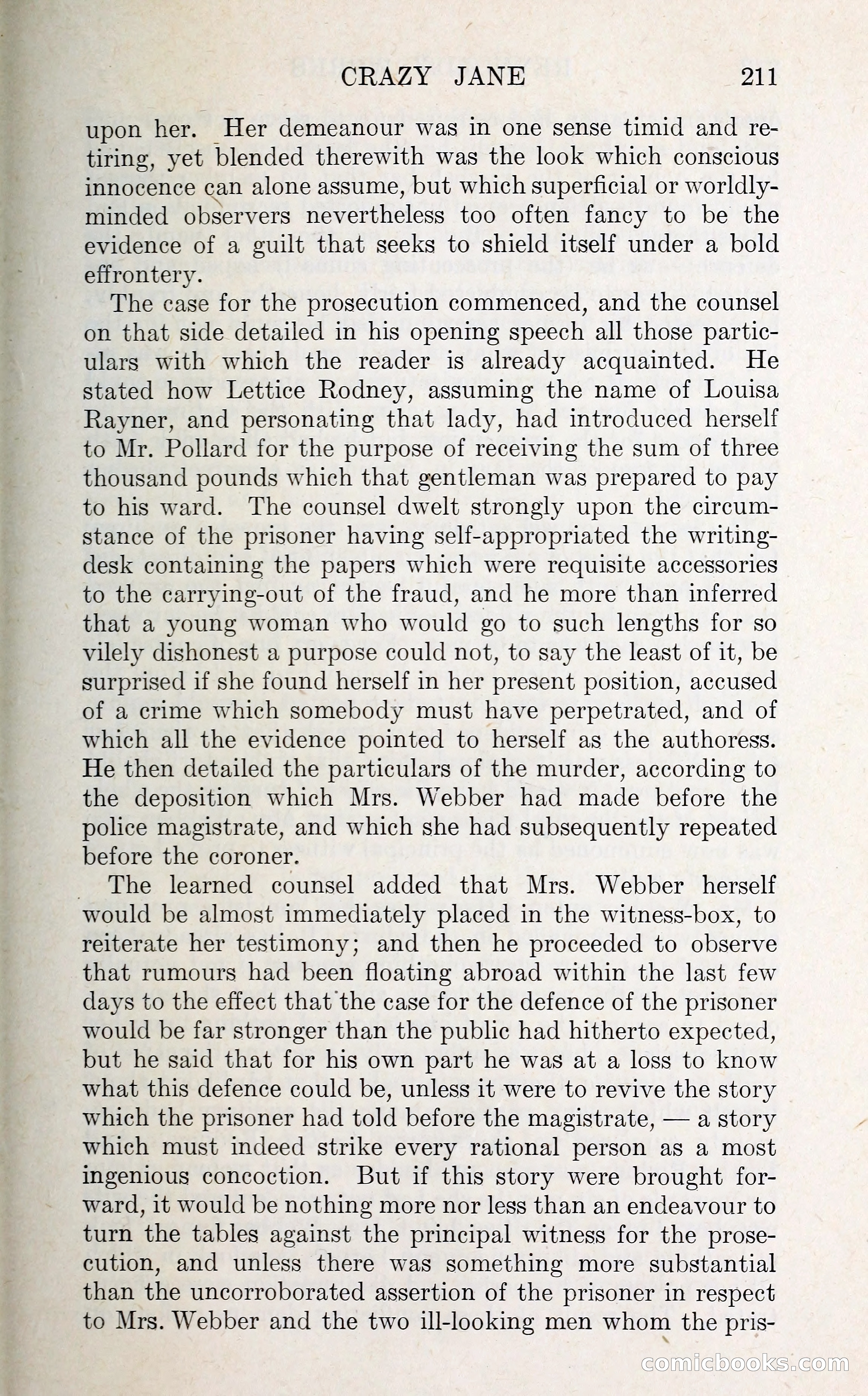
A restored page from Penny Dreadfuls, 1870. Page through the whole issue in the reader above.
📄 Transcribed text from this page (OCR, searchable)
Machine-transcribed from the original scan — historical spelling and the odd misread are preserved.
CRAZY JANE 211 upon her. Her demeanour was in one sense timid and re- tiring, yet blended therewith was the look which conscious innocence can alone assume, but which superficial or worldly- minded observers nevertheless too often fancy to be the evidence of a guilt that seeks to shield itself under a bold effrontery. The case for the prosecution commenced, and the counsel on that side detailed in his opening speech all those partic- ulars with which the reader is already acquainted. He stated how Lettice Rodney, assuming the name of Louisa Rayner, and personating that lady, had introduced herself to Mr. Pollard for the purpose of receiving the sum of three thousand pounds which that gentleman was prepared to pay to his ward. The counsel dwelt strongly upon the circum- stance of the prisoner having self-appropriated the writing- desk containing the papers which were requisite accessories to the carrying-out of the fraud, and he more than inferred that a young woman who would go to such lengths for so vilely dishonest a purpose could not, to say the least of it, be surprised if she found herself in her present position, accused of a crime which somebody must have perpetrated, and of which all the evidence pointed to herself as the authoress. He then detailed the particulars of the murder, according to the deposition which Mrs. Webber had made before the police magistrate, and which she had subsequently repeated before the coroner. _ The learned counsel added that Mrs. Webber herself would be almost immediately placed in the witness-box, to reiterate her testimony; and then he proceeded to observe that rumours had been floating abroad within the last few days to the effect that the case for the defence of the prisoner would be far stronger than the public had hitherto expected, but he said that for his own part he was at a loss to know what this defence could be, unless it were to revive the story which the prisoner had told before the magistrate, — a story which must indeed strike every rational person as a most ingenious concoction. But if this story were brought for- ward, it would be nothing more nor less than an endeavour to turn the tables against the principal witness for the prose- cution, and unless there was something more substantial than the uncorroborated assertion of the prisoner in respect to Mrs. Webber and the two ill-looking men whom the pris- CONNIE DOOKS (C(O) m