
Penny Dreadfuls, 1870 · page 94 of 392
The Works of George W. M. Reynolds — page 94: what you’re looking at
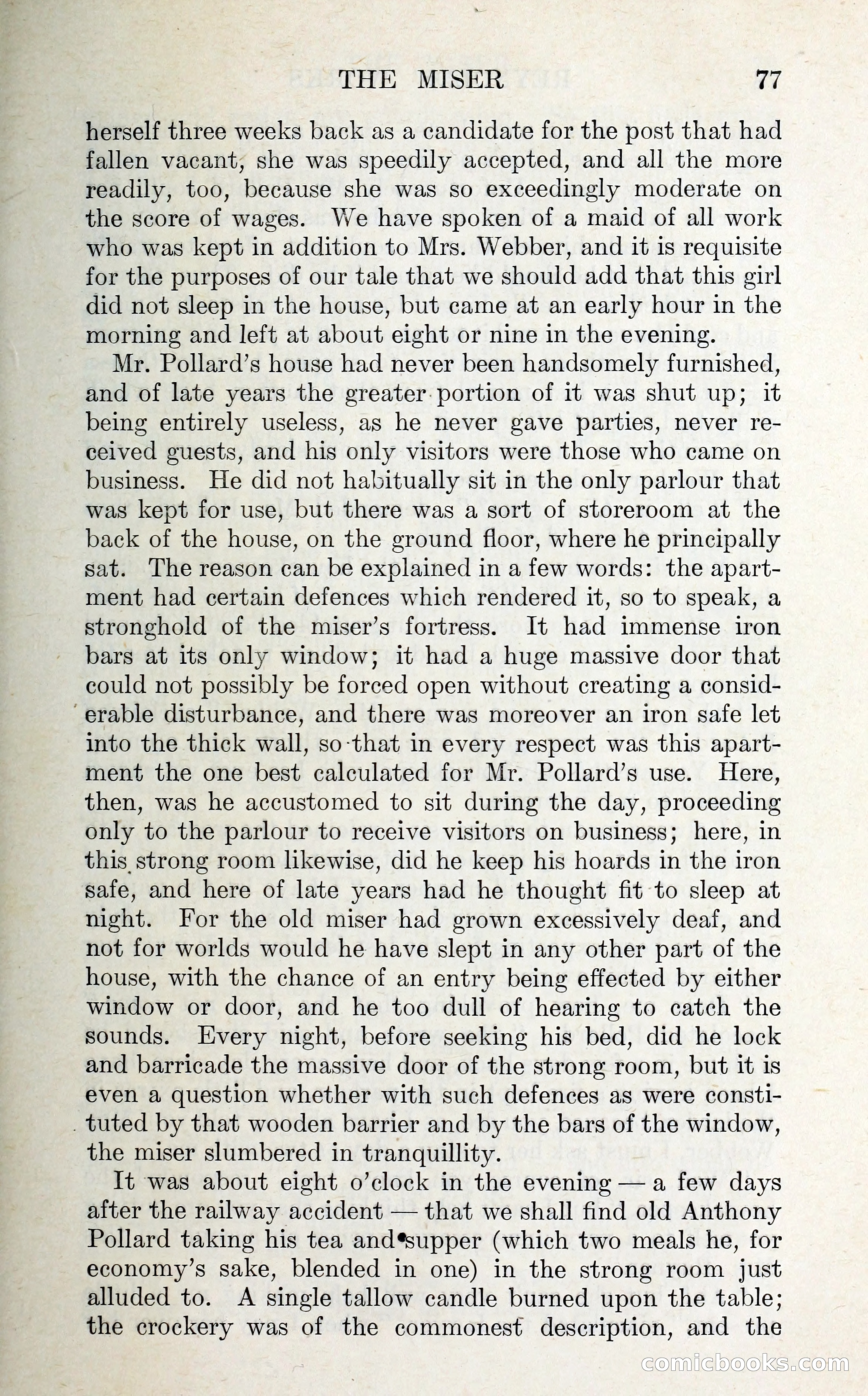
A restored page from Penny Dreadfuls, 1870. Page through the whole issue in the reader above.
📄 Transcribed text from this page (OCR, searchable)
Machine-transcribed from the original scan — historical spelling and the odd misread are preserved.
THE MISER 77 herself three weeks back as a candidate for the post that had fallen vacant, she was speedily accepted, and all the more readily, too, because she was so exceedingly moderate on the score of wages. We have spoken of a maid of all work who was kept in addition to Mrs. Webber, and it is requisite for the purposes of our tale that we should add that this girl did not sleep in the house, but came at an early hour in the morning and left at about eight or nine in the evening. Mr. Pollard’s house had never been handsomely furnished, and of late years the greater portion of 1t was shut up; it being entirely useless, as he never gave parties, never re- ceived guests, and his only visitors were those who came on business. He did not habitually sit in the only parlour that was kept for use, but there was a sort of storeroom at the back of the house, on the ground floor, where he principally sat. The reason can be explained in a few words: the apart- ment had certain defences which rendered it, so to speak, a stronghold of the miser’s fortress. It had immense iron bars at its only window; it had a huge massive door that could not possibly be forced open without creating a consid- erable disturbance, and there was moreover an iron safe let into the thick wall, so-that in every respect was this apart- ment the one best calculated for Mr. Pollard’s use. Here, then, was he accustomed to sit during the day, proceeding only to the parlour to receive visitors on business; here, in this strong room likewise, did he keep his hoards in the iron safe, and here of late years had he thought fit to sleep at night. For the old miser had grown excessively deaf, and not for worlds would he have slept in any other part of the house, with the chance of an entry being effected by either window or door, and he too dull of hearing to catch the sounds. Every night, before seeking his bed, did he lock and barricade the massive door of the strong room, but it is even a question whether with such defences as were consti- . tuted by that wooden barrier and by the bars of the window, the miser slumbered in tranquillity. It was about eight o’clock in the evening — a few days after the railway accident — that we shall find old Anthony Pollard taking his tea and*supper (which two meals he, for economy’s sake, blended in one) in the strong room just alluded to. A single tallow candle burned upon the table; the crockery was of the commonest description, and the GOmiGcoaooks (C(O)