
Penny Dreadfuls, 1900 · page 172 of 399
The Mysteries of the Court of London — page 172: what you’re looking at
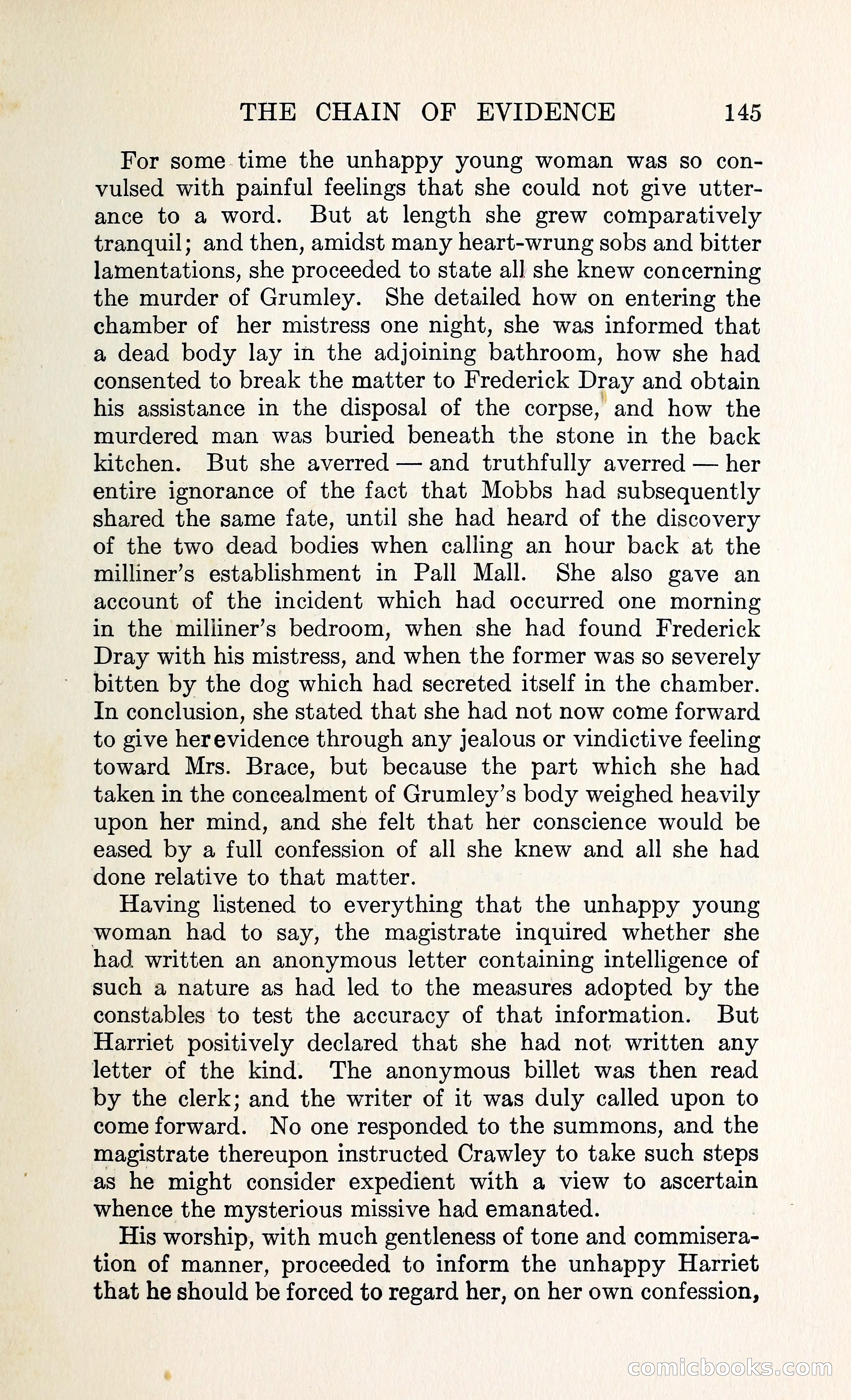
A restored page from Penny Dreadfuls, 1900. Page through the whole issue in the reader above.
📄 Transcribed text from this page (OCR, searchable)
Machine-transcribed from the original scan — historical spelling and the odd misread are preserved.
THE CHAIN OF EVIDENCE 145 For some time the unhappy young woman was so con- vulsed with painful feelings that she could not give utter- ance to a word. But at length she grew comparatively tranquil; and then, amidst many heart-wrung sobs and bitter lamentations, she proceeded to state all she knew concerning the murder of Grumley. She detailed how on entering the chamber of her mistress one night, she was informed that a dead body lay in the adjoining bathroom, how she had consented to break the matter to Frederick Dray and obtain his assistance in the disposal of the corpse, and how the murdered man was buried beneath the stone in the back kitchen. But she averred — and truthfully averred — her entire ignorance of the fact that Mobbs had subsequently shared the same fate, until she had heard of the discovery of the two dead bodies when calling an hour back at the milliner’s establishment in Pall Mall. She also gave an account of the incident which had occurred one morning in the miliiner’s bedroom, when she had found Frederick Dray with his mistress, and when the former was so severely bitten by the dog which had secreted itself in the chamber. In conclusion, she stated that she had not now come forward to give herevidence through any jealous or vindictive feeling toward Mrs. Brace, but because the part which she had taken in the concealment of Grumley’s body weighed heavily upon her mind, and she felt that her conscience would be eased by a full confession of all she knew and all she had done relative to that matter. Having listened to everything that the unhappy young woman had to say, the magistrate inquired whether she had written an anonymous letter containing intelligence of such a nature as had led to the measures adopted by the constables to test the accuracy of that information. But Harriet positively declared that she had not written any letter of the kind. The anonymous billet was then read by the clerk; and the writer of it was duly called upon to come forward. No one responded to the summons, and the magistrate thereupon instructed Crawley to take such steps as he might consider expedient with a view to ascertain whence the mysterious missive had emanated. His worship, with much gentleness of tone and commisera- tion of manner, proceeded to inform the unhappy Harriet that he should be forced to regard her, on her own confession, COnnICLOOKS (S@)