
Penny Dreadfuls, 1870 · page 360 of 392
The Works of George W. M. Reynolds — page 360: what you’re looking at
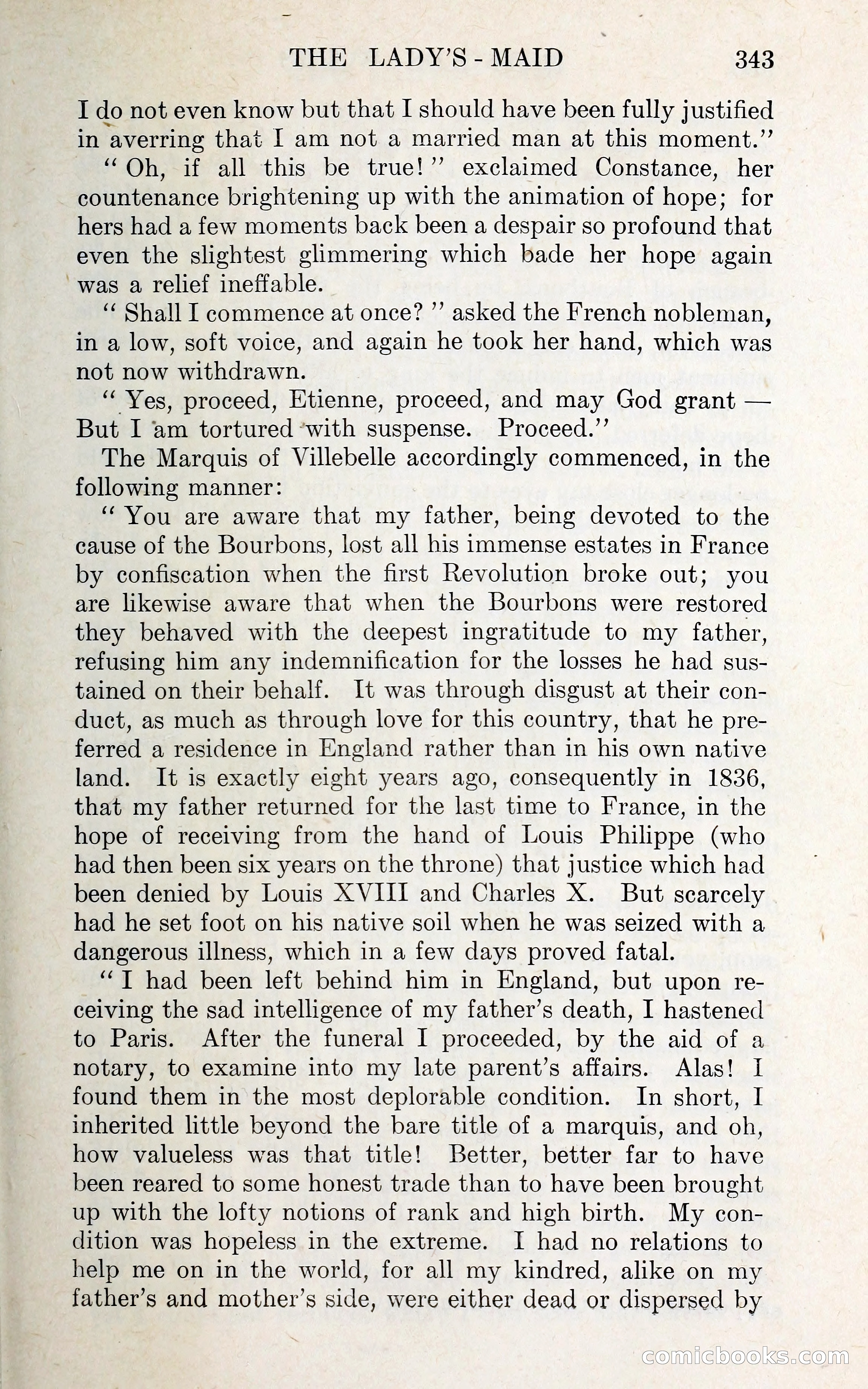
A restored page from Penny Dreadfuls, 1870. Page through the whole issue in the reader above.
📄 Transcribed text from this page (OCR, searchable)
Machine-transcribed from the original scan — historical spelling and the odd misread are preserved.
— THE LADY’S-MAID _ 343 I do not even know but that I should have been fully justified in averring that I am not a married man at this moment.”’ “Oh, if all this be true!’ exclaimed Constance, her countenance brightening up with the animation of hope; for hers had a few moments back been a despair so profound that even the slightest glimmering which bade her hope again was a relief ineffable. “ Shall I commence at once? ”’ asked the French nobleman, in a low, soft voice, and again he took her hand, which was not now withdrawn. “Yes, proceed, Etienne, proceed, and may God grant — But I am tortured ‘with suspense. Proceed.”’ The Marquis of Villebelle accordingly commenced, in the following manner: “You are aware that my father, being devoted to the cause of the Bourbons, lost all his immense estates in France by confiscation when the first Revolution broke out; you are likewise aware that when the Bourbons were restored they behaved with the deepest ingratitude to my father, refusing him any indemnification for the losses he had sus- tained on their behalf. It was through disgust at their con- duct, as much as through love for this country, that he pre- ferred a residence in England rather than in his own native land. It is exactly eight years ago, consequently in 1836, that my father returned for the last time to France, in the hope of receiving from the hand of Louis Philippe (who had then been six years on the throne) that justice which had been denied by Louis XVIII and Charles X. But scarcely had he set foot on his native soil when he was seized with a dangerous illness, which in a few days proved fatal. ‘““T had been left behind him in England, but upon re- ceiving the sad intelligence of my father’s death, I hastened to Paris. After the funeral I proceeded, by the aid of a notary, to examine into my late parent’s affairs. Alas! I found them in the most deplorable condition. In short, I inherited little beyond the bare title of a marquis, and oh, how valueless was that title! Better, better far to have been reared to some honest trade than to have been brought up with the lofty notions of rank and high birth. My con- dition was hopeless in the extreme. I had no relations to help me on in the world, for all my kindred, alike on my father’s and mother’s side, were either dead or dispersed by Gomicdoo <S (SO)