
Penny Dreadfuls, 1870 · page 366 of 392
The Works of George W. M. Reynolds — page 366: what you’re looking at
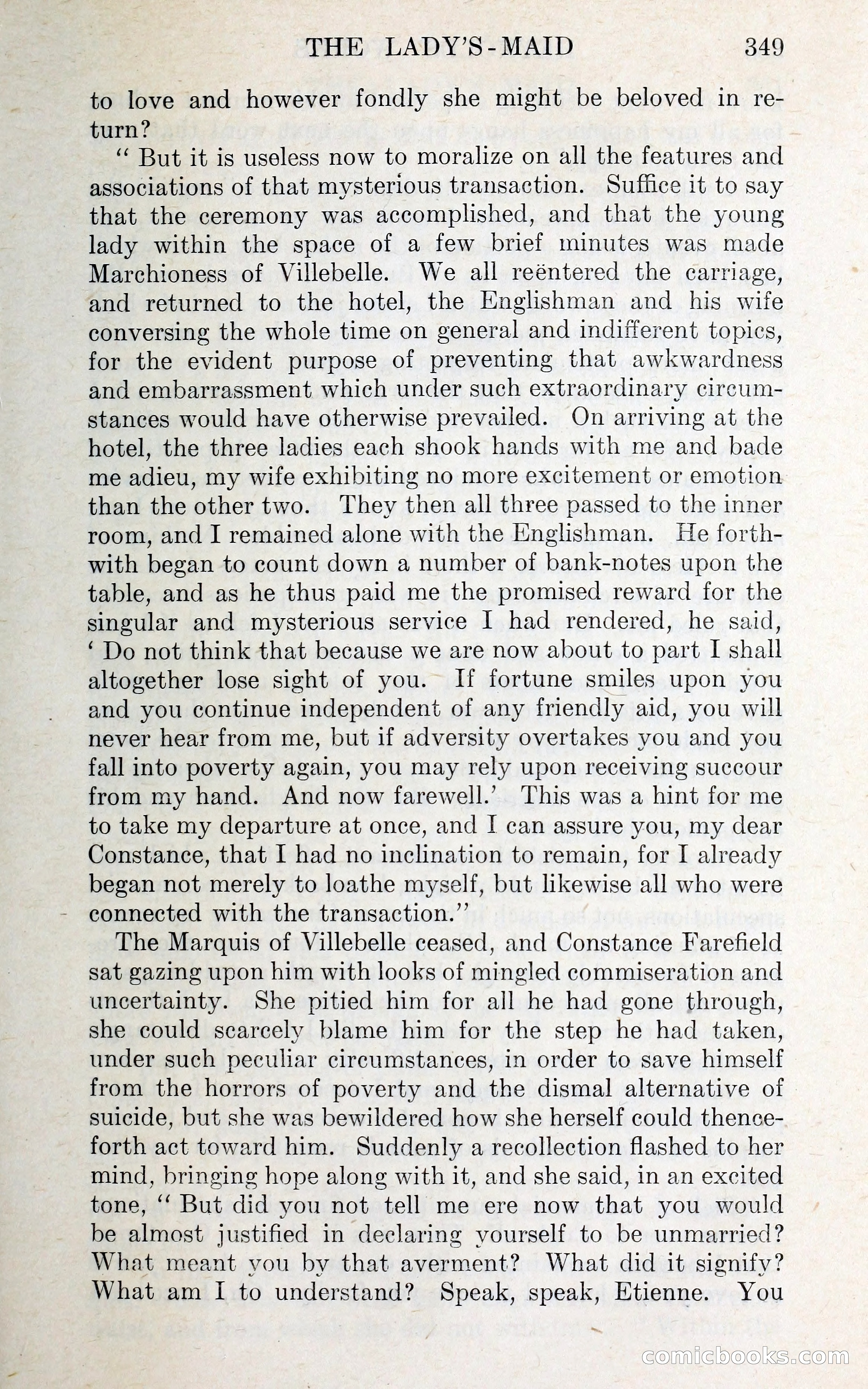
A restored page from Penny Dreadfuls, 1870. Page through the whole issue in the reader above.
📄 Transcribed text from this page (OCR, searchable)
Machine-transcribed from the original scan — historical spelling and the odd misread are preserved.
THE LADY’S-MAID d49 to love and however fondly she might be beloved in re- turn? ‘ But it is useless now to moralize on all the features and associations of that mysterious transaction. Suffice it to say that the ceremony was accomplished, and that the young lady within the space of a few brief minutes was made Marchioness of Villebelle. We all reéntered the carriage, and returned to the hotel, the Englishman and his wife conversing the whole time on general and indifferent topics, for the evident purpose of preventing that awkwardness and embarrassment which under such extraordinary circum- stances would have otherwise prevailed. On arriving at the hotel, the three ladies each shook hands with me and bade me adieu, my wife exhibiting no more excitement or emotion than the other two. ‘They then all three passed to the inner room, and J remained alone with the Englishman. He forth- with began to count down a number of bank-notes upon the table, and as he thus paid me the promised reward for the singular and mysterious service I had rendered, he said, ‘Do not think that because we are now about to part I shall altogether lose sight of you. If fortune smiles upon you and you continue independent of any triendly aid, you will never hear from me, but if adversity overtakes you and you fall into poverty again, you may rely upon receiving succour from my hand. And now farewell.’ This was a hint for me to take my departure at once, and I can assure you, my dear Constance, that I had no inclination to remain, for I already began not merely to loathe myself, but likewise all who were connected with the transaction.”’ The Marquis of Villebelle ceased, and Constance Farefield sat gazing upon him with looks of mingled commiseration and uncertainty. She pitied him for all he had gone through, she could scarcely blame him for the step he had taken, under such peculiar circumstances, in order to save himself from the horrors of poverty and the dismal alternative of suicide, but she was bewildered how she herself could thence- forth act toward him. Suddenly a recollection flashed to her mind, bringing hope along with it, and she said, in an excited tone, “‘ But did you not tell me ere now that you would be almost justified in declaring vourself to be unmarried? What meant vou by that averment? What did it signify? What am I to understand? Speak, speak, Etienne. You COnnicooolkKs (SO)