
Penny Dreadfuls, 1900 · page 132 of 400
The Mysteries of the Court of London — page 132: what you’re looking at
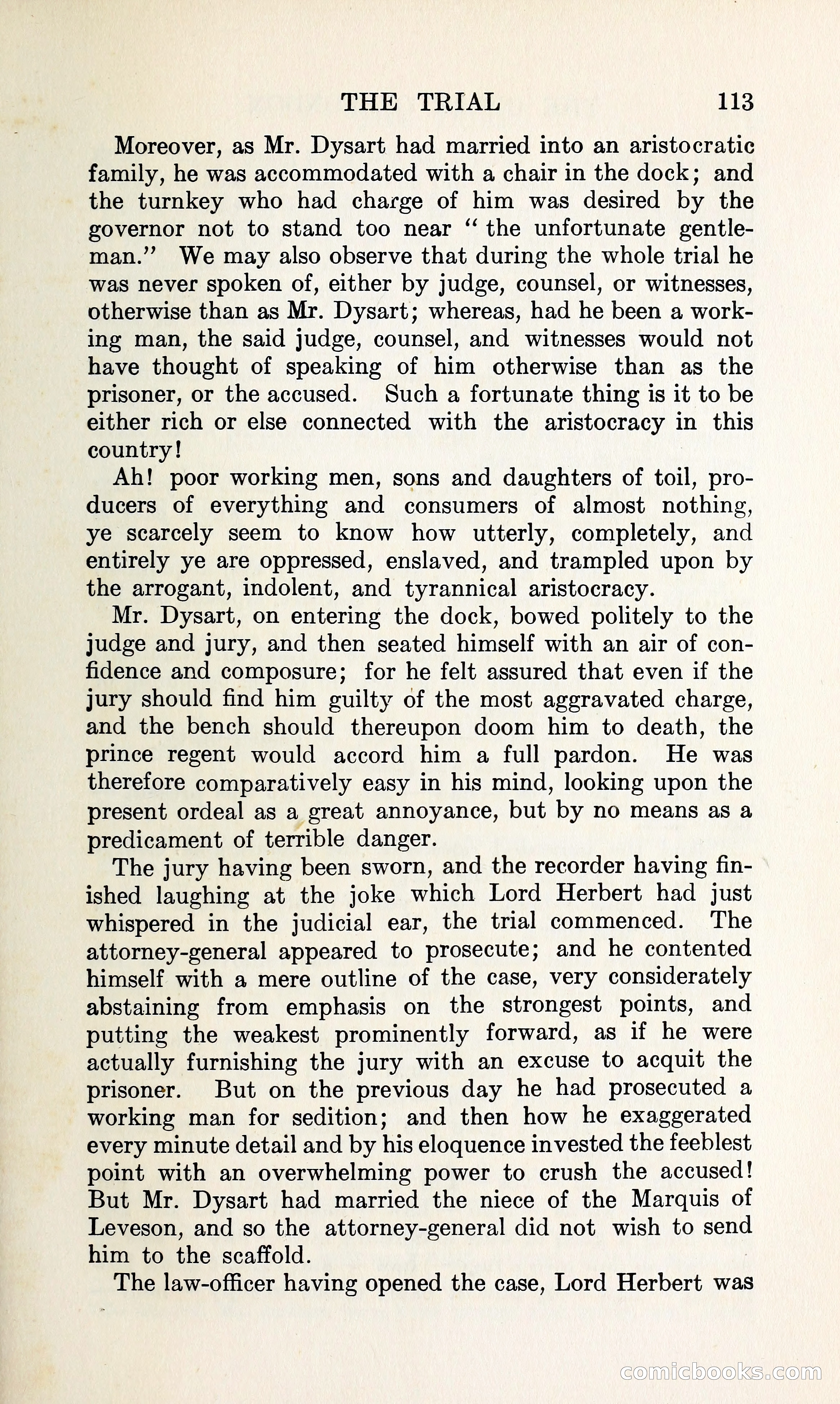
A restored page from Penny Dreadfuls, 1900. Page through the whole issue in the reader above.
📄 Transcribed text from this page (OCR, searchable)
Machine-transcribed from the original scan — historical spelling and the odd misread are preserved.
THE TRIAL 113 Moreover, as Mr. Dysart had married into an aristocratic family, he was accommodated with a chair in the dock; and the turnkey who had charge of him was desired by the governor not to stand too near “ the unfortunate gentle- man.’”’ We may also observe that during the whole trial he was never spoken of, either by judge, counsel, or witnesses, otherwise than as Mr. Dysart; whereas, had he been a work- ing man, the said judge, counsel, and witnesses would not have thought of speaking of him otherwise than as the prisoner, or the accused. Such a fortunate thing is it to be either rich or else connected with the aristocracy in this country! Ah! poor working men, sons and daughters of toil, pro- ducers of everything and consumers of almost nothing, ye scarcely seem to know how utterly, completely, and entirely ye are oppressed, enslaved, and trampled upon by the arrogant, indolent, and tyrannical aristocracy. Mr. Dysart, on entering the dock, bowed politely to the judge and jury, and then seated himself with an air of con- fidence and composure; for he felt assured that even if the jury should find him guilty of the most aggravated charge, and the bench should thereupon doom him to death, the prince regent would accord him a full pardon. He was therefore comparatively easy in his mind, looking upon the present ordeal as a great annoyance, but by no means as a predicament of terrible danger. The jury having been sworn, and the recorder having fin- ished laughing at the joke which Lord Herbert had Just whispered in the judicial ear, the trial commenced. The attorney-general appeared to prosecute; and he contented himself with a mere outline of the case, very considerately abstaining from emphasis on the strongest points, and putting the weakest prominently forward, as if he were actually furnishing the jury with an excuse to acquit the prisoner. But on the previous day he had prosecuted a working man for sedition; and then how he exaggerated every minute detail and by his eloquence invested the feeblest point with an overwhelming power to crush the accused! But Mr. Dysart had married the niece of the Marquis of Leveson, and so the attorney-general did not wish to send him to the scaffold. The law-officer having opened the case, Lord Herbert was COUN a LOOKS (CO)