
Penny Dreadfuls, 1877 · page 12 of 16
Young Briton, No. 422 — page 12: what you’re looking at
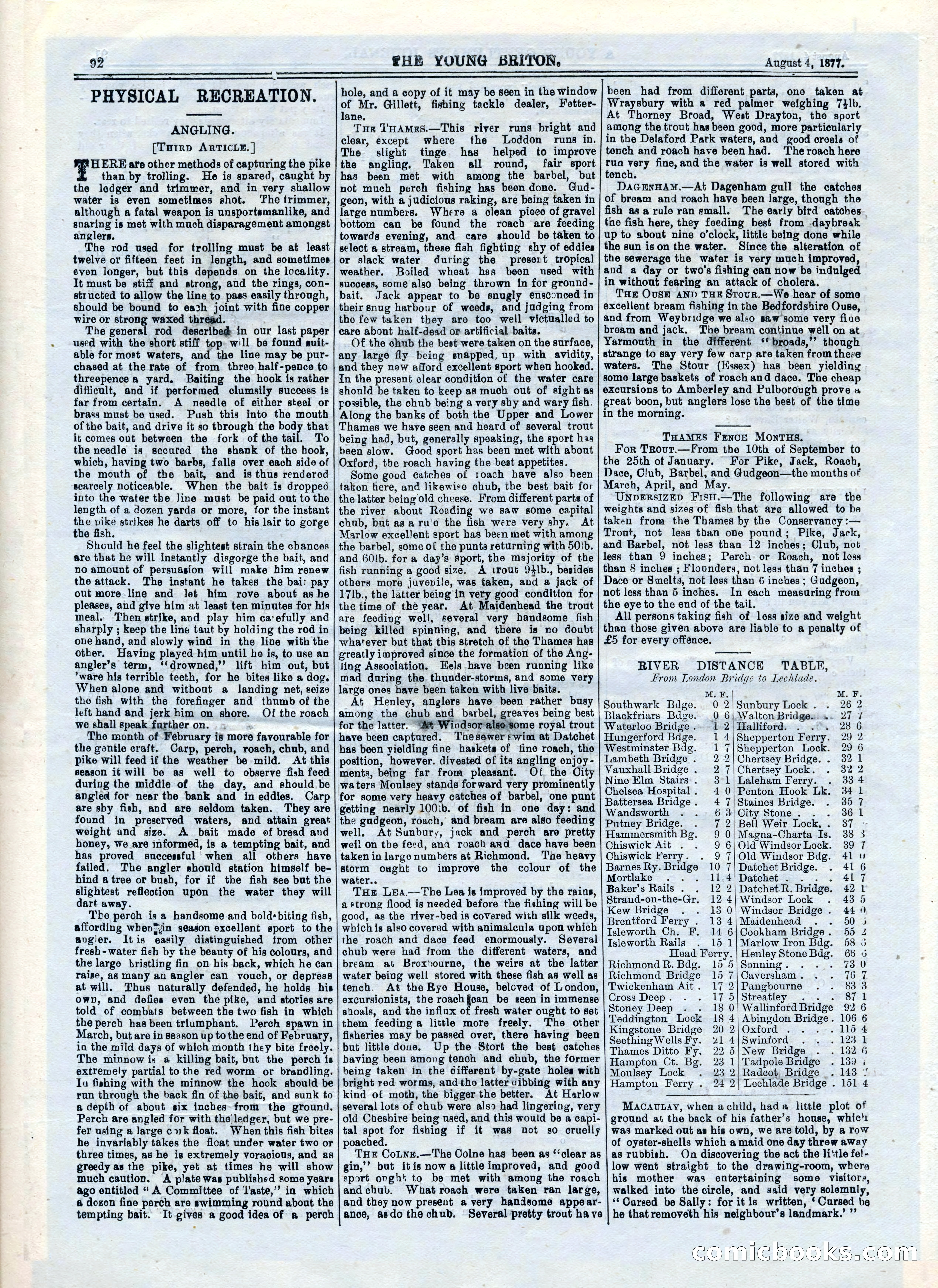
A restored page from Penny Dreadfuls, 1877. Page through the whole issue in the reader above.
📄 Transcribed text from this page (OCR, searchable)
Machine-transcribed from the original scan — historical spelling and the odd misread are preserved.
92 pe wn ee ee a enna eal PHYSICAL RECREATION, ANGLING. (THtrp ARTICLE. | HERE are other methods of capturing the pike than by trolling. He is snared, caught by the ledger and trimmer, and in very shallow water is even sometimes shot. The trimmer, although a fatal weapon is unsportemanlike, and soaring is met with much disparagement amongst anglers. The rod used for trolling must be at least twelve or fifteen feet in length, and sometimes even longer, but this depends on the locality. It must be stiff and strong, and the rings, con- structed to allow the line to pass easily through, should be bound to each joint with fine copper wire or strong waxed thread. The general rod describe@ in our last paper used with the short stiff top. will be found suit- able for moet waters, and the line may be pur- chased at the rate of from three half-pence to threepence a yard. Baiting the hook is rather difficult, and if performed clumsily success is far from certain. A needle of either steel or brass must be used. Push this into the mouth of the bait, and drive it so through the body that it comes out between the fork of the tail. To the needle is secured the shank of the hook, which, having two barbs, falls over each side of the mouth of the bait, and is thus rendered scarcely noticeable. When the bait is dropped into the water the Jine must be paid out to the length of a dozen yards or more, for the instant the pike strikes he darts off to his lair to gorge the fish. : Should he feel the slightest strain the chances are that he will instantly disgorge the bait, and no amount of persuasion will make him renew the attack. Tho instant he takes the bair pay out more line and let him rove about as he pleases, and give him at least ten minutes for his meal. Then strike, and play him cavefully and sharply ; keep the line taut by holding the rod in one hand, and slowly wind in the line with the other. Having played him until he is, to use an angler’s term, ‘‘drowned,’’ lift him out, but ’ware his terrible teeth, for he bites like a dog. When alone and without a landing net, seize the fish with the forefinger and thumb of the left hand and jerk him on shore. Of the roach we shall speak furtheron. , . The month of February is more favourable for the gentle craft. Carp, perch, roach, chub, and pike will feed if the weather be mild. At this season it will be as well to observe fish feed during the middle of the day, and should be angled for near the bank and in eddies. Carp are sby fish, and are seldom taken. They are found in preserved waters, and attain great weight and size. A bait made of bread aud honey, We are informed, is a tempting bait, and has proved successful when all others have failed, The angler should station himself be- hind a tree or bush, for if the fish see but the slightest reflection upon the water they will dart away. The perch is a handsome and bold: biting fish, affording whep*;in season excellent sport to the aogier. Itis easily distinguished trom other fresh-water fish by the beauty of his colours, and the large bristling fin on his back, which he can raise, as many an angler can vouch, or depress at will. Thus naturally defended, he holds his own, and defies even the pike, and stories are told of combats between the two fish in which the perch has been triumphant. Perch spawn in March, but are in season up tothe end of February, in the mild days of which month they bite freely. The minnow is a killing bait, but the perch is extremely partial to the red worm or brandling. Ia fishing with the minnow the hook should be run through the back fin of the bait, and sunk to a depth of about six inches from the ground. Perch are angled for with the ledger, but we pre- fer using a large ck float. When this fish bites he invariably takes the float under water two or three times, as he is extremely voracious, and as greedy asthe pike, yet at times he will show much caution. A plate was published some years ago entitled “ A Committee of l'aste,’’ in which a dozen fine perch are swimming round about the tempting bait. It gives a good idea of a perch fFHE YOUNG BRITON, hole, and a copy of it may be seen in the window of Mr. Gillett, fishing tackle dealer, Fetter- lane. Tus 1'HAMES.—This river runs bright and clear, except where the Loddon runs in. The slight tinge has helped to improve the angling. Taken all round, fair sport has been met with among the barbel, but not much perch fishing has beendone. Gud- geon, with a judicious raking, are being taken in large numbers. Where a clean piece of gravel bottom can be found the roach are feeding towards evening, and care should be taken to select a stream, these fish fighting shy of eddies or slack water during the present tropical weather. Boiled wheat has been used with success, some also being thrown in for ground- bait. Jack appear to be snugly ensconced in their snug harbour of weeds, and judging from the few taken they are too well victualled to care about half-dead or artificial baits. Of the chub the best were taken on the surface, any large fiy being snapped, up with avidity, and they now afford excellent sport when hooked. In the present clear condition of the water care should be taken to keep as much out of sight as possible, the chub being a very shy and wary fish. Along the banks of both the Upper and Lower Thames we have seen and heard of several trout being had, but, generally speaking, the sport has been slow. Good sport has been met with about Oxford, tbe roach having the best appetites. Some good catches of :oach have also been taken here, and Jikewire chub, the best bait for the latter being old cheese. From different parts of the river about Reading we saw some capital chub, but as aru'e the fish were very shy. At Marlow excellent sport has been met with among the barbel, some of the punta returning with 50lb. and 60)b. for a day’s sport, the majority of the fish running a good size. A irout 95lb., besides others more juvenile, was taken, and a jack of 17lb., the latter being in very good condition for the time of the year. At Maidenhead the trout are feeding well, several very handsome fish being killed spinning, and there is no doubt whatever but that this stretch of the Thames has greatly improved since the formation of the Ang- ling Association. Eels have been running like mad during the. thunder-storms, and some very large ones have been taken with live baits. At Henley, anglers have been rather busy among the chub and barbel, greaves being best for the latter. “tt Windsor also-some royal trout have been captured. Thesewerrwim at Datchet has been yielding fine haskets of fine roach, the position, however. divested of ita angling enjoy - ments, being far from pleasant. Of the City waters Moulsey stands forward very prominently for some very heavy catches of barbel, one punt getting nearly 100:b. of fish in one day: and the gudgeon, roach, and bream are also feeding well, At Sunbury, jack and perch aro pretty weil on the feed, and roach and dace have been taken in large numbers at Richmond. The heavy storm ought to improve the colour of the water.. THe LEea.—The Lea is improved by the rains, a strong flood is needed before the fishing will be good, as the river-bed is covered with silk weeds, which is also covered with animalcula upon which the roach and dace feed enormously. Several chub were had from the different waters, and bream at Broxbourne, the weirs at the latter water being well stored with these fish as well as tench. At the Rye House, beloved of London, excursionists, the roachfcan be eeen in immense sdoals, and the influx of fresh water ought to set them feeding a little more freely. The other fisheries may be passed over, there having been but little done. Up the Stort the best catches having been among tench and chub, the former heing taken in the different by-gate holes with bright red worms, and the latter vibbing with any kind of moth, the bigger the better. At Harlow several lots of chub were als» had lingering, very old Cheshire being used, and this would be a capi- tal spot for fishing if it was not so cruelly poached. THE CoLtNns.—The Colne has been as ‘‘clear as gin,’’ but itis now a little improved, and good sport ovght to be met with among the roach andchub. What roach were taken ran large, and they now present a very handsome appear- ance, asdothechub. Several pretty trout have the 25th of January. Dace, Club, Barbel, and Gudgeon—the months of March, April, and May. August 4, 1877. been had from different parts, one taken at Wraysbury with a red palmer welghing 7}lb. At Thorney Broad, West Drayton, the sport among the trout has been good, more particularly in the Delaford Park waters, and good creels of tench and roach have been had. The roach here rua very fine, and the water is well stored with tench. DaGENHAM.—At Dagenham gull the catches of bream and roach have been large, though the fish as a rule ran small. The early bird catches. the fish here, they feeding best from daybreak up to about nine o’clock, little being done while the sun ison the water. Since the alteration of the sewerage the water is very much improved, and a day or two's fishing can now be indulged in without fearing an attack of cholera. THE Ouse AND THE StouR.—We hear of some excellent bream fishing in the Bedfordshire Ouse, and from Weybridge we also saw some very fine bream and jack. The bream continue well on at Yarmouth in the different ‘* broads,’’ though strange to say very few carp are taken from these waters. some large baskets of roach and dace. The cheap excursions to Amberley and Pulborough prove « great boon, but anglers lose the best of the time in the morning. The Stour (Essex) has been yielding THAMES Fence MonTus. For Trourt.—From the 10th of September to For Pike, Jack, Roach, UNDERSIZED FisH.—The following are the weights and sizes of fish that are allowed to ba taken from the Thames by the Conservancy :— Trout, not less than one pound; Pike, Jack, and Barbel, not less than 12 inches; Club, not less than 9 inches; Perch or Roach, not less than 8 inches ; Flounders, not less than 7 inches ; Dace or Smelts, not less than 6 inches ; Gudgeon, not less than 5 inches. the eye to the end of the tail. In each measuring from All persons taking fish of less size and weight than those given above are liable to a penalty of £5 for every offence. RIVER DISTANCE TABLE, From London Bridge to Lechlade. M. F. M. F Southwark Bdge. 0 2|Sunbury Lock . 26 2 Blackfriars Bdge. 0 6| Walton Bridges... 27 7 Waterloo Bridge. 1 2) Halliford. ef... 28°6 Hungerford Bdge. 1 4)Shepperton Ferry. 29 2 Westminster Bdg. 1 7|Shepperton Lock. 29 6 Lambeth Bridge . 2 2|Chertsey Bridge. . 32 1 Vauxhall Bridge . 2 7|Chertsey Lock. 32 2 Nine Elm Stairs. 3 1|Laleham Ferry. . 33 4 Chelsea Hospital. 4 0|Penton Hook Lk. 34 1 Battersea Bridge. 4 7|Staines Bridge. 35 7 Wandsworth 6 3/City Stone. . . 361 Putney Bridge. 7 2|Bell Weir Lock, . 37 | Hammersmith Bg. 9 0|}Magna-Charta Is. 38 3 Chiswick Ait . 9 6|Old Windsor Lock. 39 7 Chiswick Ferry. 9 7;Old Windsor Bdg. 41 4 Barnes Ry. Bridge 10 7| Datchet Bridge. 41 6 Mortlake” «. % 11.4) Datenet-s. .. . 407 Baker’s Rails . . 12 2|DatchetR. Bridge. 42 1 Strand-on-the-Gr, 12 4|Windsor Lock . 43 5 Kew Bridge . 13 0| Windsor Bridge. 44 #) Brentford Ferry . 13 4| Maidenhead 50 5 Isleworth Ch. F. 14 6|Coohham Bridge. 55 2 Isleworth Rails 15 1| Marlow Iron Bdg. 58 5 Head Ferry. | Henley Stone Bdg. 66 5 Richmond R. Bdg. 15 5|Sonning. . . . 73 0 Richmond Bridge 15 7| Caversham . 76 7 Twickenham Ait. 17 2| Pangbourne 83 3 Cross Deep . 1} 5| Streatioy..... 7. 87-1 Stoney Deep 18 0| Wallinford Bridge 92 6 Teddington Lock 18 4| Abingdon Bridge. 106 6 Kingstone Bridge 20 2|}Oxford . . . . 1164 SeethingWells Fy. 41 4|Swinford . 123 1 Thames Ditto Fy, 22 5|New Bridge . 132 6 Hampton Ct. Bg. 23 1|/Tadpole Bridge . 139 i Moulsey Lock 23 2|Radeot, Bridge 143 7 Hampton Ferry . 24 2| Lechlade Bridge . 151 4 Macautay, when achild, hada little plot of ground at the back of his father’s house, which was marked out as his own, we are told, by a row of oyster-shells which a maid one day threw away as rubbieh. On discovering the act the li'tle fel- low went straight to the drawing-room, where his mother was entertaining some visitors, walked into the circle, and said very solemaly, ‘©Qursed be Sally: for it is written, ‘Cursed be he that removeth his neighbour’s landmark.’ ”’ (EO) 6)(6)(6) AMUCE SalEO