
Penny Dreadfuls, 1877 · page 5 of 16
Young Briton, No. 422 — page 5: what you’re looking at
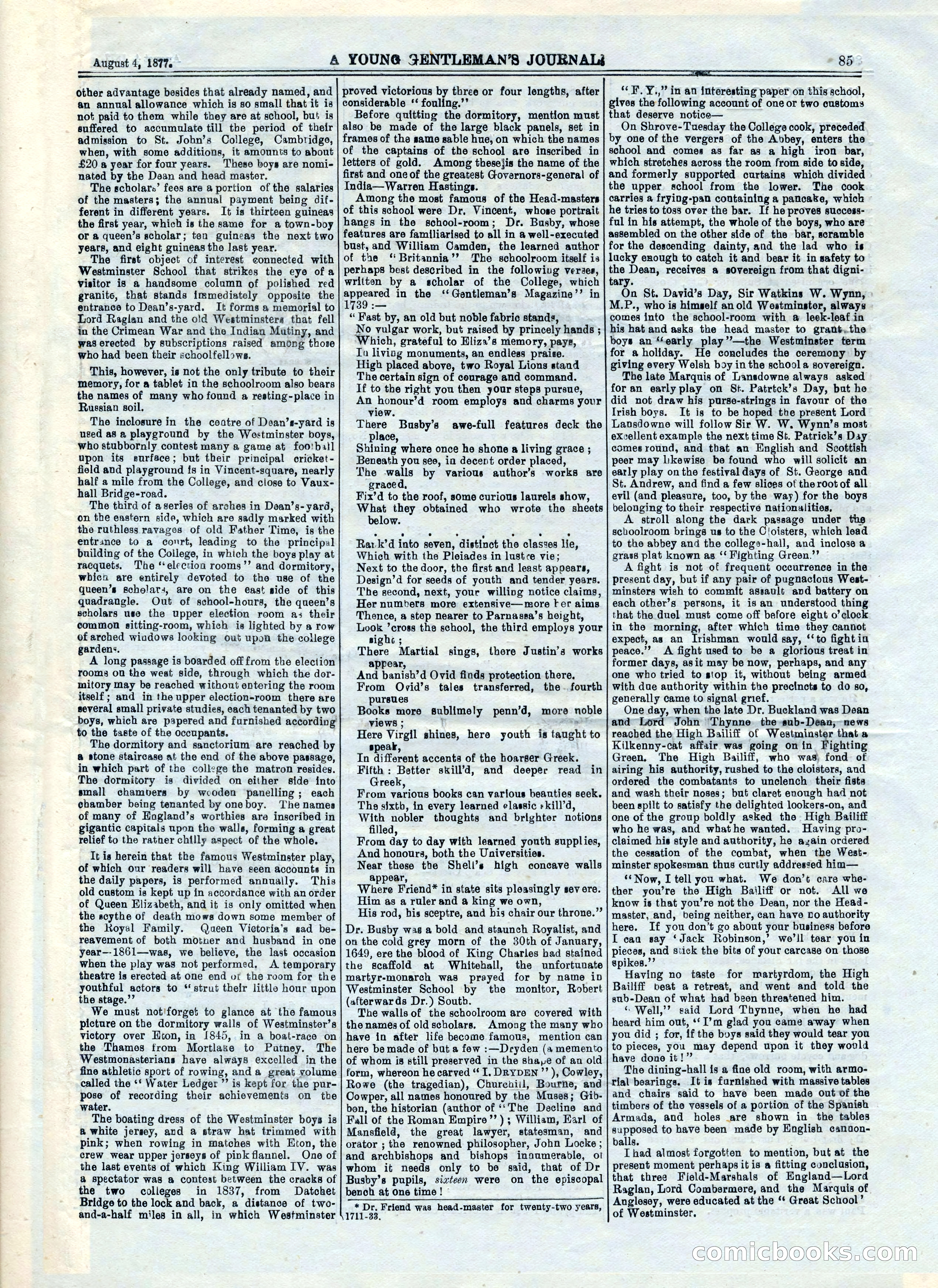
A restored page from Penny Dreadfuls, 1877. Page through the whole issue in the reader above.
📄 Transcribed text from this page (OCR, searchable)
Machine-transcribed from the original scan — historical spelling and the odd misread are preserved.
August 4, 1877. Other advantage besides that already named, and an annual allowance which is so small that it is not paid to them while they are at school, but is suffered to accumulate till the period of their admission fo St. John’s College, Cambridge, when, with some additions, it amounts to about $20 a year for four years. These boys are nomi- nated by the Dean and head master. The scholar.’ fees are & portion of the salaries of the masters; the annual payment being dif- ferent in different years. It is thirteen guineas the first year, which is the same for a town-boy or a queen’s scholar; ten guineas the next two years, and eight guineas the last year. The firet object of interest connected with Westminster School that strikes the eye ofa Visitor is a handsome column of polished red granite, that stands immediately opposite the entrance to Dean’s-yard. It forms a memorial to Lord Raglan and the old Westminstera that fell in the Crimean War and the Indian Mutiny, and was erected by subscriptions raised among those who had been their schoolfellows. This, however, is not the only tribute to their memory, for a tablet in the schoolroom also bears the names of many who found a resting-place in Russian soil. The inclosure in the ceatre of Dean’s-yard is used as a playground by the Westminster boys, who stubbornly contest many a game at foo!ball upon its eurface; but their principal cricket- field and playground {fs in Vincent-square, nearly half a mile from the College, and ciose to Vaux- hall Bridge-road. The third of aseries of arches in Dean’s- yard, on the eastern side, which are sadly marked with the ruthless ravages of old Father Time, is the entrance to a conrt, leading to the principal building of the College, in which the boys play at racquets. The ‘election rooms’’ and dormitory, which are entirely devoted to the use of the queen’s scholars, are on the east side of this quadrangle. Out of school-hours, the queen’s scholars use the upper election room a3; their common sitting-room, which is lighted by a row of arched wiudows looking out upon the college gardens. A long passage is boarded off from the election rooms ou the west side, through which the dor- mitory May be reached without entering the room itself ; and in the upper election-room there are several small private studies, each tenanted by two boys, which are papered and furnished according to the taste of the occupants. The dormitory and sanctorium are reached by a stone staircase at the end of the above passage, in which part of the college the matron resides. The dormitory is divided on either side into small chamvers by weoden panelling; each chamber being tenanted by oneboy. The names of many of England’s worthies are inscribed in gigantic capitals upon the walls, forming a great relief to the rather chilly aspect of the whole. It is herein that the famous Westminster play, of which our readers will have seen accounts in the daily papers, is performed annually. This old custom is kept up in accordance with an order of Queen Elizabeth, and it is only omitted when the scythe of death mows down some member of the Roysl Family. Queen Victoria’s sad be- reavement of both mother and husband in one year—-1861—was, we believe, the last occasion when the play was not performed, <A temporary theatre is erected at one end ot the room for the youthful actors to “strut thelr little hour upon the stage.”’ We must notiforget to glance at the famous picture on the dormitory walls of Westminster’s victory over Eton, in [845, in a boat-race on the Thames from Mortlake to Patney. The Westmonasterians have always excelled in the fine athletic sport of rowing, anda great volume called the ‘‘ Water Ledger ”’ is kept for the pur- pose of recording their achievements on the water. The boating dress of the Westminster boys is & white jersey, and a straw hat trimmed with pink; when rowing in matches with Eton, the crew wear upper jerseys of pink flannel. One of the last events of which King William IV. was @ spectator was a contest between the cracks of the two colleges in 1837, from Datchet Bridge to the lock and back, a distance of two- and-a-half miles in all, in which Westminster A YOUNG GENTLEMAN’S JOURNALI proved victorious by three or four lengths, after considerable ‘‘ fouling.’’ Before quitting the dormitory, mention must also be made of the large black panels, set in frames of the same sable hue, on which the names of the captains of the school are inscribed in letters of gold. Among thesejis the name of the first and one of the greatest Governors-general of India—Warren Hastings. Among the most famous of the Head-masters of this school were Dr, Vincent, whose portrait hangs in the school-room; Dr. Busby, whose features are familiarised to sll in a well-executed bust, and William Camden, the learned author of the ‘ Britannia’’ The schoolroom itself is perhaps best described in the followiug veraes, written by a scholar of the College, which arate in the ‘‘Gentleman’s Magazine’’ in 39 :— “Fast by, an old but noble fabric stands, No vulgar work, but raised by princely hands ; hich, grateful to Hliza’s memory, pays, Iu living monuments, an endless praise. High placed above, two Royal Lions stand The certain sign of courage and command. If to the right you then your steps pursue, An honour’d room employs and charms your view. There Busby’s place, Shining where once he shone a living grace ; Beneath you see, in decent order placed, The walls by various author’s works are graced, Fix’d to the roof, some curious laurels show, What they obtained who wrote the sheots below. awe-full features deck the Ratk’d into seven, distinct the classes lie, Which with the Pleiades in lustce vie; Next to the door, the first and least appears, Design’d for seeds of youth and tender years. The second, next, your willing notice claims, Her numbers more extensive—more ter aims Thence, a step nearer to Parnassa’s height, Look ’cross the school, the third employs your sighe ; There Martial sings, there Justin's works appear, And banish’d Ovid finds protection there, From Ovid’s tales transferred, the. fourth pursues Books more sublimely penn’d, more noble views ; ie Here Virgil shines, here youth is taught to speak, In different accents of the hoarser Greek. Fifth : Better skill’d, and deeper read in Greek, From various books can various beanties seek. The sixth, in every learned ¢lassic rkill’d, With nobler thoughts and brighter notions filled, From day to day with learned youth supplies, And honours, both the Universities. Near these the Sheli’s high concave walls appear, Where Friend* in state sits pleasingly sev ore. Him as a ruler and a king we own, His rod, his sceptre, and bis chair our throne.” Dr. Busby was a bold and staunch Royalist, and on the cold grey morn of the 30th of January, 1649, ere the blood of King Charles had stained the scaffold at Whitehall, the unfortunate martyr-monarch was prayed for by name ip Westminster School by the monitor, Robert (afterwards Dr.) South. The walls of the schoolroom are covered with the names of old scholars, Among the many who have in after life become famous, mention can here be made of but a fow :—Dryden (a memento of whom is still preserved in the sha,e of an old form, whereon he carved ‘‘ I. DRYDEN ’’ ), Cowley, Rowe (the tragedian), Churchiil, Bourne, and Cowper, all names honoured by the Muses; Gib- bon, the historian (author of ‘‘The Decline and Fall of the Roman Empire’’) ; William, Earl of Mansfield, the great lawyer, statesman, and orator ; the renowned philosopher, John Locke ; and archbishops and bishops inaumerable, oi whom it needs only to be said, that of Dr Busby’s pupils, sizteen were on the episcopal bench at One time ! : * Dr. Friend was head-master for twenty-two years, 711-33, 85 wie “<F. Y.,” in an interesting paper on this school, gives the following account of one or two customs that deserve notice— On Shrove-Tuesday the College cook, preceded by one of the vergers of the Abbey, enters the school and comes as far as a high iron bar, which stretches across the room from side to side, and formerly supported curtains which divided the upper school from the lower. The cook carries a frying-pan containing a pancake, which ~ he tries to toss over the bar. If he proves success- ful in his attempt, the whole of the boys, who are assembled on the other side of the bar, scramble for the descending dainty, and the lad who is lucky enough to catch it and bear it in safety to the Dean, receives a sOvereign from that digni- tary. On St. David’s Day, Sir Watkins W. Wynn, M.P., who is himself an old Westminster, always comes into the school-room with a leek-leafin his hat and asks the head master to grant.the boys an *‘early play’’—the Westminster term for a holiday. He concludes the ceremony by giving every Welsh boy in the school a sovereign. The late Marquis of Lansdowne always asked for an early play on St. Patrtck’s Day, but he did not draw his purse-strings in favour of the Irish boys. It is to be hoped the present Lord Lansdowne will follow Sir W. W. Wynn’s most excellent example the next time St. Patrick’s Day eomes round, and that an English and Scottish peer may likewise be found who will solicit an early play on the festival days of St. George and St. Andrew, and find a few slices of the root of all evil (and pleasure, too, by the way) for the boys belonging to their respective nationalities, A stroll along the dark passage under the scuoolroom brings us to the Cloisters, which lead to the abbey and the college-hall, and inclose a grass plat known as ‘‘ Fighting Green.’’ A fight is not of frequent occurrence in the present day, but if any pair of pugnaclous West- minsters wish to commit assault and battery on each other’s persons, it is an understood thing that the duel must come off before eight o’ clock in the morning, after which time they cannot expect, as an Irishman would say, ‘‘to fightin peace.” A fight used to be a glorious treat in former days, asit may be now, perhaps, and any one who tried to stop it, without being armed with due authority within the precincts to do so, generally came to signal grief. One day, when the late Dr. Buckland was Dean and Lord John Thynne the sub- Dean; news reached the High Bailiff of Westminster thata Kilkenny-cat affair was going on in Fighting Green. The High Bailiff, who was, fond of airing his authority, rushed to the cloisters, and ordered the combatants to unclench their fista and wash their noses; but claret enough had not been spilt to satisfy the delighted lookers-on, and one of the group boldly asked the High Bailiff who he was, and whathe wanted. Having pro- claimed his style and authority, he azain ordered the cessation of the combat, when the West- minster spokesman thus curtly addressed him— ‘*Now, I tell you what. We don’t care whe- ther you’re the High Bailiff or not. All we know is that you’re not the Dean, nor the Head- master, and, being neither, can have Do authority here. If you don’t go about your business before I can say ‘Jack Robinson,’ we’ll tear you in pieces, and stick the bits of your carcase on those spikes.”’ Having no taste for martyrdom, the High Bailiff beat a retreat, and went and told the sub-Dean of what had been threatened him. ‘ Well,’’ said Lord Thynne, when he had heard him out, ‘‘I’m glad you came away when you did ; for, {f the boys said they would tear you to pieces, you may depend upon it they would have done it!” The dining-hall is a fine old room, with armo- rial bearings. It is farnished with massive tables and chairs said to have been made out of the timbors of the vessels of a portion of the Spanish Armada, and holes sre shown in the tables supposed to have been made by English candon- balls. Thad almost forgotten to mention, but at the present moment perhaps it is a fitting conclusion, that three Field-Marshals of England—Lord Raglan, Lord Combermere, and the Marquis of Anglesey, were educated at the ‘* Great School’ of Westminster. CORMIELDOO SS (EO)