
Pulp Fiction, 1954 · page 60 of 116
Fifteen Western Tales, March 1954 — page 60: what you’re looking at
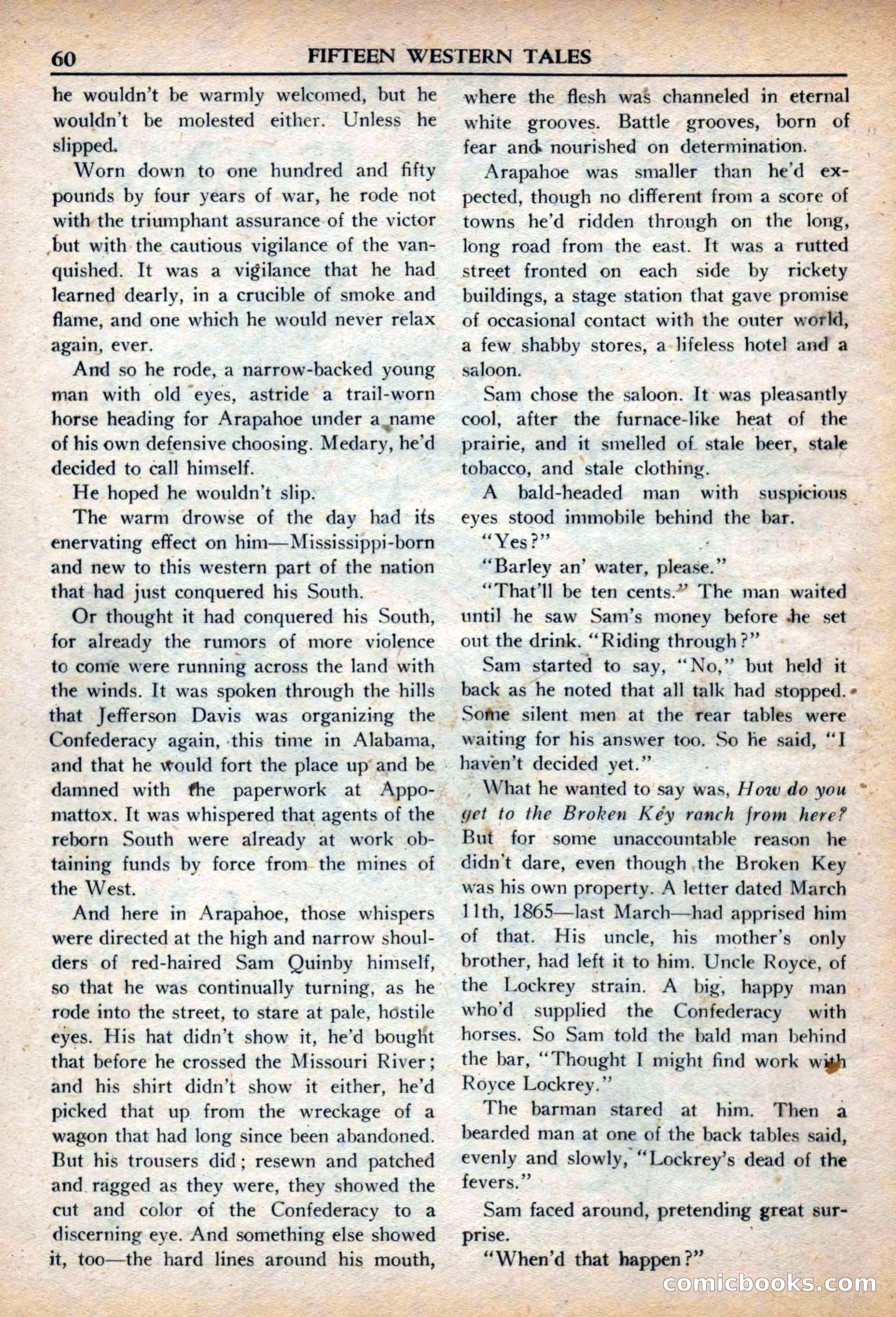
A restored page from Pulp Fiction, 1954. Page through the whole issue in the reader above.
📄 Transcribed text from this page (OCR, searchable)
Machine-transcribed from the original scan — historical spelling and the odd misread are preserved.
FIFTEEN WESTERN TALES - 60 he wouldn’t be warmly welcomed, but he wouldn't be molested either. Unless he slipped. Worn down to one hundred and fifty pounds by four years of war, he rode not with the triumphant assurance of the victor but with the cautious vigilance of the van- quished. It was a vigilance that he had learned dearly, in a crucible of smoke and flame, and one which he would never relax again, ever. And so he rode, a narrow-backed young man with old eyes, astride a trail-worn horse heading for Arapahoe under a_name of his own defensive choosing. Medary, he'd decided to call himself. He hoped he wouldn’t slip. The warm drowse of the day had its enervating effect on him— Mississippi-born and new to this western part of the nation that had just conquered his South. Or thought it had conquered his South, _ for already the rumors of more violence to come were running across the land with the winds. It was spoken through the hills that Jefferson Davis was organizing the - Confederacy again, this time in Alabama, and that he would fort the place up’ and be . damned with fhe paperwork at Appo-. mattox. It was whispered that agents of the reborn South were already at work ob- taining funds by force from the mines of the West. And here in Arapahoe, those whispers were directed at the high and narrow shoul- ders of red-haired Sam Quinby himself, so that he was continually turning, as he - rode into the street, to stare at pale, hostile eyes. His hat didn’t show it, he’d bought that before he crossed the Missouri River; and his shirt didn’t show it either, he’d picked that up from the wreckage of a wagon that had long since been abandoned. But his trousers did; resewn and patched and ragged as they were, they showed the cut and color of the Confederacy to a discerning eye. And something else showed it, too—the hard lines around his mouth, where the flesh was channeled in eternal | white grooves. Battle grooves, born of fear anc nourished on determination. Arapahoe was smaller than hed ex- pected, though no different from a score of towns he’d ridden through on the long, long road from the east. It was a rutted street fronted on each side by rickety buildings, a stage station that gave promise of occasional contact with the outer world, a few shabby stores, a Jifeless hotel and a saloon. Sam chose the saloon. It: was pleasantly cool, after the furnace-like heat of the prairie, and it smelled of stale beer, stale tobacco, and stale clothing. A bald-headed man with eyes stood immobile behind the bar. “Yes?” “Barley an’ water, please:” “That'll be ten cents.” The man waited until he saw Sam’s money before she set out the drink. “Riding through?” Sam started to say, “No,” but held it suspicious _ back as he noted that all talk had stopped.+— 2 _Sotme silent men at the rear tables were waiting for his answer too, So he said, “I haven't decided yet.” , What he wanted to say was, How do you get to the Broken Kéy ranch from here? But for some unaccountable reason he didn't dare, even though the Broken Key — was his own property. A letter dated March 11th, 1865—last March—had apprised him of that. His uncle, his mother’s only brother, had left it to him. Uncle Royce, of ‘the Lockrey strain. A big, happy man who'd supplied the Confederacy with horses. So Sam told the bald man behind the bar, “Thought I might find work wigh Royce Lockrey.” The barman stared at him. Then a bearded man at one of the back tables said, evenly and slowly, “Lockrey’s dead of the fevers.” Sam faced around, pretending great sur- prise. ‘“When’d that happen ?”’ cComicbooks —— = = a - I~ > Rees eS ee i aoe