
Pulp Fiction, 1954 · page 86 of 116
Fifteen Western Tales, March 1954 — page 86: what you’re looking at
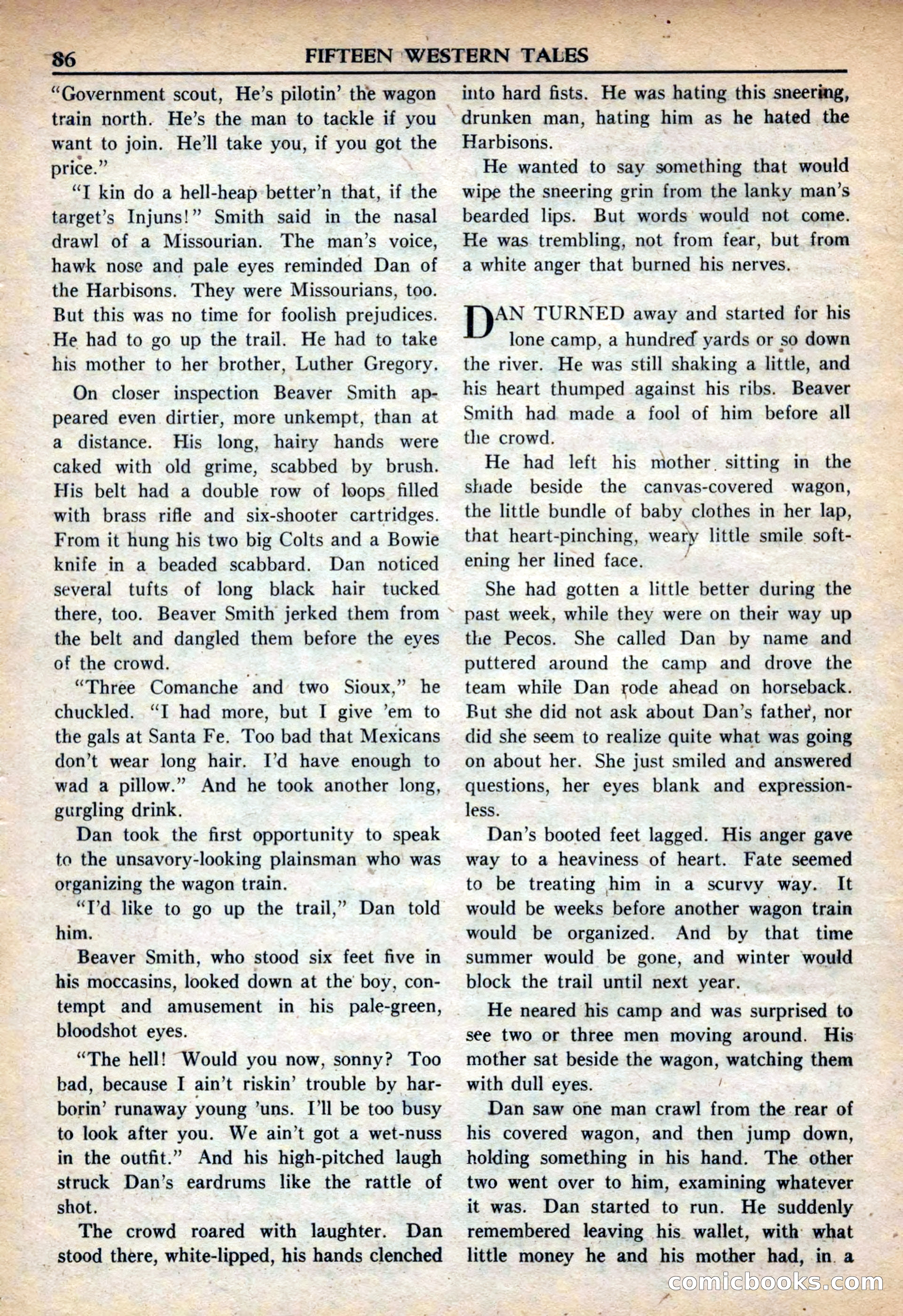
A restored page from Pulp Fiction, 1954. Page through the whole issue in the reader above.
📄 Transcribed text from this page (OCR, searchable)
Machine-transcribed from the original scan — historical spelling and the odd misread are preserved.
= ~s: 3 a “. eS — FIFTEEN ‘WESTERN. TALES ~~ “Government scout, He’s pilotin’ the wagon train north. He’s the man to tackle if you want to join. He'll take you, if you got the price.” “TY kin do a hell-heap better’n that, if the target’s Injuns!” Smith said in the nasal drawl of a Missourian. The man’s voice, hawk nose and pale eyes reminded Dan of the Harbisons. They were Missourians, too. But this was no time for foolish prejudices. He had to go up the trail. He had to take his mother to her brother, Luther Gregory. On closer inspection Beaver Smith ap- peared even dirtier, more unkempt, than at a distance. His long, hairy hands were caked with old grime, scabbed by brush. His belt had a double row of leops filled with brass rifle and six-shooter cartridges. From it hung his two big Colts and a Bowie knife in a beaded scabbard. Dan noticed several tufts of long black hair tucked there, too. Beaver Smith jerked them from > the belt and dangled them befor the eyes of the crowd. “Three Comanche and two Sioux,” he chuckled. “I had more, but I give ’em to the gals at Santa Fe. Too bad that Mexicans don’t wear long hair. I’d have enough to wad a pillow.” And he took mHOEnES long, gurgling drink. Dan took the first opportunity to speak to the unsavory-looking plainsman who was organizing the wagon train. “T’d_ like to go up the trail,” Dan told him. Beaver Smith, who stood six feet five in his moccasins, looked down at the boy, con- tempt and amusement in his pale-green, bloodshot eyes. “The hell! Would you now, sonny? Too bad, because I ain’t riskin’ trouble by har- borin’ runaway young ’uns. I'll be too busy to look after you. We ain’t got a wet-nuss in the outfit.” And his high-pitched laugh struck Dan’s eardrums like the rattle of shot. The crowd roared with laughter. Dan _ stood there, white-lipped, his hands clenched into hard fists. He was hating this sneering, “drunken man, hating him as he hated the Harbisons. He wanted to say something that would wipe the sneering grin from the lanky man’s bearded lips. But words would not come. He was trembling, not from fear, but from a white anger that burned his nerves. AN TURNED away and started for his lone camp, a hundred yards or so down the river. He was still shaking a little, and his heart thumped against his ribs. Beaver Smith had made a fool of him before all the crowd. He had left his mother. sitting in the shade beside the canvas-covered wagon, the little bundle of baby clothes in her lap, that heart-pinching, weary little smile soft- ening her lined face. She had gotten a little better during the past week, while they were on their way up the Pecos. She called Dan by name and puttered around the camp and drove the team while Dan rode ahead on horseback. But she did not ask about Dan’s father, nor did she seem to realize quite what was going on about her. She just smiled and answered questions, her eyes blank and expression- less. : Dan’s booted feet lagged. His anger gave way to a heaviness of heart. Fate seemed to be treating him in a scurvy way. It would be weeks before another wagon train would be organized. And by that time summer would be gone, and winter would block the trail until next year. He neared his camp and was surprised to see two or three men moving around. His mother sat beside the wagon, watching them with dull eyes. | Dan saw one man crawl from the rear of his covered wagon, and then jump down, holding something in his hand. The other two went over to him, examining whatever it was. Dan started to run. He suddenly . remembered leaving his. wallet, with what little money he and his mother had, in. a COMIC IOOKS (E(0)