
Pulp Fiction, 1952 · page 106 of 132
5 Detective Novels Magazine — page 106: what you’re looking at
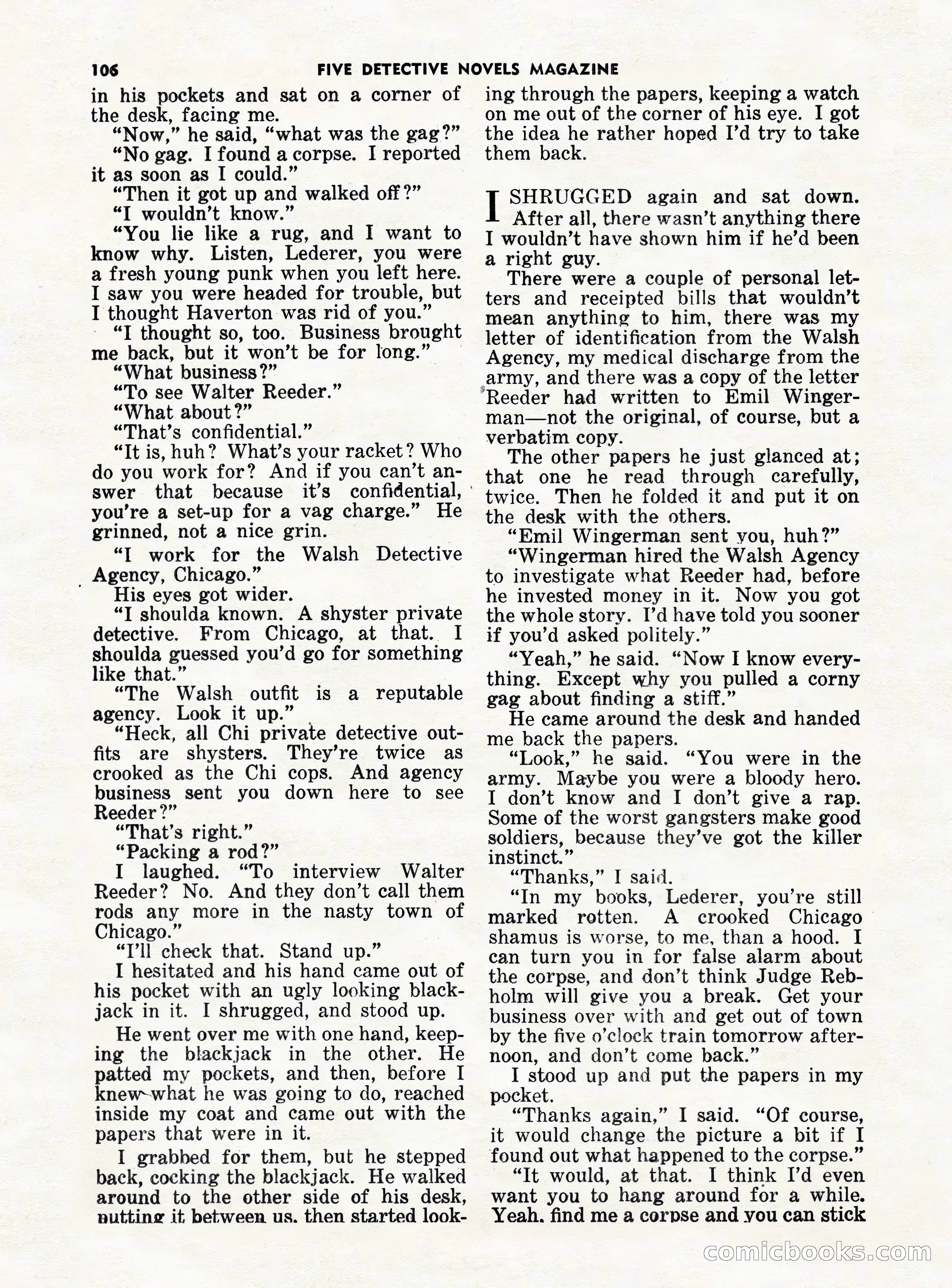
A restored page from Pulp Fiction, 1952. Page through the whole issue in the reader above.
📄 Transcribed text from this page (OCR, searchable)
Machine-transcribed from the original scan — historical spelling and the odd misread are preserved.
106 in his pockets and sat on a corner of the desk, facing me. “Now,” he said, “what was the gag?” “No gag. I found acorpse. I reported it as soon as I could.” “Then it got up and walked off ?” “IT wouldn’t know.” “You lie like a rug, and I want to know why. Listen, Lederer, you were a fresh young punk when you left here. I saw you were headed for trouble, but I thought Haverton was rid of you.” “IT thought so, too. Business brought me back, but it won’t be for long.” “What business?” | “To see Walter Reeder.” “What about?” “That’s confidential.” “It is, huh? What’s your racket? Who do you work for? And if you can’t an- swer that because you’re a set-up for a vag charge.” He grinned, not a nice grin. | “T work for the Walsh Detective _ Agency, Chicago.” His eyes got wider. “I shoulda known. A shyster private detective. From Chicago, at that. I shoulda guessed you’d go for something like that.” “The Walsh outfit is a reputable agency. Look it up.” | “Heck, all Chi private detective out- fits are shysters. They’re twice as crooked as the Chi cops. And agency business sent you down here to see Reeder ?” “That’s right.” “Packing a rod?” I laughed. “To interview Walter Reeder? No. And they don’t call them rods any more in the nasty town of Chicago.” “T’ll check that. Stand up.” I hesitated and his hand came out of his pocket with an ugly looking black- jack in it. I shrugged, and stood up. He went over me with one hand, keep- ing the blackjack in the other. He patted my pockets, and then, before I knew-what he was going to do, reached inside my coat and came out with the papers that were in it. I grabbed for them, but he stepped back, cocking the blackjack. He walked around to the other side of his desk, nutting it between us. then started look- it’s confidential, ° FIVE DETECTIVE NOVELS MAGAZINE ing through the papers, keeping a watch on me out of the corner of his eye. I got the idea he rather hoped I’d try to take them back. SHRUGGED again and sat down. After all, there wasn’t anything there I wouldn’t have shown him if he’d been a right guy. There were a couple of personal let- ters and receipted bills that wouldn’t mean anything to him, there was my letter of identification from the Walsh Agency, my medical discharge from the army, and there was a copy of the letter ‘Reeder had written to Emil Winger- man—not the original, of course, but a verbatim copy. The other papers he just glanced at; that one he read through carefully, twice. Then he folded it and put it on the desk with the others. “Emil Wingerman sent you, huh?” “Wingerman hired the Walsh Agency to investigate what Reeder had, before he invested money in it. Now you got the whole story. I’d have told you sooner if you’d asked politely.” “Yeah,” he said. “Now I know every- thing. Except why you pulled a corny gag about finding a stiff.” He came around the desk and handed me back the papers. “Look,” he said. “You were in the army. Maybe you were a bloody hero. I don’t know and I don’t give a rap. Some of the worst gangsters make good soldiers, because they’ve got the killer instinct.” “Thanks,” I said. “In my books, Lederer, you're still marked rotten. shamus is worse, to me, than a hood. I can turn you in for false alarm about the corpse, and don’t think Judge Reb- holm will give you a break. Get your business over with and get out of town by the five o’clock train tomorrow after- noon, and don’t come back.” I stood up and put the papers in my pocket. “Thanks again,” I said. “Of course, it would change the picture a bit if I found out what happened to the corpse.” — “Tt would, at that. I think [’d even want you to hang around for a while. Yeah. find me a corpse and you can stick A crooked Chicago MICLOO (CO) <S) (C(O)