
Pulp Fiction, 1952 · page 118 of 132
5 Detective Novels Magazine — page 118: what you’re looking at
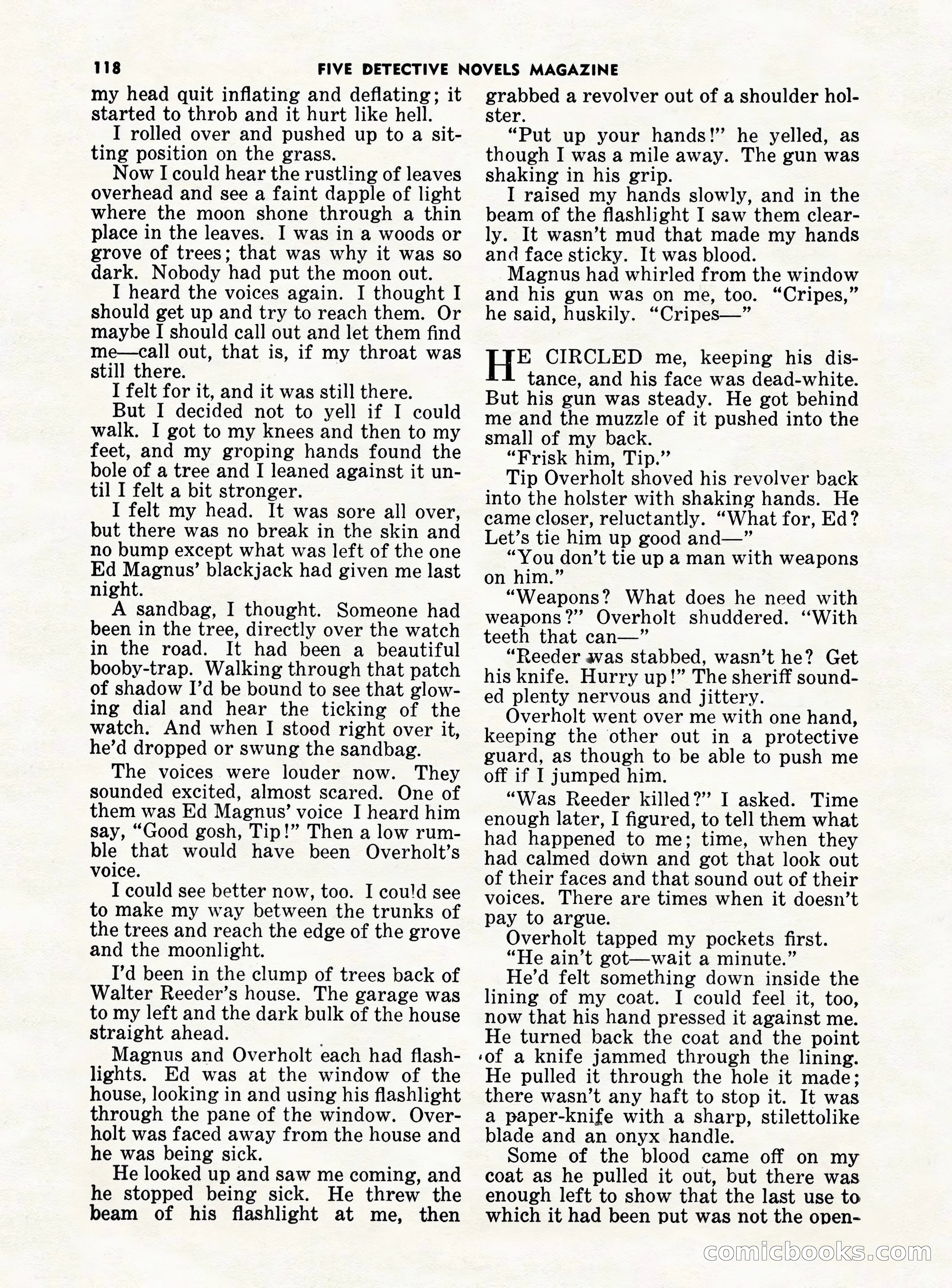
A restored page from Pulp Fiction, 1952. Page through the whole issue in the reader above.
📄 Transcribed text from this page (OCR, searchable)
Machine-transcribed from the original scan — historical spelling and the odd misread are preserved.
my head quit inflating and deflating; it started to throb and it hurt like hell. I rolled over and pushed up to a sit- ting position on the grass. Now I could hear the rustling of leaves overhead and see a faint dapple of light Where the moon shone through a thin place in the leaves. I was in a woods or grove of trees; that was why it was so dark. Nobody had put the moon out. I heard the voices again. I thought I should get up and try to reach them. Or maybe I should call out and let them find me—call out, that is, if my throat was still there. I felt for it, and it was still there. But I decided not to yell if I could walk. I got to my knees and then to my feet, and my groping hands found the bole of a tree and I leaned against it un- til I felt a bit stronger. I felt my head. It was sore all over, but there was no break in the skin and no bump except what was left of the one Ed Magnus’ blackjack had given me last night. A sandbag, I thought. Someone had been in the tree, directly over the watch in the road. It had been a beautiful booby-trap. Walking through that patch of shadow I’d be bound to see that glow- ing dial and hear the ticking of the watch. And when I stood right over it, he’d dropped or swung the sandbag. The voices were louder now. They sounded excited, almost scared. One of them was Ed Magnus’ voice I heard him say, “Good gosh, Tip!” Then a low rum- ble that would have been Overholt’s voice. I could see better now, too. I could see to make my way between the trunks of the trees and reach the edge of the grove and the moonlight. I’d been in the clump of trees back of Walter Reeder’s house. The garage was to my left and the dark bulk of the house straight ahead. Magnus and Overholt each had flash- lights. Ed was at the window of the house, looking in and using his flashlight through the pane of the window. Over- holt was faced away from the house and he was being sick. He looked up and saw me coming, and he stopped being sick. He threw the beam of his flashlight at me, then FIVE DETECTIVE NOVELS MAGAZINE grabbed a revolver out of a shoulder hol- ster. “Put up your hands!” he yelled, as though I was a mile away. The gun was shaking in his grip. I raised my hands slowly, and in the beam of the flashlight I saw them clear- ly. It wasn’t mud that made my hands and face sticky. It was blood. Magnus had whirled from the window and his gun was on me, too. “Cripes,” he said, huskily. “Cripes—” H* CIRCLED me, keeping his dis- tance, and his face was dead-white. But his gun was steady. He got behind me and the muzzle of it pushed into the small of my back. “Frisk him, Tip.” Tip Overholt shoved his revolver back into the holster with shaking hands. He came closer, reluctantly. “What for, Ed? Let’s tie him up good and—” “You don’t tie up a man with weapons on him.” “Weapons? What does he need with weapons?” Overholt shuddered. ‘With teeth that can—” “Reeder avas stabbed, wasn’t he? Get his knife. Hurry up!” The sheriff sound- ed plenty nervous and jittery. Overholt went over me with one hand, keeping the other out in a protective guard, as though to be able to push me off if I jumped him. “Was Reeder killed?” I asked. Time enough later, I figured, to tell them what had happened to me; time, when they had calmed down and got that look out of their faces and that sound out of their voices. There are times when it doesn’t pay to argue. Overholt tapped my pockets first. “He ain’t got—wait a minute.” He’d felt something down inside the lining of my coat. I could feel it, too, now that his hand pressed it against me. He turned back the coat and the point ‘of a knife jammed through the lining. He pulled it through the hole it made; there wasn’t any haft to stop it. It was a paper-knife with a sharp, stilettolike blade and an onyx handle. Some of the blood came off on my coat as he pulled it out, but there was enough left to show that the last use to which it had been put was not the open- COMmiclooo S