
Pulp Fiction, 1952 · page 29 of 132
5 Detective Novels Magazine — page 29: what you’re looking at
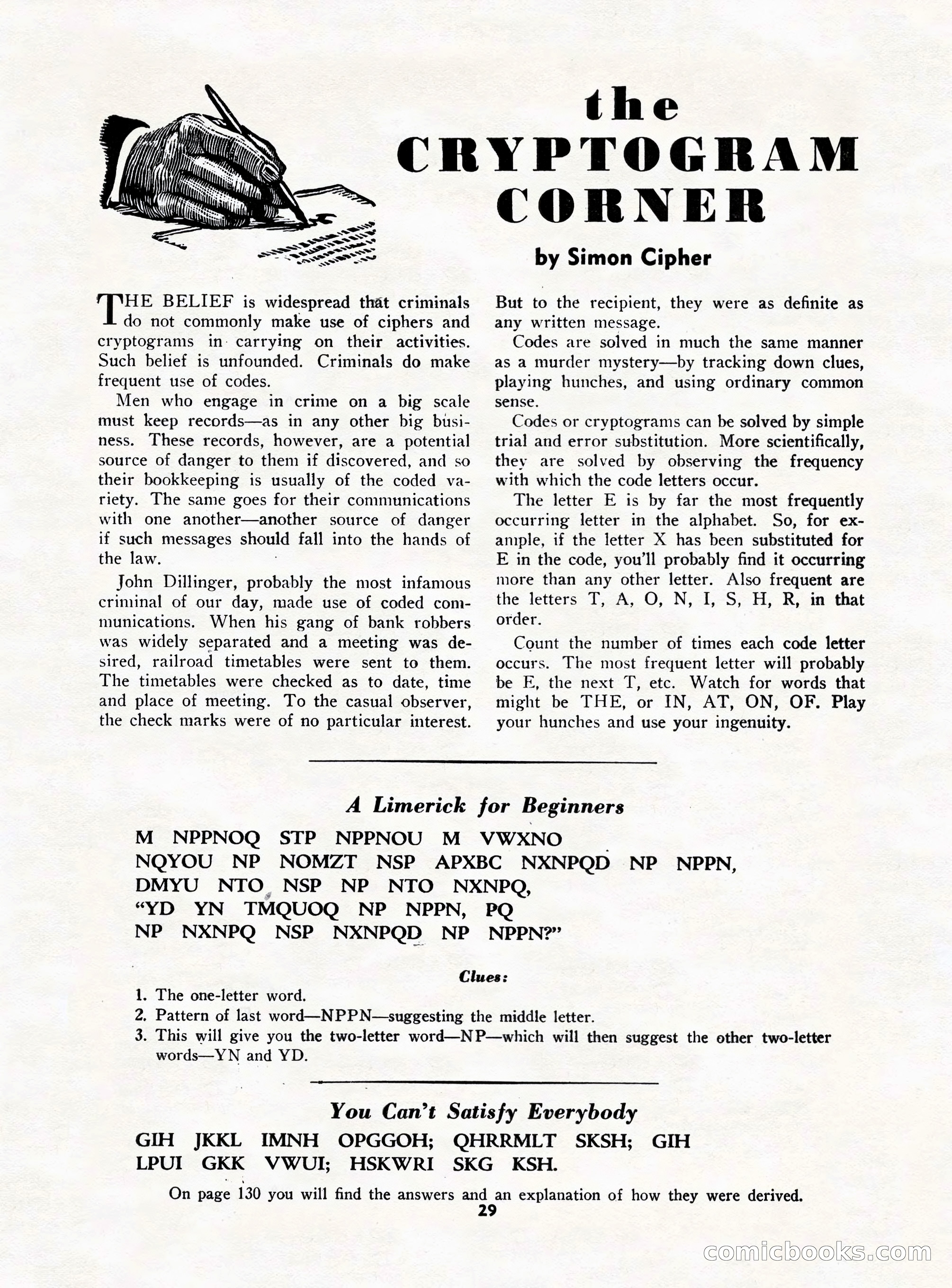
A restored page from Pulp Fiction, 1952. Page through the whole issue in the reader above.
📄 Transcribed text from this page (OCR, searchable)
Machine-transcribed from the original scan — historical spelling and the odd misread are preserved.
ihe BELIEF is widespread that criminals do not commonly make use of ciphers and cryptograms in: carrying on their activities. Such belief is unfounded. Criminals do make frequent use of codes. Men who engage in crime on a big scale must keep records—as in any other big busi- ness. These records, however, are a potential source of danger to them if discovered, and so their bookkeeping is usually of the coded va- riety. The same goes for their communications with one another—another source of danger if such messages should fall into the hands of the law. John Dillinger, probably the most infamous criminal of our day, made use of coded com- munications. When his gang of bank robbers was widely separated and a meeting was de- sired, railroad timetables were sent to them. The timetables were checked as to date, time and place of meeting. To the casual observer, the check marks were of no particular interest. the CRYPTOGRAM CORNER by Simon Cipher But to the recipient, they were as definite as any written message. Codes are solved in much the same manner as a murder mystery—by tracking down clues, playing hunches, and using ordinary common sense. Codes or cryptograms can be solved by simple trial and error substitution. More scientifically, they are solved by observing the frequency with which the code letters occur. The letter E is by far the most frequently occurring letter in the alphabet. So, for ex- aniple, if the letter X has been substituted for E in the code, you'll probably find it occurring more than any other letter. Also frequent are the letters T, A, O, N, I, S, H, R, in that order. Count the number of times each code letter occurs. The most frequent letter will probably be E, the next T, etc. Watch for words that might be THE, or IN, AT, ON, OF. Play your hunches and use your ingenuity. A Limerick for Beginners M NPPNOQ STP NPPNOU M VWXNO NQYOU NP NOMZT NSP APXBC NXNPQD NP NPPN, DMYU NTO_ NSP “YD YN TMQUOQ NP NP NTO NXNPQ, NPPN, PQ NP NXNPQ NSP NXNPQD NP _ NPPN?” Clues: 1. The one-letter word. 2. Pattern of last word—NPPN—suggesting the middle letter. 3. This will give you the two-letter word—NP—which will then suggest the other two-letter words—YN and YD. You Can’t Satisfy Everybody GIH JKKL IMNH OPGGOH; QHRRMLT SKSH; GIH LPUI GKK VWUI; HSKWRI SKG_ KSH. On page 130 you will find the answers and an explanation of how they were derived. 29 MICLOO (CO SH