
Pulp Fiction, 1952 · page 73 of 132
5 Detective Novels Magazine — page 73: what you’re looking at
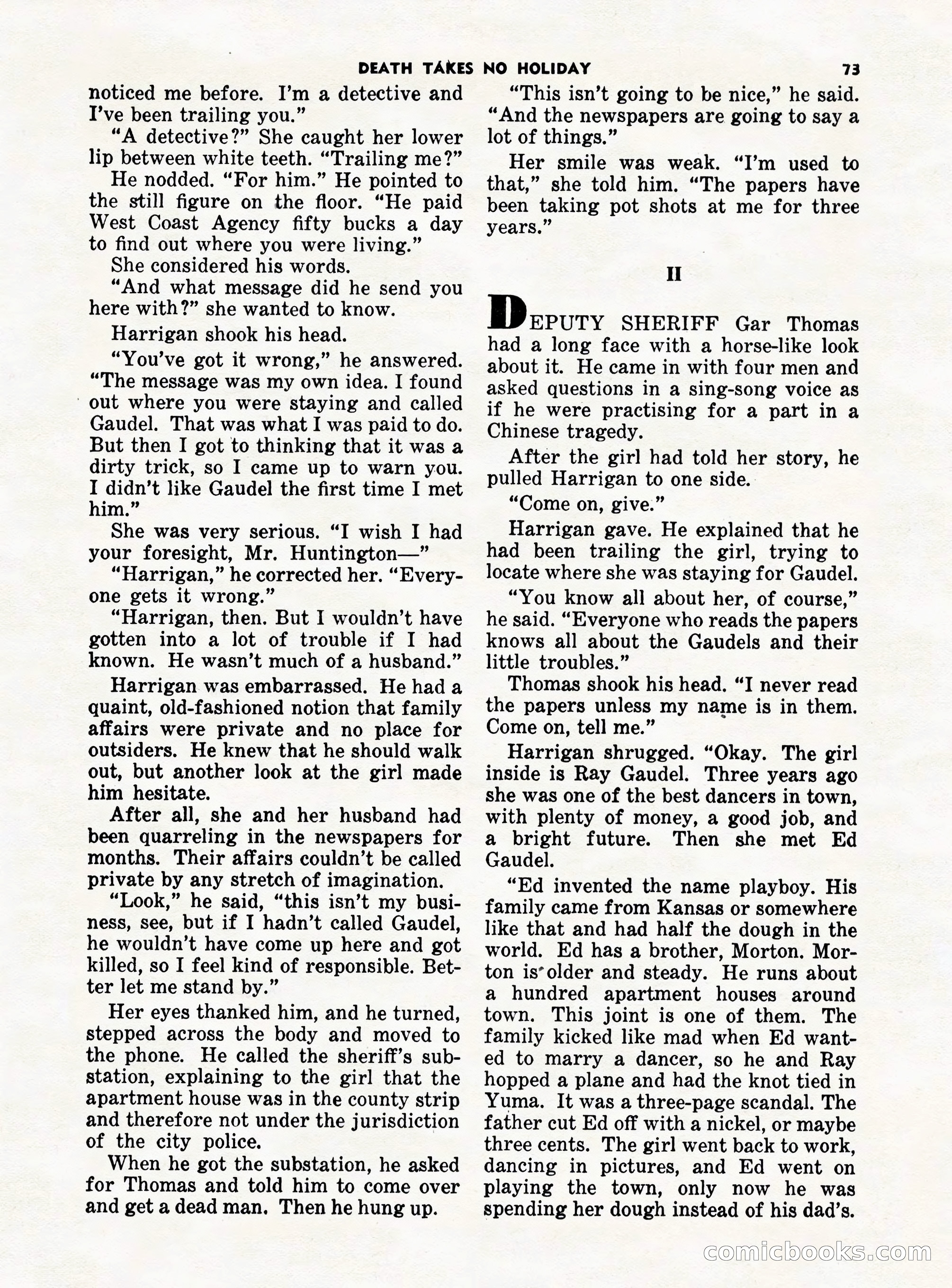
A restored page from Pulp Fiction, 1952. Page through the whole issue in the reader above.
📄 Transcribed text from this page (OCR, searchable)
Machine-transcribed from the original scan — historical spelling and the odd misread are preserved.
DEATH TAKES NO HOLIDAY noticed me before. I’m a detective and I’ve been trailing you.” “A detective?” She caught her lower lip between white teeth. “Trailing me?” He nodded. “For him.” He pointed to the still figure on the floor. “He paid West Coast Agency fifty bucks a day to find out where you were living.” She considered his words. “And what message did he send you here with?” she wanted to know. Harrigan shook his head. “You’ve got it wrong,” he answered. “The message was my own idea. I found out where you were staying and called Gaudel. That was what I was paid to do. But then I got to thinking that it was a dirty trick, so I came up to warn you. I didn’t like Gaudel the first time I met him.” She was very serious. “I wish I had your foresight, Mr. Huntington—” “Harrigan,” he corrected her. “Every- one gets it wrong.” “Harrigan, then. But I wouldn’t have gotten into a lot of trouble if I had known. He wasn’t much of a husband.” Harrigan was embarrassed. He had a quaint, old-fashioned notion that family affairs were private and no place for outsiders. He knew that he should walk out, but another look at the girl made him hesitate. After all, she and her husband had been quarreling in the newspapers for months. Their affairs couldn’t be called private by any stretch of imagination. “Look,” he said, “this isn’t my busi- ness, see, but if I hadn’t called Gaudel, he wouldn’t have come up here and got killed, so I feel kind of responsible. Bet- ter let me stand by.” Her eyes thanked him, and he turned, stepped across the body and moved to the phone. He called the sheriff’s sub- station, explaining to the girl that the apartment house was in the county strip and therefore not under the jurisdiction of the city police. When he got the substation, he asked for Thomas and told him to come over and get a dead man. Then he hung up. 73 “This isn’t going to be nice,” he said. “And the newspapers are going to say a lot of things.” Her smile was weak. “I’m used to that,” she told him. “The papers have been taking pot shots at me for three years.” Il D EPUTY SHERIFF Gar Thomas had a long face with a horse-like look about it. He came in with four men and asked questions in a sing-song voice as if he were practising for a part in a Chinese tragedy. After the girl had told her story, he pulled Harrigan to one side. “Come on, give.” Harrigan gave. He explained that he had been trailing the girl, trying to locate where she was staying for Gaudel. “You know all about her, of course,” he said. “Everyone who reads the papers knows all about the Gaudels and their little troubles.” Thomas shook his head. “I never read the papers unless my name is in them. Come on, tell me.” Harrigan shrugged. “Okay. The girl inside is Ray Gaudel. Three years ago she was one of the best dancers in town, with plenty of money, a good job, and a bright future. Then she met Ed Gaudel. “Ed invented the name playboy. His family came from Kansas or somewhere like that and had half the dough in the world. Ed has a brother, Morton. Mor- ton is’older and steady. He runs about a hundred apartment houses around town. This joint is one of them. The family kicked like mad when Ed want- ed to marry a dancer, so he and Ray hopped a plane and had the knot tied in Yuma. It was a three-page scandal. The father cut Ed off with a nickel, or maybe three cents. The girl went back to work, dancing in pictures, and Ed went on playing the town, only now he was spending her dough instead of his dad’s. GOMmiGbooks