
Pulp Fiction, 1952 · page 126 of 132
5 Detective Novels Magazine Cover — page 126: what you’re looking at
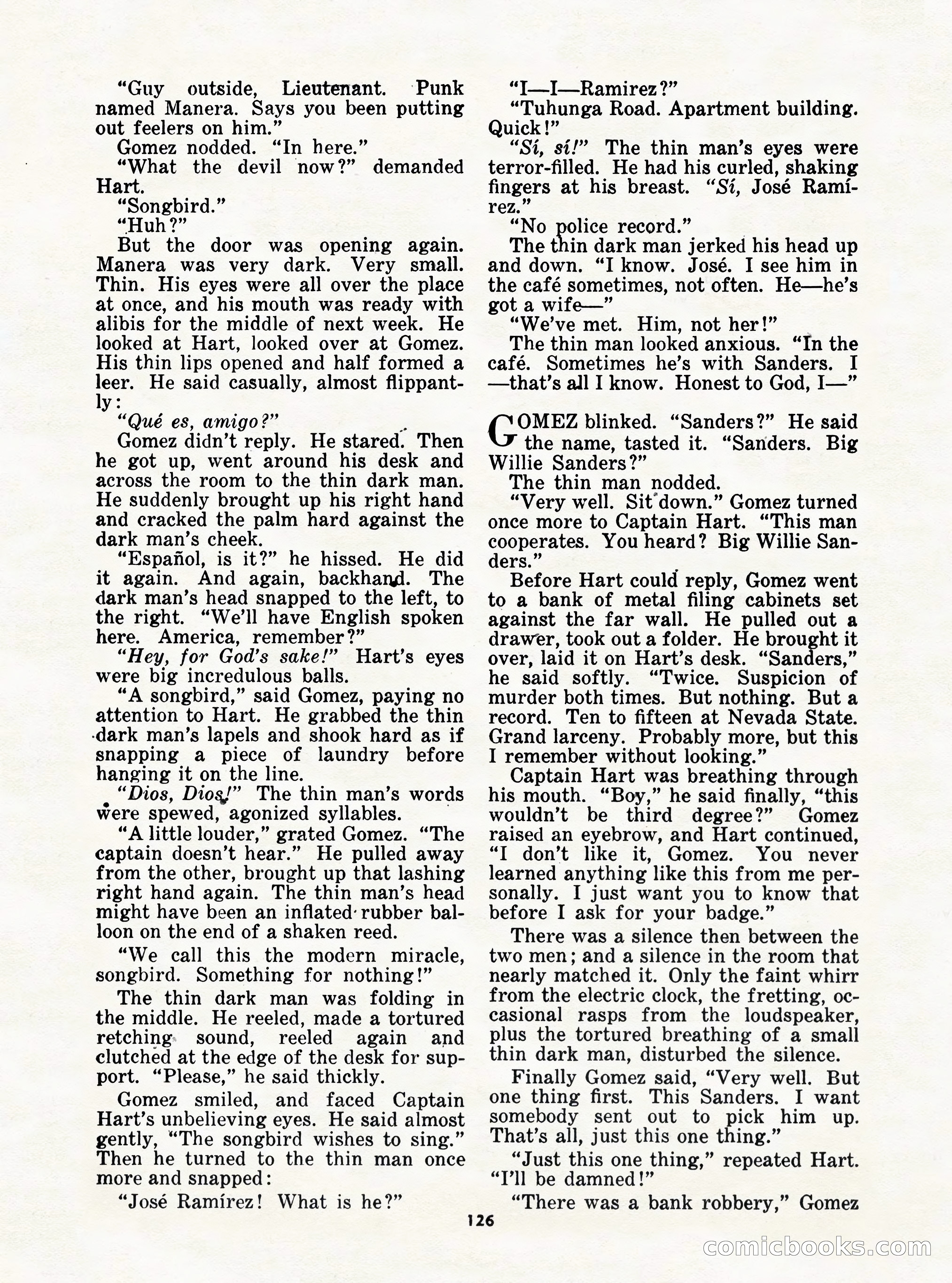
A restored page from Pulp Fiction, 1952. Page through the whole issue in the reader above.
📄 Transcribed text from this page (OCR, searchable)
Machine-transcribed from the original scan — historical spelling and the odd misread are preserved.
“Guy outside, Lieutenant. Punk named Manera. Says you been putting out feelers on him.” Gomez nodded. “In here.” “What the devil now?” Hart. “Songbird.” “Huh?” But the door was opening again. Manera was very dark. Very small. Thin. His eyes were all over the place at once, and his mouth was ready with alibis for the middle of next week. He looked at Hart, looked over at Gomez. His thin lips opened and half formed a leer. He said casually, almost flippant- demanded “Qué es, amigo?” Gomez didn’t reply. He stared. Then he got up, went around his desk and across the room to the thin dark man. He suddenly brought up his right hand and cracked the palm hard against the dark man’s cheek. “Espanol, is it?” he hissed. He did it again. And again, backhand. The dark man’s head snapped to the left, to the right. “We’ll have English spoken here. America, remember?” “Hey, for God’s sake!’ Hart’s eyes were big incredulous balls. “A songbird,” said Gomez, paying no attention to Hart. He grabbed the thin -dark man’s lapels and shook hard as if snapping a piece of laundry before hanging it on the line. “Dios, Dios!” The thin man’s words were spewed, agonized syllables. “A little louder,” grated Gomez. “The captain doesn’t hear.” He pulled away from the other, brought up that lashing right hand again. The thin man’s head might have been an inflated: rubber bal- loon on the end of a shaken reed. “We call this the modern miracle, songbird. Something for nothing!” The thin dark man was folding in the middle. He reeled, made a tortured retching. sound, reeled again and clutched at the edge of the desk for sup- port. “Please,” he said thickly. Gomez smiled, and faced Captain Hart’s unbelieving eyes. He said almost gently, “The songbird wishes to sing.” Then he turned to the thin man once more and snapped: “José Ramirez! What is he?” “{—_I—-Ramirez?” “Tuhunga Road. Apartment building. Quick!” “Si, si!’ The thin man’s eyes were terror-filled. He had his curled, shaking fingers at his breast. “Si, José Rami- rez.” “No police record.” The thin dark man jerked his head up and down. “I know. José. I see him in the café sometimes, not often. He—he’s got a wife—” “We've met. Him, not her!” The thin man looked anxious. “In the café. Sometimes he’s with Sanders. I —that’s all I know. Honest to God, I—” OMEZ blinked. “Sanders?” He said the name, tasted it. “Sanders. Big Willie Sanders?” The thin man nodded. “Very well. Sit down.” Gomez turned once more to Captain Hart. “This man coop ee You heard? Big Willie San- ers.” Before Hart could reply, Gomez went to a bank of metal filing cabinets set against the far wall. He pulled out a drawer, took out a folder. He brought it over, laid it on Hart’s desk. “San ers,” he said softly. “Twice. Suspicion of murder both times. But nothing. But a record. Ten to fifteen at Nevada State. Grand larceny. Probably more, but this I remember without looking.” Captain Hart was breathing through his mouth. “Boy,” he said finally, “this wouldn’t be third degree?” Gomez raised an eyebrow, and Hart continued, “IT don’t like it, Gomez. You never learned anything like this from me per- sonally. I just want you to know that before I ask for your badge.” There was a silence then between the two men; and a silence in the room that nearly matched it. Only the faint whirr from the electric clock, the fretting, oc- casional rasps from the loudspeaker, plus the tortured breathing of a small thin dark man, disturbed the silence. Finally Gomez said, “Very well. But one thing first. This Sanders. I want somebody sent out to pick him up. That’s all, just this one thing.” “Just this one thing,” repeated Hart. “T’ll be damned!” “There was a bank robbery,” Gomez 126 CoOnniclooo SH (C(O) mM