
Pulp Fiction, 1952 · page 29 of 132
5 Detective Novels Magazine Cover — page 29: what you’re looking at
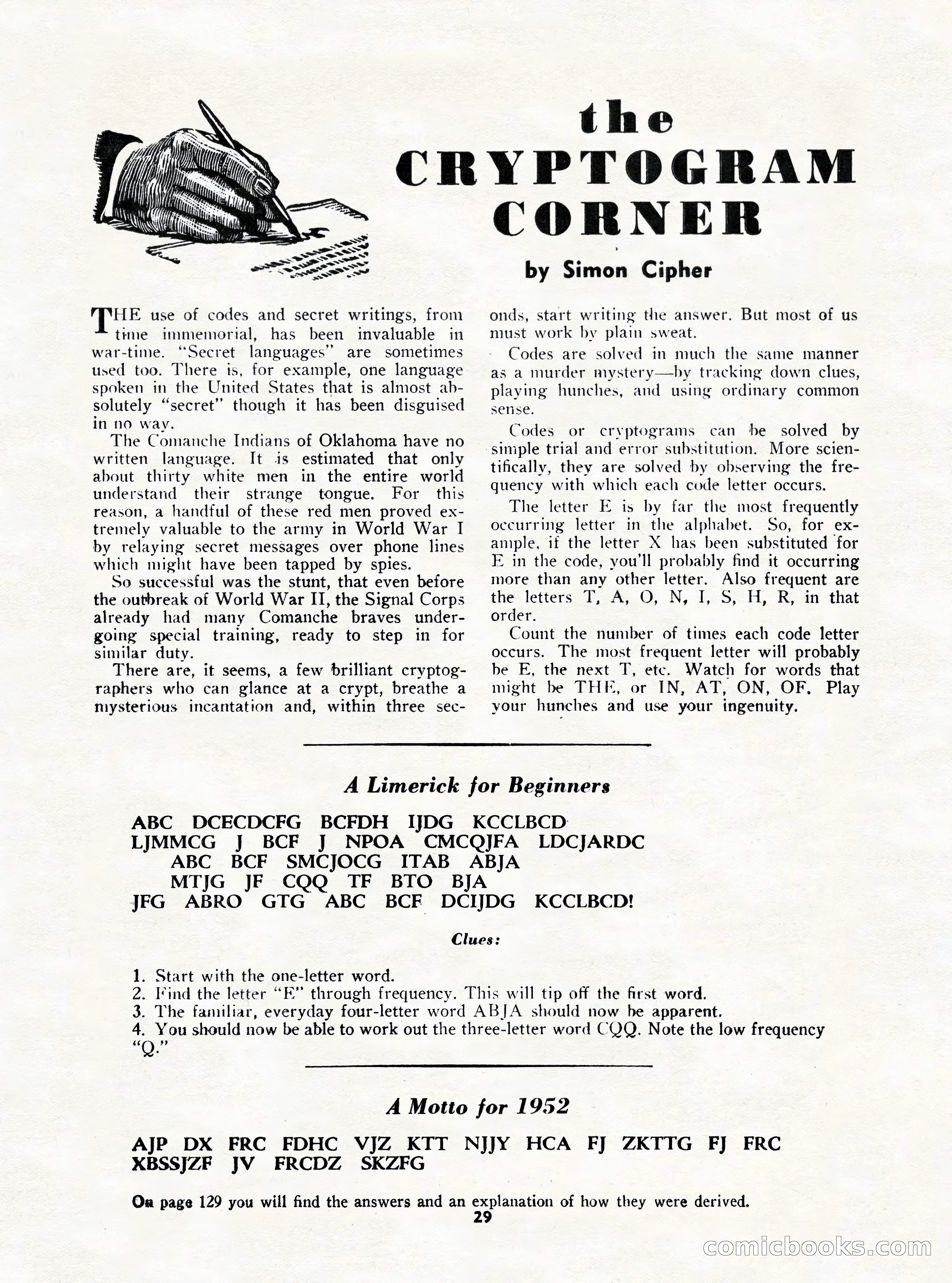
A restored page from Pulp Fiction, 1952. Page through the whole issue in the reader above.
📄 Transcribed text from this page (OCR, searchable)
Machine-transcribed from the original scan — historical spelling and the odd misread are preserved.
nf a WN HE use of codes and secret writings, from time immemorial, has been invaluable in war-time. “Secret languages’ are sometimes used too. There ts, for example, one language spoken in the United States that is almost ab- solutely “secret’’ though it has been disguised in no way. The Comanche Indians of Oklahoma have no written language. It is estimated that only about thirty white men in the entire world understand their strange tongue. For this reason, a handful of these red men proved ex- tremely valuable to the army in World War I by relaying secret messages over phone lines which might have been tapped by spies. So successful was the stunt, that even before the outbreak of World War II, the Signal Corps already had many Comanche braves under- going special training, ready to step in for similar duty. There are, it seems, a few brilliant cryptog- raphers who can glance at a crypt, breathe a mysterious incantation and, within three sec- CRYPTOGRAM the CORNER by Simon Cipher onds, start writing the answer. But most of us must work by plain sweat. Codes are solved in much the same manner as a murder mystery—by tracking down clues, playing hunches, and using ordinary common sense. Codes or cryptograms can be solved by simple trial and error substitution. More scien- tically, they are solved by observing the fre- quency with which each code letter occurs. The letter E is by far the most frequently occurring letter in the alphabet. So, for ex- ample, if the letter X has been substituted for FE in the code, you'll probably find it occurring more than any other letter. Also frequent are the letters T, A, O, N, I, S, H, R, in that order. Count the number of times each code letter occurs. The most frequent letter will probably be E, the next T, etc. Watch for words that might be THE, or IN, AT, ON, OF. Play vour hunches and use your ingenuity. A Limerick for Beginners ABC DCECDCFG BCFDH IJDG KCCLBCD LIMMCG J BCE J NPOA CMCQJFA LDCJARDC ABC BCE SMCJOCG ITAB ABJA MTJG JE CQQ TF BIO BJA JFG ABRO GTG ABC BCF DCIJDG KCCLBCD! Clues: . Start with the one-letter word. shWN OC . lind the letter “E”’ through frequency. This will tip off the first word. . The familiar, everyday four-letter word ABJA should now be apparent. You should now be able to work out the three-letter word CQQ. Note the low frequency A Motto for 1952 AJP DX FRC FDHC VJZ KTT NJJY HCA FJ ZKTTG FJ FRC XBSSJZF JV FRCDZ SKZFG Oa page 129 you will find the answers and an explanation of how they were derived. 29 CONMUC NOOO S (C(O)