
Pulp Fiction, 1952 · page 32 of 132
5 Detective Novels Magazine Cover — page 32: what you’re looking at
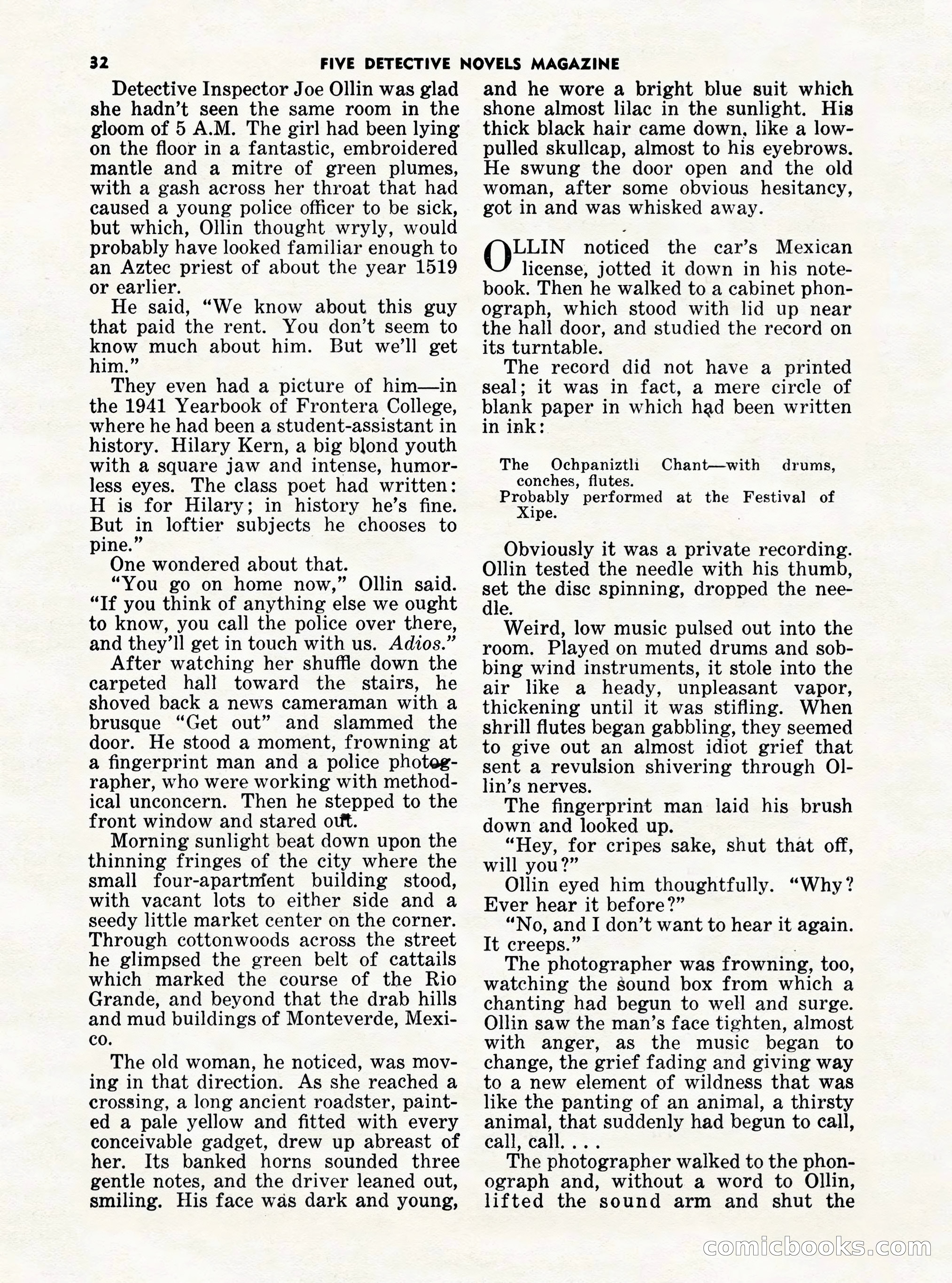
A restored page from Pulp Fiction, 1952. Page through the whole issue in the reader above.
📄 Transcribed text from this page (OCR, searchable)
Machine-transcribed from the original scan — historical spelling and the odd misread are preserved.
32 Detective Inspector Joe Ollin was glad she hadn’t seen the same room in the gloom of 5 A.M. The girl had been lying on the floor in a fantastic, embroidered mantle and a mitre of green plumes, with a gash across her throat that had caused a young police officer to be sick, but which, Ollin thought wryly, would probably have looked familiar enough to an Aztec priest of about the year 1519 or earlier. He said, “We know about this guy that paid the rent. You don’t seem to know much about him. But we’ll get him.” They even had a picture of him—in the 1941 Yearbook of Frontera College, where he had been a student-assistant in history. Hilary Kern, a big blond youth with a square jaw and intense, humor- less eyes. The class poet had written: H is for Hilary; in history he’s fine. But in loftier subjects he chooses to pine.” One wondered about that. “You go on home now,” Ollin said. “If you think of anything else we ought to know, you call the police over there, and they’ll get in touch with us. Adios.” After watching her shuffle down the carpeted hall toward the stairs, he shoved back a news cameraman with a brusque “Get out” and slammed the door. He stood a moment, frowning at a fingerprint man and a police photeg- rapher, who were working with method- ical unconcern. Then he stepped to the front window and stared out. Morning sunlight beat down upon the thinning fringes of the city where the small four-apartnient building stood, with vacant lots to either side and a seedy little market center on the corner. Through cottonwoods across the street he glimpsed the green belt of cattails which marked the course of the Rio Grande, and beyond that the drab hills and mud buildings of Monteverde, Mexi- CO. The old woman, he noticed, was mov- ing in that direction. As she reached a crossing, a long ancient roadster, paint- ed a pale yellow and fitted with every conceivable gadget, drew up abreast of her. Its banked horns sounded three gentle notes, and the driver leaned out, smiling. His face was dark and young, FIVE DETECTIVE NOVELS MAGAZINE and he wore a bright blue suit which shone almost lilac in the sunlight. His thick black hair came down, like a low- pulled skullcap, almost to his eyebrows. He swung the door open and the old woman, after some obvious hesitancy, got in and was whisked away. LLIN noticed the car’s Mexican license, jotted it down in his note- book. Then he walked to a cabinet phon- ograph, which stood with lid up near the hall door, and studied the record on its turntable. The record did not have a printed seal; it was in fact, a mere circle of Hae paper in which had been written in ink: The Ochpaniztli conches, flutes. Probably performed at the Festival of Xipe. Chant—with drums, Obviously it was a private recording. Ollin tested the needle with his thumb, ah the disc spinning, dropped the nee- e. Weird, low music pulsed out into the room. Played on muted drums and sob- bing wind instruments, it stole into the air like a heady, unpleasant vapor, thickening until it was stifling. When shrill flutes began gabbling, they seemed to give out an almost idiot grief that sent a revulsion shivering through Ol- lin’s nerves. The fingerprint man laid his brush down and looked up. “Hey, for cripes sake, shut that off, will you?” Ollin eyed him thoughtfully. “Why? Ever hear it before?” “No, and I don’t want to hear it again. It creeps.” The photographer was frowning, too, watching the sound box from which a chanting had begun to well and surge. Ollin saw the man’s face tighten, almost with anger, as the music began to change, the grief fading and giving way to a new element of wildness that was like the panting of an animal, a thirsty animal, that suddenly had begun to call, €all “calb... The photographer walked to the phon- ograph and, without a word to Ollin, lifted the sound arm and shut the CoOnniclooo SJ (C(O) mM