
Pulp Fiction, 1952 · page 40 of 132
5 Detective Novels Magazine Cover — page 40: what you’re looking at
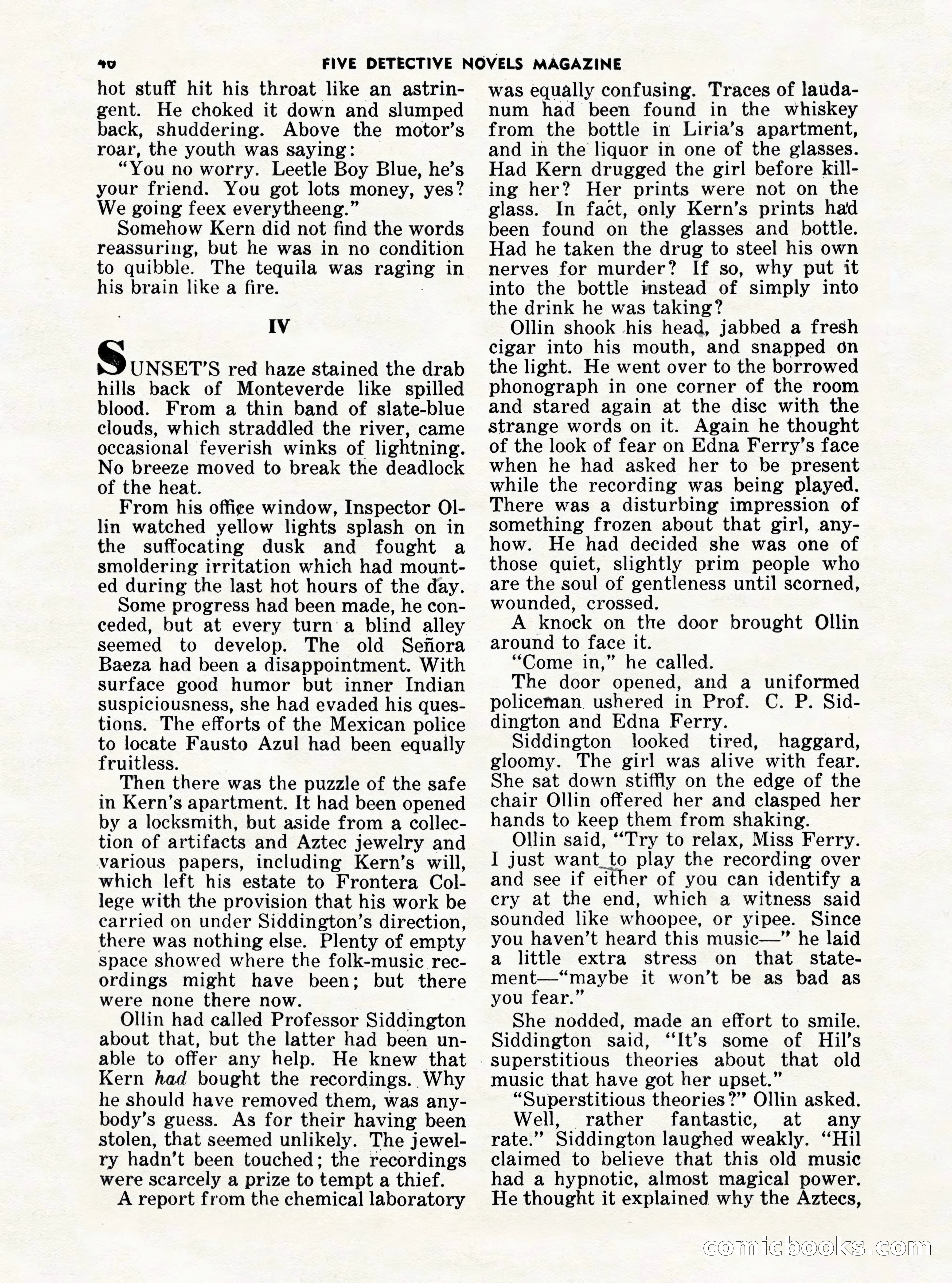
A restored page from Pulp Fiction, 1952. Page through the whole issue in the reader above.
📄 Transcribed text from this page (OCR, searchable)
Machine-transcribed from the original scan — historical spelling and the odd misread are preserved.
“4U hot stuff hit his throat like an astrin- gent. He choked it down and slumped back, shuddering. Above the motor’s roar, the youth was saying: “You no worry. Leetle Boy Blue, he’s your friend. You got lots money, yes? We going feex everytheeng.” Somehow Kern did not find the words reassuring, but he was in no condition to quibble. The tequila was raging in his brain like a fire. IV Sux SET’S red haze stained the drab hills back of Monteverde like spilled blood. From a thin band of slate-blue clouds, which straddled the river, came occasional feverish winks of lightning. No breeze moved to break the deadlock of the heat. From his office window, Inspector Ol- lin watched yellow lights splash on in the suffocating dusk and fought a smoldering irritation which had mount- ed during the last hot hours of the day. Some progress had been made, he con- ceded, but at every turn a blind alley seemed to develop. The old Senora Baeza had been a disappointment. With surface good humor but inner Indian suspiciousness, she had evaded his ques- tions. The efforts of the Mexican police to locate Fausto Azul had been equally fruitless. Then there was the puzzle of the safe in Kern’s apartment. It had been opened by a locksmith, but aside from a collec- tion of artifacts and Aztec jewelry and various papers, including Kern’s will, which left his estate to Frontera Col- lege with the provision that his work be carried on under Siddington’s direction, there was nothing else. Plenty of empty space showed where the folk-music rec- ordings might have been; but there were none there now. Ollin had called Professor Siddington about that, but the latter had been un- able to offer any help. He knew that Kern had bought the recordings. Why he should have removed them, was any- body’s guess. As for their having been stolen, that seemed unlikely. The jewel- ry hadn’t been touched; the recordings were scarcely a prize to tempt a thief. A report from the chemical laboratory FIVE DETECTIVE NOVELS MAGAZINE was equally confusing. Traces of lauda- num had been found in the whiskey from the bottle in Liria’s apartment, and in the liquor in one of the glasses. Had Kern drugged the girl before kill- ing her? Her prints were not on the glass. In fact, only Kern’s prints had been found on the glasses and bottle. Had he taken the drug to steel his own nerves for murder? If so, why put it into the bottle instead of simply into the drink he was taking? Ollin shook his head, jabbed a fresh cigar into his mouth, and snapped on the light. He went over to the borrowed phonograph in one corner of the room and stared again at the disc with the strange words on it. Again he thought of the look of fear on Edna Ferry’s face when he had asked her to be present while the recording was being played. There was a disturbing impression of something frozen about that girl, any- how. He had decided she was one of those quiet, slightly prim people who are the soul of gentleness until scorned, wounded, crossed. A knock on the door brought Ollin around to face it. “Come in,” he called. The door opened, and a uniformed policeman. ushered in Prof. C. P. Sid- dington and Edna Ferry. Siddington looked tired, haggard, gloomy. The girl was alive with fear. She sat down stiffly on the edge of the chair Ollin offered her and clasped her hands to keep them from shaking. Ollin said, “Try to relax, Miss Ferry. I just want_to play the recording over and see if either of you can identify a cry at the end, which a witness said sounded like whoopee, or yipee. Since you haven’t heard this music—” he laid a little extra stress on that state- ment—“maybe it won’t be as bad as you fear.” She nodded, made an effort to smile. Siddington said, “It’s some of Hil’s superstitious theories about that old music that have got her upset.” “Superstitious theories?” Ollin asked. Well, rather fantastic, at any rate.” Siddington laughed weakly. “Hil claimed to believe that this old music had a hypnotic, almost magical power. He thought it explained why the Aztecs, AMICLOOO@ (CO) SJ (C(O) mM