
Pulp Fiction, 1952 · page 51 of 132
5 Detective Novels Magazine Cover — page 51: what you’re looking at
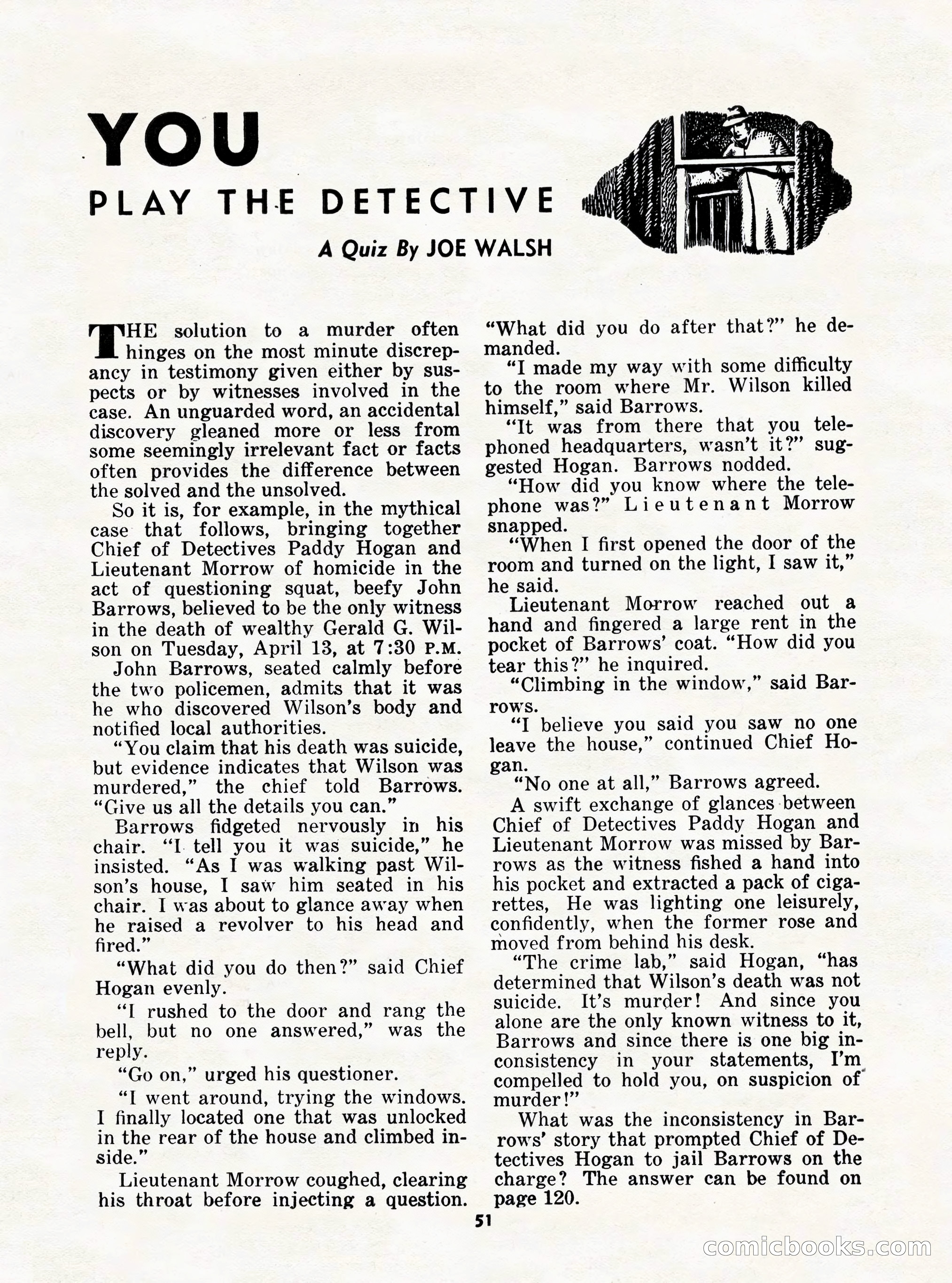
A restored page from Pulp Fiction, 1952. Page through the whole issue in the reader above.
📄 Transcribed text from this page (OCR, searchable)
Machine-transcribed from the original scan — historical spelling and the odd misread are preserved.
YOU PLAY THE DETECTIVE A Quiz By JOE WALSH HE solution to a murder often hinges on the most minute discrep- ancy in testimony given either by sus- pects or by witnesses involved in the case. An unguarded word, an accidental discovery gleaned more or less from some seemingly irrelevant fact or facts often provides the difference between the solved and the unsolved. So it is, for example, in the mythical case that follows, bringing together Chief of Detectives Paddy Hogan and Lieutenant Morrow of homicide in the act of questioning squat, beefy John Barrows, believed to be the only witness in the death of wealthy Gerald G. Wil- son on Tuesday, April 13, at 7:30 P.M. John Barrows, seated calmly before the two policemen, admits that it was he who discovered Wilson’s body and notified local authorities. “You claim that his death was suicide, but evidence indicates that Wilson was murdered,” the chief told Barrows. “Give us all the details you can.” Barrows fidgeted nervously in his chair. “I. tell you it was suicide,” he insisted. “As I was walking past Wil- son’s house, I saw him seated in his chair. I was about to glance away when he raised a revolver to his head and fired.” “What did you do then?” said Chief Hogan evenly. “T rushed to the door and rang the bell, but no one answered,” was the reply. “Go on,” urged his questioner. “IT went around, trying the windows. I finally located one that was unlocked in the rear of the house and climbed in- side.” Lieutenant Morrow coughed, clearing his throat before injecting a question. 51 SSSA ~~~ SW SN MYO To == SSS = ~ 4 417 AY ‘ll! Vai G44 / rt} nS AS ae f= gs “What did you do after that?’ he de- manded. “I made my way with some difficulty to the room where Mr. Wilson killed himself,” said Barrows. “It was from there that you tele- phoned headquarters, wasn’t it?” sug- gested Hogan. Barrows nodded. “How did you know where the tele- phone was?” Lieutenant Morrow snapped. “When I first opened the door of the room and turned on the light, I saw it,” he said. Lieutenant Morrow reached out a hand and fingered a large rent in the pocket of Barrows’ coat. “How did you tear this?” he inquired. “Climbing in the window,” said Bar- rows. “IT believe you said you saw no one leave the house,” continued Chief Ho- gan. “No one at all,” Barrows agreed. A swift exchange of glances between Chief of Detectives Paddy Hogan and Lieutenant Morrow was missed by Bar- rows as the witness fished a hand into his pocket and extracted a pack of ciga- rettes, He was lighting one leisurely, confidently, when the former rose and moved from behind his desk. “The crime lab,” said Hogan, “has determined that Wilson’s death was not suicide. It’s murder! And since you alone are the only known witness to it, Barrows and since there is one big in- consistency in your statements, I’m compelled to hold you, on suspicion of murder!” What was the inconsistency in Bar- rows’ story that prompted Chief of De- tectives Hogan to jail Barrows on the charge? The answer can be found on page 120. OOO (CO) im S ©) (C(O) mM