
Pulp Fiction, 1952 · page 67 of 132
5 Detective Novels Magazine Cover — page 67: what you’re looking at
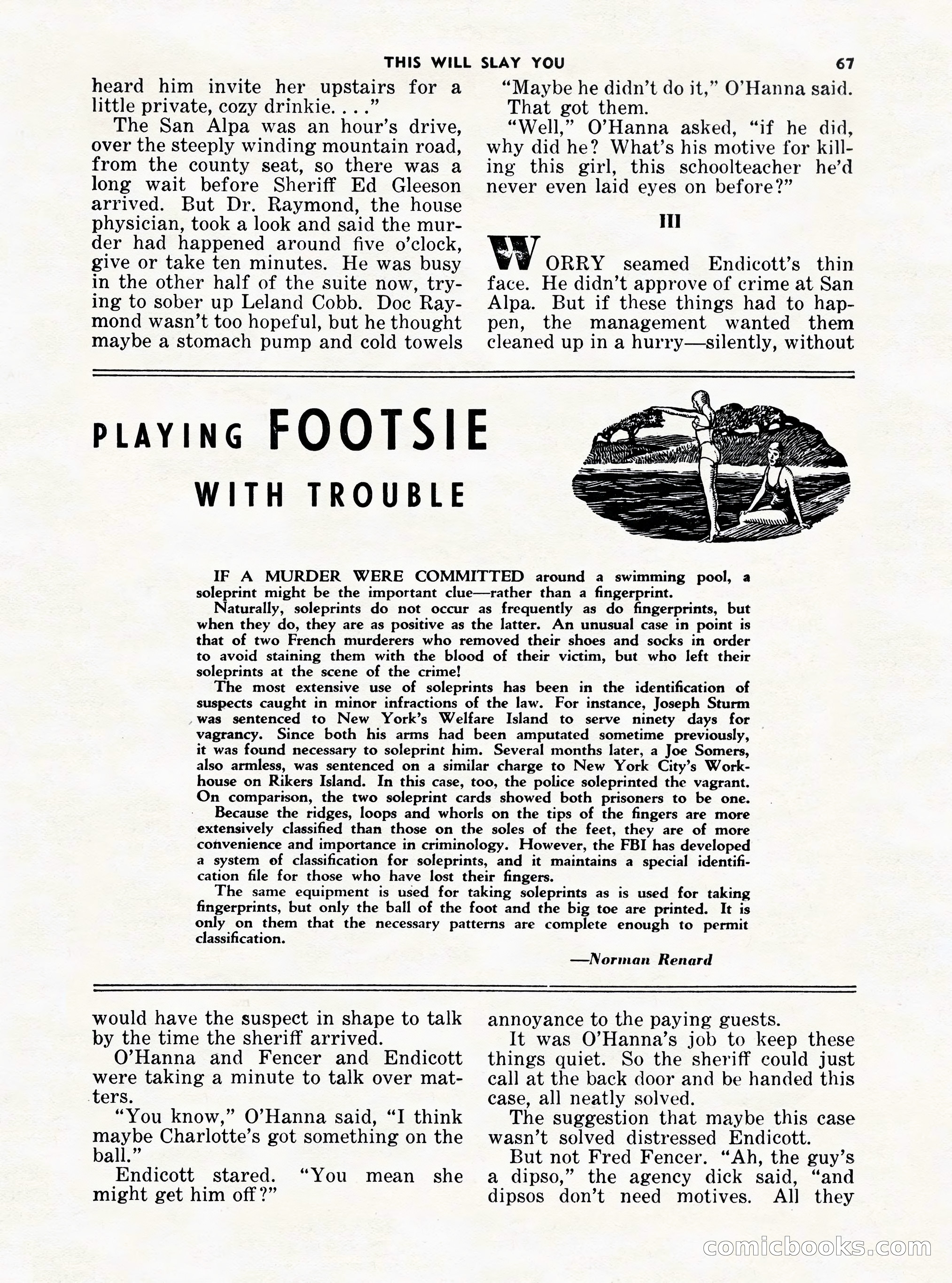
A restored page from Pulp Fiction, 1952. Page through the whole issue in the reader above.
📄 Transcribed text from this page (OCR, searchable)
Machine-transcribed from the original scan — historical spelling and the odd misread are preserved.
THIS WILL SLAY YOU heard him invite her upstairs for a little private, cozy drinkie....” The San Alpa was an hour’s drive, over the steeply winding mountain road, from the county seat, so there was a long wait before Sheriff Ed Gleeson arrived. But Dr. Raymond, the house physician, took a look and said the mur- der had happened around five o’clock, give or take ten minutes. He was busy in the other half of the suite now, try- ing to sober up Leland Cobb. Doc Ray- mond wasn’t too hopeful, but he thought maybe a stomach pump and cold towels 67 “Maybe he didn’t do it,” O’Hanna said. That got them. “Well,” O’Hanna asked, “if he did, why did he? What’s his motive for kill- ing this girl, this schoolteacher he’d never even laid eyes on before?” iil WW ORRY seamed Endicott’s thin face. He didn’t approve of crime at San Alpa. But if these things had to hap- pen, the management wanted them cleaned up in a hurry—silently, without pLtaYinc FOOTSIE WITH TROUBLE IF A MURDER WERE COMMITTED around a swimming pool, a soleprint might be the important clue—rather than a fingerprint. Naturally, soleprints do not occur as frequently as do fingerprints, but when they do, they are as positive as the latter. An unusual case in point is that of two French murderers who removed their shoes and socks in order to avoid staining them with the blood of their victim, but who left their soleprints at the scene of the crime! The most extensive use of soleprints has been in the identification of suspects caught in minor infractions of the law. For instance, Joseph Sturm -was sentenced to New York’s Welfare Island to serve ninety days for vagrancy. Since both his arms had been amputated sometime previously, it was found necessary to soleprint him. Several months later, a Joe Somers, also armless, was sentenced on a similar charge to New York City’s Work- house on Rikers Island. In this case, too, the police soleprinted the vagrant. On comparison, the two soleprint cards showed both prisoners to be one. Because the ridges, loops and whorls on the tips of the fingers are more extensively classified than those on the soles of the feet, they are of more cofivenience and importance in criminology. However, the FBI has developed a system of classification for soleprints, and it maintains a special identifi- cation file for those who have lost their fingers. The same equipment is used for taking soleprints as is used for taking fingerprints, but only the ball of the foot and the big toe are printed. It is only on them that the necessary patterns are complete enough to permit classification. —Norman Renard would have the suspect in shape to talk by the time the sheriff arrived. O’Hanna and Fencer and Endicott were taking a minute to talk over mat- ters. “You know,” O’Hanna said, “I think maybe Charlotte’s got something on the ball.” Endicott stared. might get him off?” “You mean. she annoyance to the paying guests. It was O’Hanna’s job to keep these things quiet. So the sheriff could just call at the back door and be handed this case, all neatly solved. The suggestion that maybe this case wasn’t solved distressed Endicott. But not Fred Fencer. “Ah, the guy’s a dipso,” the agency dick said, “and dipsos don’t need motives. All they MIG EO NOOKS (C(O)