
Pulp Fiction, 1952 · page 92 of 132
5 Detective Novels Magazine Cover — page 92: what you’re looking at
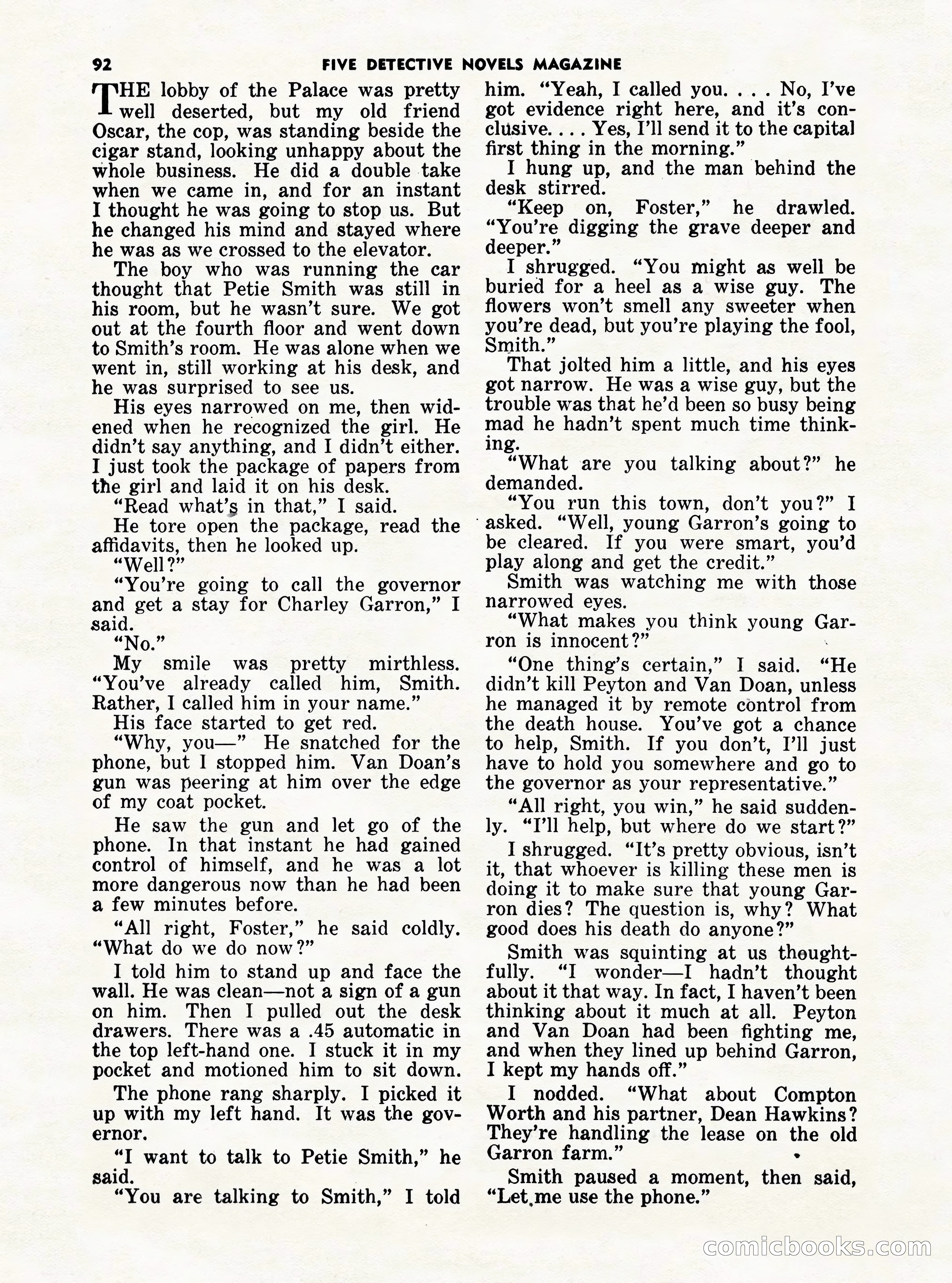
A restored page from Pulp Fiction, 1952. Page through the whole issue in the reader above.
📄 Transcribed text from this page (OCR, searchable)
Machine-transcribed from the original scan — historical spelling and the odd misread are preserved.
FIVE DETECTIVE NOVELS MAGAZINE 92 ghee lobby of the Palace was pretty well deserted, but my old friend Oscar, the cop, was standing beside the cigar stand, looking unhappy about the whole business. He did a double take when we came in, and for an instant I thought he was going to stop us. But he changed his mind and stayed where he was as we crossed to the elevator. The boy who was running the car thought that Petie Smith was still in his room, but he wasn’t sure. We got out at the fourth floor and went down to Smith’s room. He was alone when we went in, still working at his desk, and he was surprised to see us. His eyes narrowed on me, then wid- ened when he recognized the girl. He didn’t say anything, and I didn’t either. I just took the package of papers from the girl and laid it on his desk. “Read what’s in that,” I said. He tore open the package, read the affidavits, then he looked up. “You’re going to call the governor and get a stay for Charley Garron,” I said. “No.” My smile was pretty mirthless. “You’ve already called him, Smith. Rather, I called him in your name.” His face started to get red. “Why, you—” He snatched for the phone, but I stopped him. Van Doan’s gun was peering at him over the edge of my coat pocket. He saw the gun and let go of the phone. In that instant he had gained control of himself, and he was a lot more dangerous now than he had been a few minutes before. “All right, Foster,” he said coldly. “What do we do now 2?” I told him to stand up and face the wall. He was clean—not a sign of a gun on him. Then I pulled out the desk drawers. There was a .45 automatic in the top left-hand one. I stuck it in my pocket and motioned him to sit down. The phone rang sharply. I picked it up with my left hand. It was the gov- ernor. “I want to talk to Petie Smith,” he said. “You are talking to Smith,” I told him. “Yeah, I called you. ... No, I’ve got evidence right here, and it’s con- clusive. ... Yes, I’ll send it to the capital first thing in the morning.” I hung up, and the man behind the desk stirred. “Keep on, Foster,” he drawled. “You’re digging the grave deeper and deeper.” I shrugged. “You might as well be buried for a heel as a wise guy. The flowers won’t smell any sweeter when you're dead, but you’re playing the fool, Smith.” That jolted him a little, and his eyes got narrow. He was a wise guy, but the trouble was that he’d been so busy being mad he hadn’t spent much time think- ing. “What are you talking about?” he demanded. “You run this town, don’t you?” I ‘asked. “Well, young Garron’s going to be cleared. If you were smart, you’d play along and get the credit.” Smith was watching me with those narrowed eyes. “What makes you think young Gar- ron is innocent?” “One thing’s certain,” I said. “He didn’t kill Peyton and Van Doan, unless he managed it by remote control from the death house. You’ve got a chance to help, Smith. If you don’t, I’ll just have to hold you somewhere and go to the governor as your representative.” “All right, you win,” he said sudden- ly. “I'll help, but where do we start?” I shrugged. “It’s pretty obvious, isn’t it, that whoever is killing these men is doing it to make sure that young Gar- ron dies? The question is, why? What good does his death do anyone?” Smith was squinting at us theught- fully. “I wonder—I hadn’t thought about it that way. In fact, I haven’t been thinking about it much at all. Peyton and Van Doan had been fighting me, and when they lined up behind Garron, I kept my hands off.” I nodded. “What about Compton Worth and his partner, Dean Hawkins? They’re handling the lease on the old Garron farm.” ° Smith paused a moment, then said, “Let,me use the phone.” COMmMiICcloooe (”) SJ (CO) mM