
Pulp Fiction, 1953 · page 124 of 132
5 Detective Novels Magazine Cover — page 124: what you’re looking at
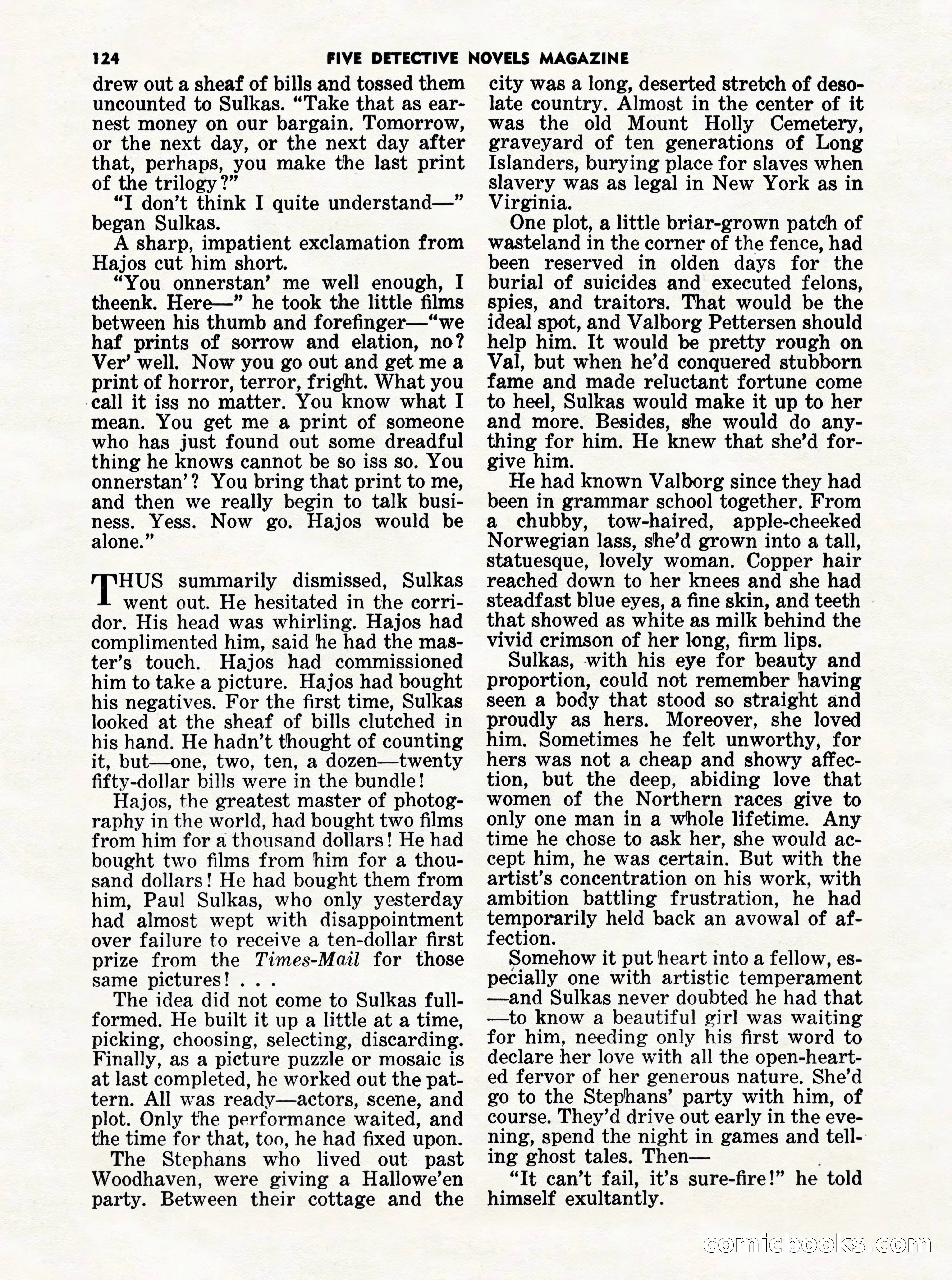
A restored page from Pulp Fiction, 1953. Page through the whole issue in the reader above.
📄 Transcribed text from this page (OCR, searchable)
Machine-transcribed from the original scan — historical spelling and the odd misread are preserved.
124 drew out a sheaf of bills and tossed them uncounted to Sulkas. “Take that as ear- nest money on our bargain. Tomorrow, or the next day, or the next day after that, perhaps, you make the last print of the trilogy ?” “IT don’t think I quite understand—” began Sulkas. A sharp, impatient exclamation from Hajos cut him short. “You onnerstan’ me well enough, I theenk. Here—” he took the little films between his thumb and forefinger—“we haf prints of sorrow and elation, no? Ver’ well. Now you go out and get me a print of horror, terror, fright. What you -eall it iss no matter. You know what I mean. You get me a print of someone who has just found out some dreadful thing he knows cannot be so iss so. You onnerstan’? You bring that print to me, and then we really begin to talk busi- ness. Yess. Now go. Hajos would be alone.” f summarily dismissed, Sulkas went out. He hesitated in the corri- dor. His head was whirling. Hajos had complimented him, said he had the mas- ter’s touch. Hajos had commissioned him to take a picture. Hajos had bought his negatives. For the first time, Sulkas looked at the sheaf of bills clutched in his hand. He hadn’t thought of counting it, but—one, two, ten, a dozen—twenty fifty-dollar bills were in the bundle! Hajos, the greatest master of photog- raphy in the world, had bought two films from him for a thousand dollars! He had bought two films from him for a thou- sand dollars! He had bought them from him, Paul Sulkas, who only yesterday had almost wept with disappointment over failure to receive a ten-dollar first prize from the Times-Mail for those same pictures! . . The idea did not come to Sulkas full- formed. He built it up a little at a time, picking, choosing, selecting, discarding. Finally, as a picture puzzle or mosaic is at last completed, he worked out the pat- tern. All was ready—actors, scene, and plot. Only the performance waited, and the time for that, too, he had fixed upon. The Stephans who lived out past Woodhaven, were giving a Hallowe’en party. Between their cottage and the FIVE DETECTIVE NOVELS MAGAZINE city was a long, deserted stretch of deso- late country. Almost in the center of it was the old Mount Holly Cemetery, graveyard of ten generations of Long Islanders, burying place for slaves when slavery was as legal in New York as in Virginia. One plot, a little briar-grown patch of wasteland in the corner of the fence, had been reserved in olden days for the burial of suicides and executed felons, spies, and traitors. That would be the ideal spot, and Valborg Pettersen should help him. It would be pretty rough on Val, but when he’d conquered stubborn fame and made reluctant fortune come to heel, Sulkas would make it up to her and more. Besides, she would do any- thing for him. He knew that she’d for- give him. He had known Valborg since they had been in grammar school together. From a chubby, tow-haired, apple-cheeked Norwegian lass, she’d grown into a tall, statuesque, lovely woman. Copper hair reached down to her knees and she had steadfast blue eyes, a fine skin, and teeth | that showed as white as milk behind the vivid crimson of her long, firm lips. Sulkas, with his eye for beauty and proportion, could not remember having seen a body that stood so straight and proudly as hers. Moreover, she loved him. Sometimes he felt unworthy, for hers was not a cheap and showy affec- tion, but the deep, abiding love that women of the Northern races give to only one man in a whole lifetime. Any time he chose to ask her, she would ac- cept him, he was certain. But with the artist’s concentration on his work, with ambition battling frustration, he had temporarily held back an avowal of af- fection. Somehow it put heart into a fellow, es- pecially one with artistic temperament —and Sulkas never doubted he had that —to know a beautiful girl was waiting for him, needing only his first word to declare her love with all the open-heart- ed fervor of her generous nature. She’d go to the Stephans’ party with him, of course. They’d drive out early in the eve- ning, spend the night in games and tell-. ing ghost tales. Then— “It can’t fail, it’s sure-fire!” he told himself exultantly. GoMmililGebaoo (") S