
Pulp Fiction, 1953 · page 50 of 132
5 Detective Novels Magazine Cover — page 50: what you’re looking at
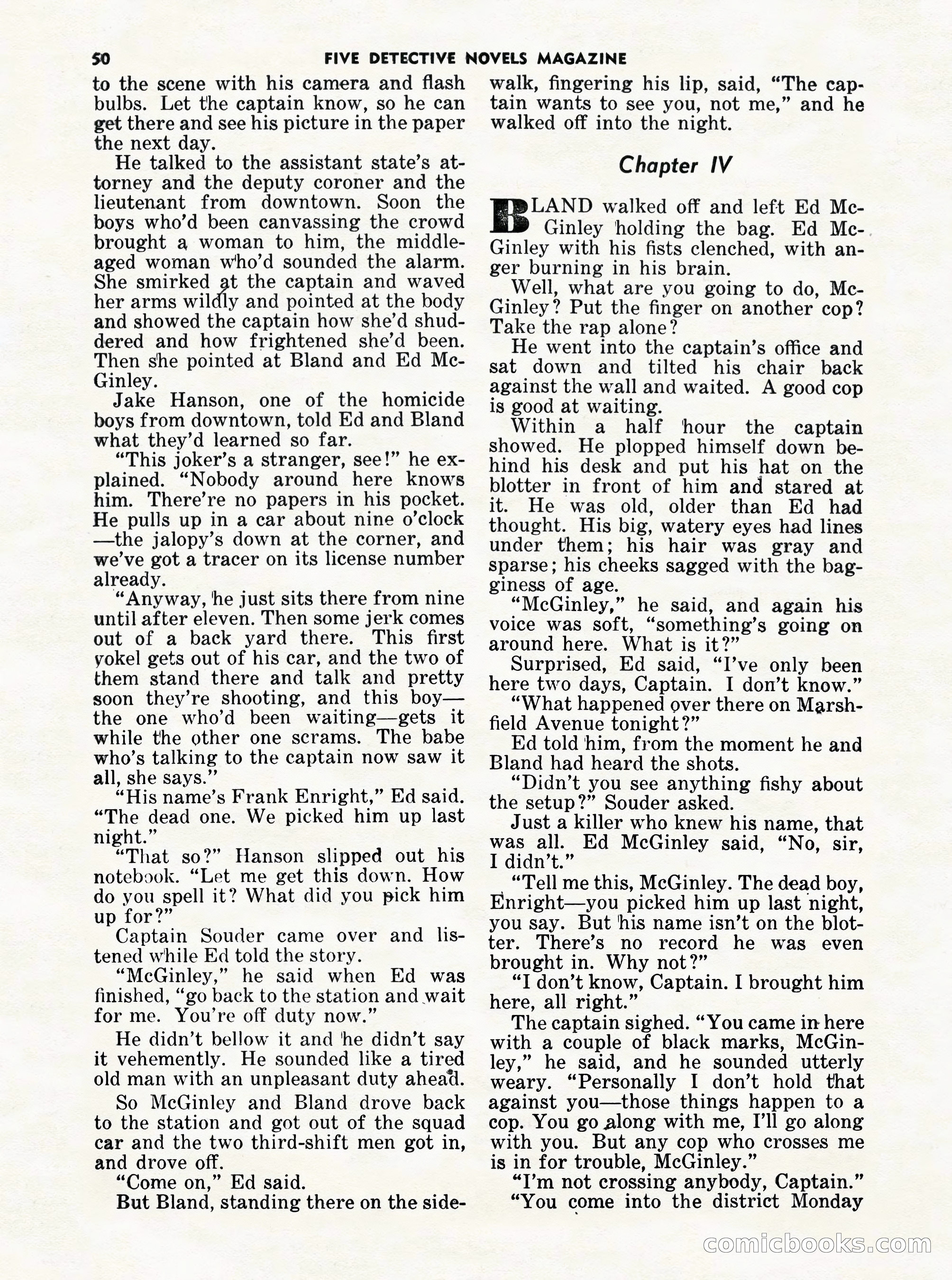
A restored page from Pulp Fiction, 1953. Page through the whole issue in the reader above.
📄 Transcribed text from this page (OCR, searchable)
Machine-transcribed from the original scan — historical spelling and the odd misread are preserved.
$0 to the scene with his camera and flash bulbs. Let the captain know, so he can get there and see his picture in the paper the next day. He talked to the assistant state’s at- torney and the deputy coroner and the lieutenant from downtown. Soon the boys who’d been canvassing the crowd brought a woman to him, the middle- aged woman who’d sounded the alarm. She smirked gt the captain and waved her arms ildiy and pointed at the body and showed che captain how she’d shud- dered and how frightened she’d been. Then she pointed at Bland and Ed Mce- Ginley. Jake Hanson, one of the homicide boys from downtown, told Ed and Bland what they’d learned so far. “This joker’s a stranger, see!” he ex- plained. “Nobody around here knows him. There’re no papers in his pocket. He pulls up in a car about nine o’clock —the jalopy’s down at the corner, and we've got a tracer on its license number already. “Anyway, he just sits there from nine until after eleven. Then some jerk comes out of a back yard there. This first yokel gets out of his car, and the two of them stand there and talk and pretty soon they’re shooting, and this boy— the one who’d been waiting—gets it while the other one scrams. The babe who’s talking to the captain now saw it all, she says.” “His name’s Frank Enright,” Ed said. “The dead one. We picked him up last night.” “That so?” Hanson slipped out his notebook. “Let me get this down. How do you spell it? What did you pick him up for?” Captain Souder came over and lis- tened while Ed told the story. “McGinley,” he said when Ed was finished, “go back to the station and wait for me. You're off duty now.” He didn’t bellow it and ‘he didn’t say it vehemently. He sounded like a tired old man with an unpleasant duty ahead. So McGinley and Bland drove back to the station and got out of the squad car and the two third-shift men got in, and drove off. “Come on,” Ed said. But Bland, standing there on the side- FIVE DETECTIVE NOVELS MAGAZINE walk, fingering his lip, said, “The cap- tain wants to see you, not me,” and he walked off into the night. Chapter IV LAND walked off and left Ed Mc- Ginley holding the bag. Ed Mc- Ginley with his fists clenched, with an- ger burning in his brain. Well, what are you going to do, Mc- Ginley? Put the finger on another cop? Take the rap alone? He went into the captain’s office and sat down and tilted his chair back against the wall and waited. A good cop is good at waiting. Within a half hour the captain showed. He plopped himself down be- hind his desk and put his hat on the blotter in front of him and stared at it. He was old, older than Ed had thought. His big, watery eyes had lines under them; his hair was gray and sparse ; his cheeks sagged with the bag- giness of age. “McGinley,” he said, and again his voice was soft, “something’s going on around here. What is it?” Surprised, Ed said, “I’ve only been here two days, Captain. I don’t know.” “What happened over there on Marsh- field Avenue tonight?” Ed told him, from the moment he and Bland had heard the shots. “Didn’t you see anything fishy about the setup?” Souder asked. Just a killer who knew his name, that was all. Ed McGinley said, “No, sir, I didn’t.” “Tell me this, McGinley. The dead boy, Enright—you picked him up last night, you say. But his name isn’t on the blot- ter. There’s no record he was even brought in. Why not?” “I don’t know, Captain. I brought him here, all right.” The captain sighed. “You came in here with a couple of black marks, McGin- ley,” he said, and he sounded utterly weary. “Personally I don’t hold that against you—those things happen to a cop. You go along with me, I’ll go along with you. But any cop who crosses me is in for trouble, McGinley.” “I’m not crossing anybody, Captain.” “You come into the district Monday AMICLOOO S (C(O) (C(O)