
Pulp Fiction, 1953 · page 55 of 132
5 Detective Novels Magazine Cover — page 55: what you’re looking at
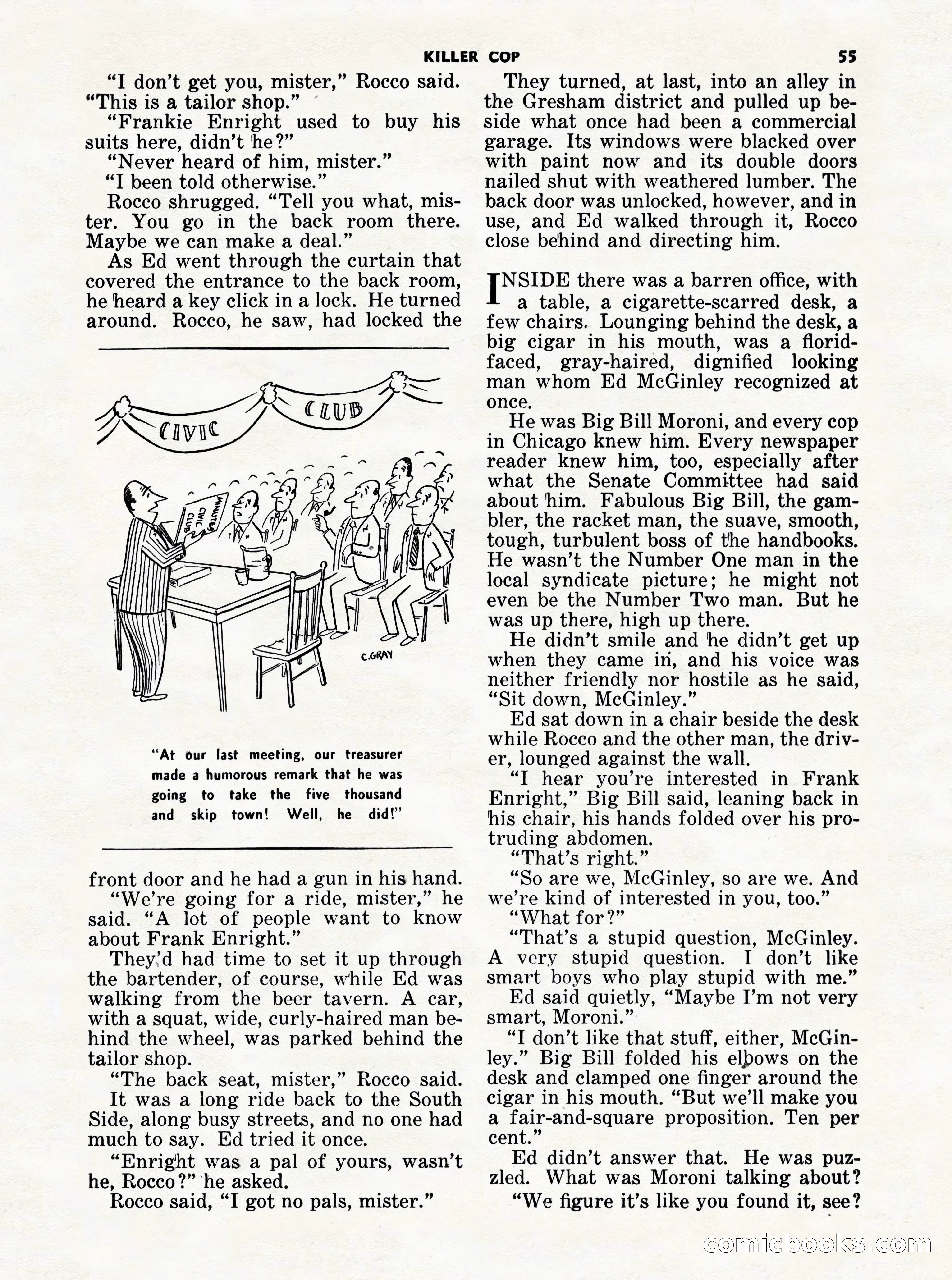
A restored page from Pulp Fiction, 1953. Page through the whole issue in the reader above.
📄 Transcribed text from this page (OCR, searchable)
Machine-transcribed from the original scan — historical spelling and the odd misread are preserved.
KILLER COP “I don’t get you, mister,” Rocco said. “This is a tailor shop.” “Frankie Enright used to buy his suits here, didn’t he?” “Never heard of him, mister.” “I been told otherwise.” Rocco shrugged. “Tell you what, mis- ter. You go in the back room there. Maybe we can make a deal.” As Ed went through the curtain that covered the entrance to the back room, he heard a key click in a lock. He turned around. Rocco, he saw, had locked the “At our last meeting, our treasurer made a humorous remark that he was going to take the five thousand and skip town! Well, he did!” front door and he had a gun in his hand. “We’re going for a ride, mister,” he said. “A lot of people want to know about Frank Enright.” They.d had time to set it up through the bartender, of course, while Ed was walking from the beer tavern. A car, with a squat, wide, curly-haired man be- hind the wheel, was parked behind the tailor shop. “The back seat, mister,” Rocco said. It was a long ride back to the South Side, along busy streets, and no one had much to say. Ed tried it once. “Enright was a pal of yours, wasn’t he, Rocco?” he asked. Rocco said, “I got no pals, mister.” 35 They turned, at last, into an alley in the Gresham district and pulled up be- side what once had been a commercial garage. Its windows were blacked over with paint now and its double doors nailed shut with weathered lumber. The back door was unlocked, however, and in use, and Ed walked through it, Rocco close behind and directing him. NSIDE there was a barren office, with a table, a cigarette-scarred desk, a few chairs. Lounging behind the desk, a big cigar in his mouth, was a florid- faced, gray-haired, dignified looking man whom Ed McGinley recognized at once. He was Big Bill Moroni, and every cop in Chicago knew him. Every newspaper reader knew him, too, especially after what the Senate Committee had said about ‘him. Fabulous Big Bill, the gam- bler, the racket man, the suave, smooth, tough, turbulent boss of the handbooks. He wasn’t the Number One man in the local syndicate picture; he might not even be the Number Two man. But he was up there, high up there. He didn’t smile and he didn’t get up when they came in, and his voice was neither friendly nor hostile as he said, “Sit down, McGinley.” Ed sat down in a chair beside the desk while Rocco and the other man, the driv- er, lounged against the wall. “IT hear you’re interested in Frank Enright,” Big Bill said, leaning back in his chair, his hands folded over his pro- truding abdomen. “That’s right.” “So are we, McGinley, so are we. And we're kind of interested in you, too.” “What for?” : “That’s a stupid question, McGinley. A very stupid question. I don’t like smart boys who play stupid with me.” Ed said quietly, “Maybe I’m not very smart, Moroni.” “T don’t like that stuff, either, McGin- ley.” Big Bill folded his elbows on the desk and clamped one finger around the cigar in his mouth. “But we’ll make you a fair-and-square proposition. Ten per cent.” Ed didn’t answer that. He was puz- zled. What was Moroni talking about? “We figure it’s like you found it, see? CoOMmniclooo S (C(O)