
Pulp Fiction, 1953 · page 6 of 132
5 Detective Novels Magazine Cover — page 6: what you’re looking at
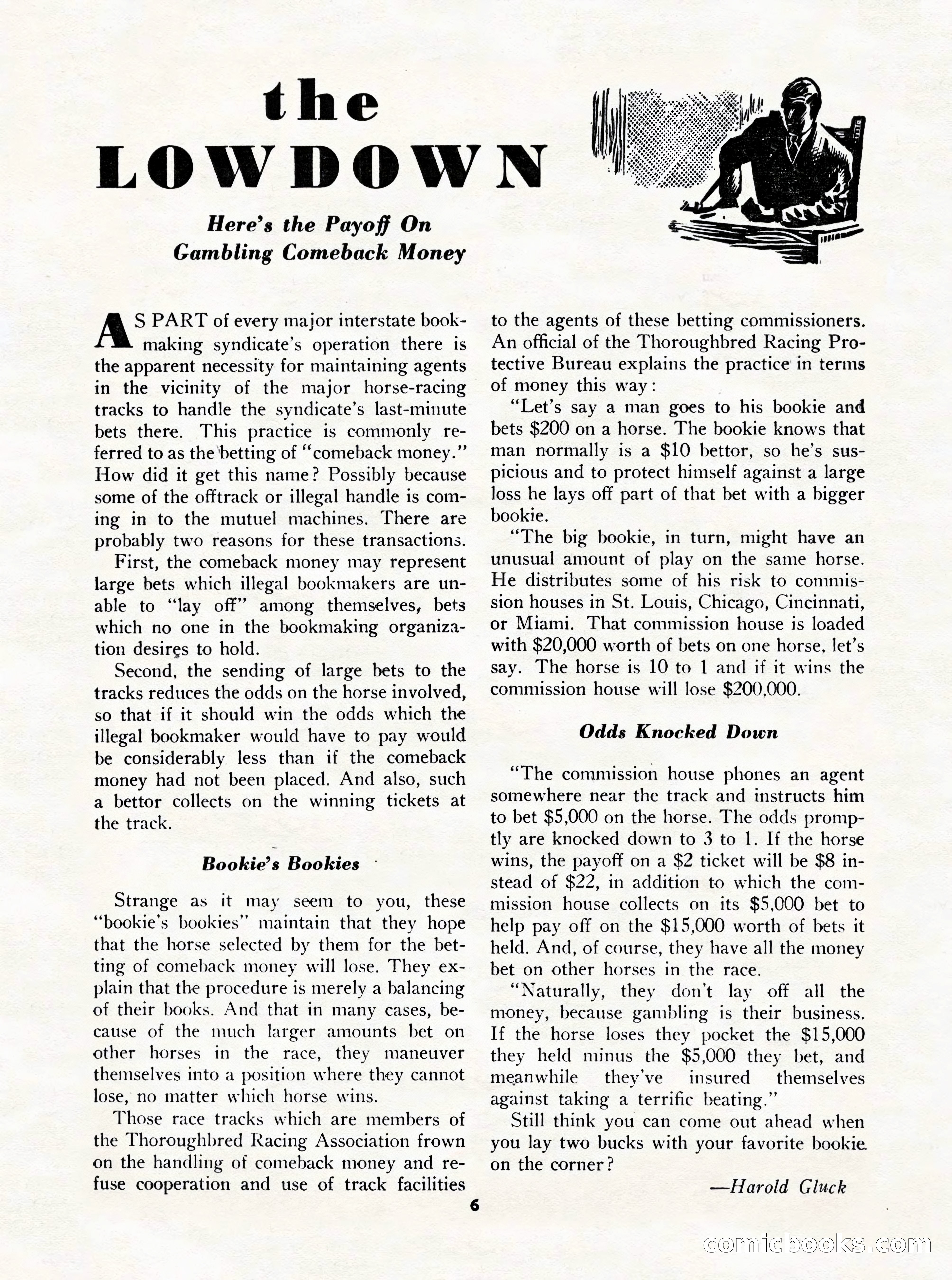
A restored page from Pulp Fiction, 1953. Page through the whole issue in the reader above.
📄 Transcribed text from this page (OCR, searchable)
Machine-transcribed from the original scan — historical spelling and the odd misread are preserved.
the LOWDOWN ° Here’s the Payoff On Gambling Comeback Money S PART of every major interstate book- making syndicate’s operation there is the apparent necessity for maintaining agents in the vicinity of the major horse-racing tracks to handle the syndicate’s last-minute bets there. This practice is commonly re- ferred to as the betting of “comeback money.”’ How did it get this name? Possibly because some of the offtrack or illegal handle is com- ing in to the mutuel machines. There are probably two reasons for these transactions. First, the comeback money may represent large bets which illegal bookmakers are un- able to “lay off” among themselves, bets which no one in the bookmaking organiza- tion desires to hold. Second, the sending of large bets to the tracks reduces the odds on the horse involved, so that if it should win the odds which the illegal bookmaker would have to pay would be considerably less than if the comeback money had not been placed. And also, such a bettor collects on the winning tickets at the track. Bookie’s Bookies Strange as it may seem to you, these “bookie’s bookies’’ maintain that they hope that the horse selected by them for the bet- ting of comeback money will lose. They ex- plain that the procedure is merely a balancing of their books. And that in many cases, be- cause of the much larger amounts bet on other horses in the race, they maneuver themselves into a position where they cannot lose, no matter which horse wins. Those race tracks which are members of the Thoroughbred Racing Association frown on the handling of comeback money and re- fuse cooperation and use of track facilities Se ————- =< ca Oe Og OF OO T ee, a Ce Oe MOOOCOO aS Br oe ee ORS ~ '. Se . s *, 3 ois wt . 2 ) te i) ° %° ey to the agents of these betting commissioners. An official of the Thoroughbred Racing Pro- tective Bureau explains the practice in terms of money this way: “Let’s say a man goes to his bookie and bets $200 on a horse. The bookie knows that man normally is a $10 bettor, so he’s sus- picious and to protect himself against a large loss he lays off part of that bet with a bigger bookie. “The big bookie, in turn, might have an unusual amount of play on the same horse. He distributes some of his risk to commis- sion houses in St. Louis, Chicago, Cincinnati, or Miami. That commission house is loaded with $20,000 worth of bets on one horse, let’s say. The horse is 10 to 1 and if it wins the commission house will lose $200,000. Odds Knocked Down “The commission house phones an agent somewhere near the track and instructs him to bet $5,000 on the horse. The odds promp- tly are knocked down to 3 to 1. If the horse wins, the payoff on a $2 ticket will be $8 in- stead of $22, in addition to which the com- mission house collects on its $5,000 bet to help pay off on the $15,000 worth of bets it held. And, of course, they have all the money bet on other horses in the race. “Naturally, they don't lay off all the money, because gambling is their business. If the horse loses they pocket the $15,000 they held minus the $5,000 they bet, and meanwhile they ve insured themselves against taking a terrific beating.”’ Still think you can come out ahead when you lay two bucks with your favorite bookie. on the corner? —RHarold Gluck (C@)