
Pulp Fiction, 1953 · page 60 of 132
5 Detective Novels Magazine Cover — page 60: what you’re looking at
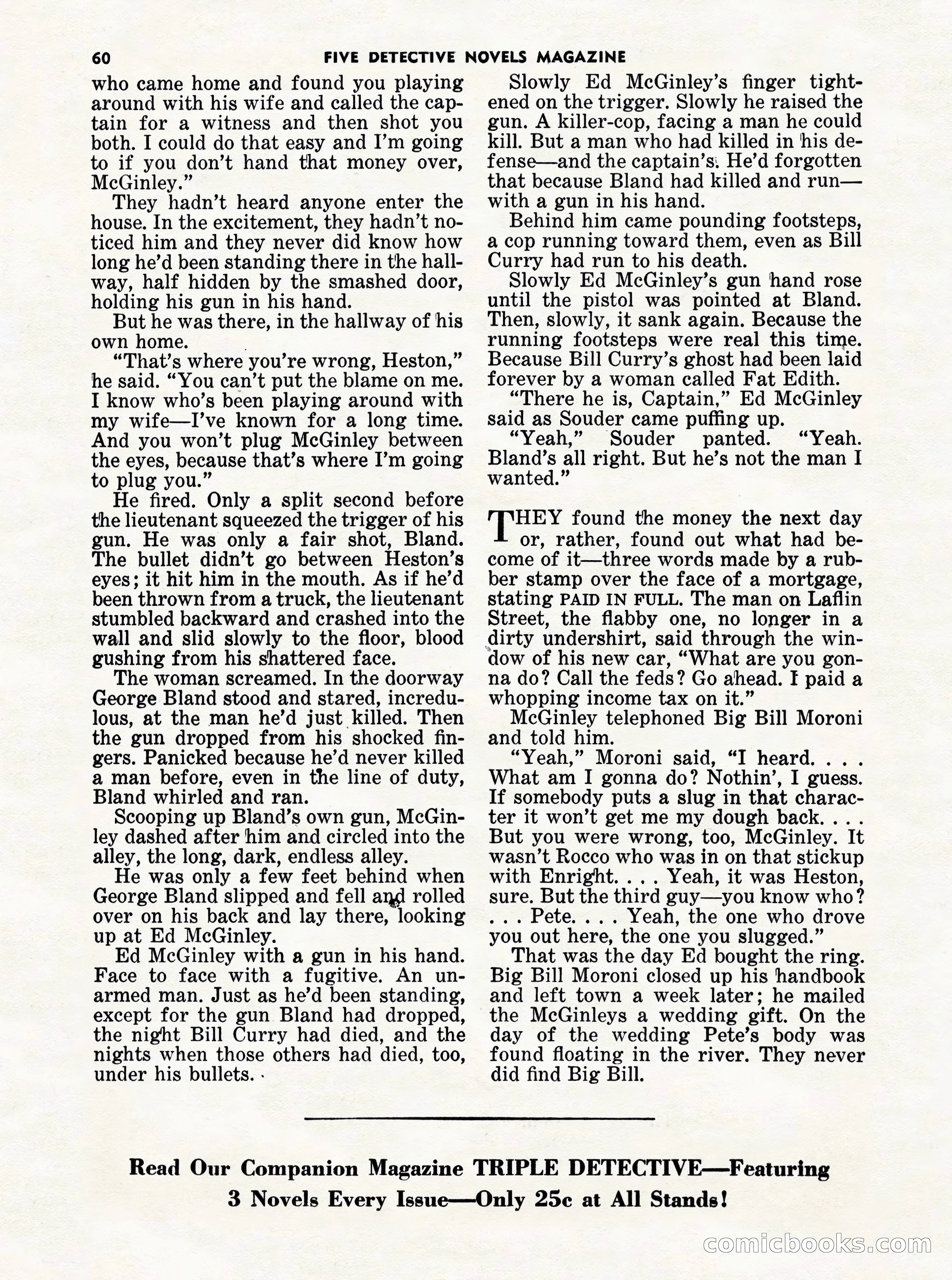
A restored page from Pulp Fiction, 1953. Page through the whole issue in the reader above.
📄 Transcribed text from this page (OCR, searchable)
Machine-transcribed from the original scan — historical spelling and the odd misread are preserved.
60 who came home and found you playing around with his wife and called the cap- tain for a witness and then shot you both. I could do that easy and I’m going to if you don’t hand that money over, McGinley.” They hadn’t heard anyone enter the house. In the excitement, they hadn’t no- ticed him and they never did know how long he’d been standing there in the hall- way, half hidden by the smashed door, holding his gun in his hand. But he was there, in the hallway of his own home. “That’s where you’re wrong, Heston,” he said. “You can’t put the blame on me. I know who’s been playing around with my wife—I’ve known for a long time. And you won’t plug McGinley between the eyes, because that’s where I’m going to plug you.” He fired. Only a split second before the lieutenant squeezed the trigger of his gun. He was only a fair shot, Bland. The bullet didn’t go between Heston’s eyes; it hit him in the mouth. As if he’d been thrown from a truck, the lieutenant stumbled backward and crashed into the wall and slid slowly to the floor, blood gushing from his shattered face. The woman screamed. In the doorway George Bland stood and stared, incredu- lous, at the man he’d just killed. Then the gun dropped from his shocked fin- gers. Panicked because he’d never killed a man before, even in the line of duty, Bland whirled and ran. Scooping up Bland’s own gun, McGin- ley dashed after him and circled into the alley, the long, dark, endless alley. He was only a few feet behind when George Bland slipped and fell and rolled over on his back and lay there, looking up at Ed McGinley. Ed McGinley with a gun in his hand. Face to face with a fugitive. An un- armed man. Just as he’d been standing, except for the gun Bland had dropped, the night Bill Curry had died, and the nights when those others had died, too, under his bullets. - FIVE DETECTIVE NOVELS MAGAZINE Slowly Ed McGinley’s finger tight- ened on the trigger. Slowly he raised the gun. A killer-cop, facing a man he could kill. But a man who had killed in his de- fense—and the captain’s: He’d forgotten that because Bland had killed and run— with a gun in his hand. Behind him came pounding footsteps, a cop running toward them, even as Bill Curry had run to his death. Slowly Ed McGinley’s gun hand rose until the pistol was pointed at Bland. Then, slowly, it sank again. Because the running footsteps were real this time. Because Bill Curry’s ghost had been laid forever by a woman called Fat Edith. “There he is, Captain,” Ed oe said as Souder came puffing up “Yeah,” Souder panted. “Yeah. Bland’s all right. But he’s not the man I wanted.” eS found the money the next day or, rather, found out what had be- come of it—three words made by a rub- ber stamp over the face of a mortgage, stating PAID IN FULL. The man on Laflin Street, the flabby one, no longer in a dirty undershirt, said through the win- dow of his new car, “What are you gon- na do? Call the feds? Go ahead. I paid a whopping income tax on it.” McGinley telephoned Big Bill Moroni and told him. “Yeah,” Moroni said, “I heard. ... What am I gonna do? Nothin’, I guess. If somebody puts a slug in that charac- ter it won’t get me my dough back... . But you were wrong, too, McGinley. It wasn’t Rocco who was in on that stickup with Enright. ... Yeah, it was Heston, sure. But the third guy—you know who? Pete. ... Yeah, the one who drove you out here, the one you slugged.” That was the day Ed bought the ring. Big Bill Moroni closed up his handbook and left town a week later; he mailed the McGinleys a wedding gift. On the day of the wedding Pete’s body was found floating in the river. They never did find Big Bill. Read Our Companion Magazine TRIPLE DETECTIVE—Featuring 3 Novels Every Issue—Only 25c at All Stands! COMmiclboo (”) (C(O)