
Pulp Fiction, 1950 · page 10 of 132
A. Merritt's Fantasy Magazine, February 1950 — page 10: what you’re looking at
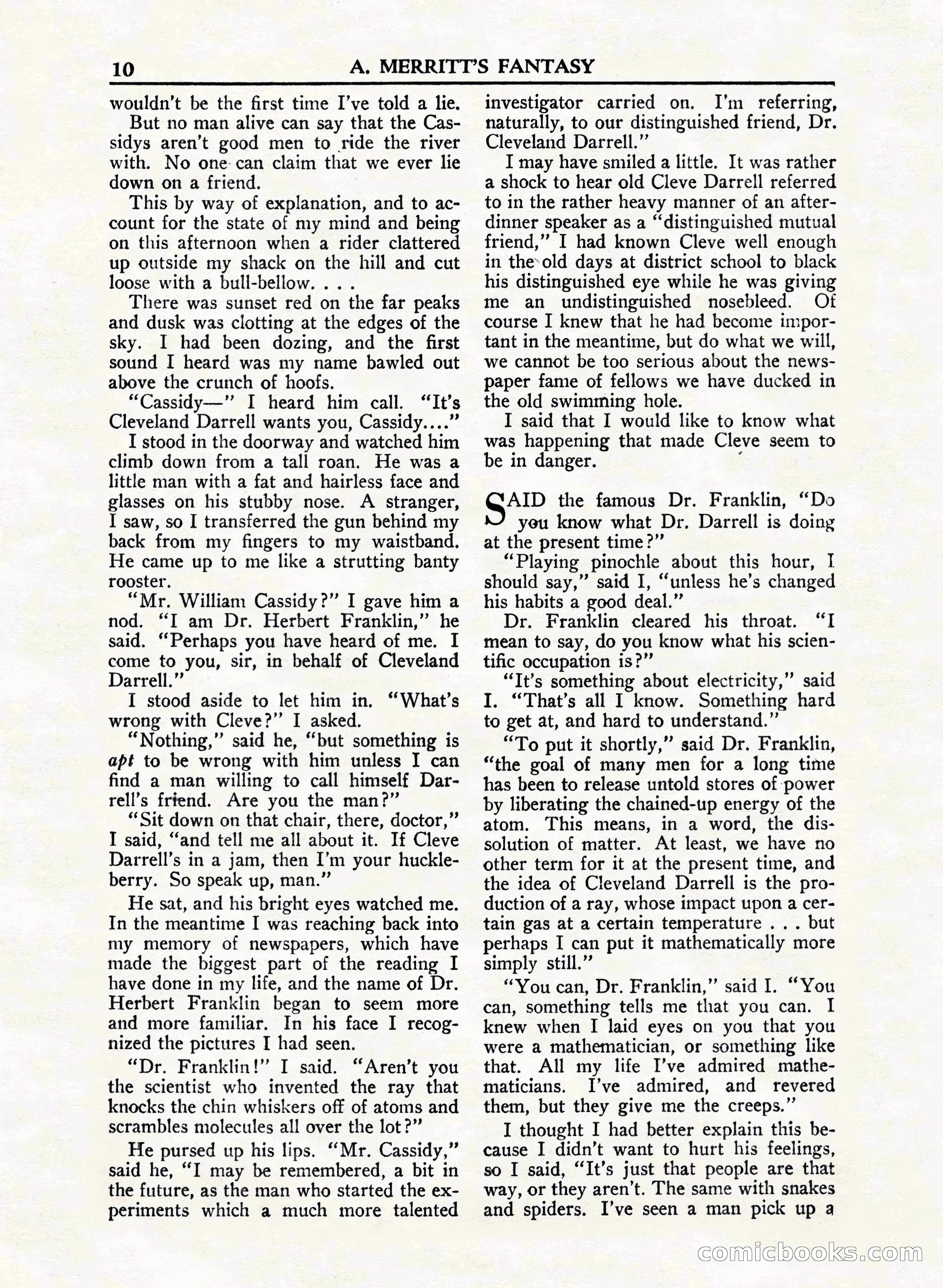
A restored page from Pulp Fiction, 1950. Page through the whole issue in the reader above.
📄 Transcribed text from this page (OCR, searchable)
Machine-transcribed from the original scan — historical spelling and the odd misread are preserved.
10 A. MERRITT’S FANTASY wouldn’t be the first time I’ve told a lie. But no man alive can say that the Cas- sidys aren’t good men to ride the river with. No one can claim that we ever lie down on a friend. This by way of explanation, and to ac- count for the state of my mind and being on this afternoon when a rider clattered up outside my shack on the hill and cut loose with a bull-bellow. ... There was sunset red on the far peaks and dusk was clotting at the edges of the sky. I had been dozing, and the first sound I heard was my name bawled out above the crunch of hoofs. “Cassidy—” I heard him call. “It’s Cleveland Darrell wants you, Cassidy....” I stood in the doorway and watched him climb down from a tall roan. He was a little man with a fat and hairless face and glasses on his stubby nose. A stranger, I saw, so I transferred the gun behind my back from my fingers to my waistband. He came up to me like a strutting banty rooster. “Mr. William Cassidy?” I gave him a nod. “I am Dr. Herbert Franklin,” he said. “Perhaps you have heard of me. I come to you, sir, in behalf of Cleveland Darrell.” I stood aside to let him in, ‘‘What’s wrong with Cleve?” I asked. “Nothing,” said he, “but something is apt to be wrong with him unless I can find a man willing to call himself Dar- rell’s friend. Are you the man?” **Sit down on that chair, there, doctor,” I said, “and tell me all about it. If Cleve Darrell’s in a jam, then I’m your huckle- berry. So speak up, man.” He sat, and his bright eyes watched me. In the meantime I was reaching back into my memory of newspapers, which have made the biggest part of the reading I have done in my life, and the name of Dr. Herbert Franklin began to seem more and more familiar. In his face I recog- nized the pictures I had seen. “Dr. Franklin!” I said. “Aren’t you the scientist who invented the ray that knocks the chin whiskers off of atoms and scrambles molecules all over the lot?” He pursed up his lips. “Mr. Cassidy,” said he, “I may be remembered, a bit in the future, as the man who started the ex- periments which a much more talented investigator carried on. I’m referring, naturally, to our distinguished friend, Dr. Cleveland Darrell.”’ I may have smiled a little. It was rather a shock to hear old Cleve Darrell referred to in the rather heavy manner of an after- dinner speaker as a “distinguished mutual friend,” I had known Cleve well enough in the-old days at district school to black his distinguished eye while he was giving me an undistinguished nosebleed. Of course I knew that he had become impor- tant in the meantime, but do what we will, we cannot be too serious about the news- paper fame of fellows we have ducked in the old swimming hole. I said that I would like to know what was happening that made Cleve seem to be in danger. : AID the famous Dr. Franklin, “Do yeu know what Dr. Darrell is doing at the present time?” “Playing pinochle about this hour, I should say,” said I, “unless he’s changed his habits a good deal.”’ Dr. Franklin cleared his throat. “I mean to say, do you know what his scien- tific occupation is?” “It’s something about electricity,” said I. “That’s all I know. Something hard to get at, and hard to understand.” “To put it shortly,” said Dr. Franklin, “the goal of many men for a long time has been to release untold stores of power by liberating the chained-up energy of the atom. This means, in a word, the dis- solution of matter. At least, we have no other term for it at the present time, and the idea of Cleveland Darrell is the pro- duction of a ray, whose impact upon a cer- tain gas at a certain temperature ... but perhaps I can put it mathematically more simply still.” “You can, Dr. Franklin,” said I. “You can, something tells me that you can. I knew when I laid eyes on you that you were a mathematician, or something like that. All my life I’ve admired mathe- maticians. I’ve admired, and revered them, but they give me the creeps.” I thought I had better explain this be- cause I didn’t want to hurt his feelings, so I said, “It’s just that people are that way, or they aren’t. The same with snakes and spiders. I’ve seen a man pick up a GoMmiGcsoo (Cc (C@