
Pulp Fiction, 1950 · page 66 of 132
A. Merritt's Fantasy Magazine, February 1950 — page 66: what you’re looking at
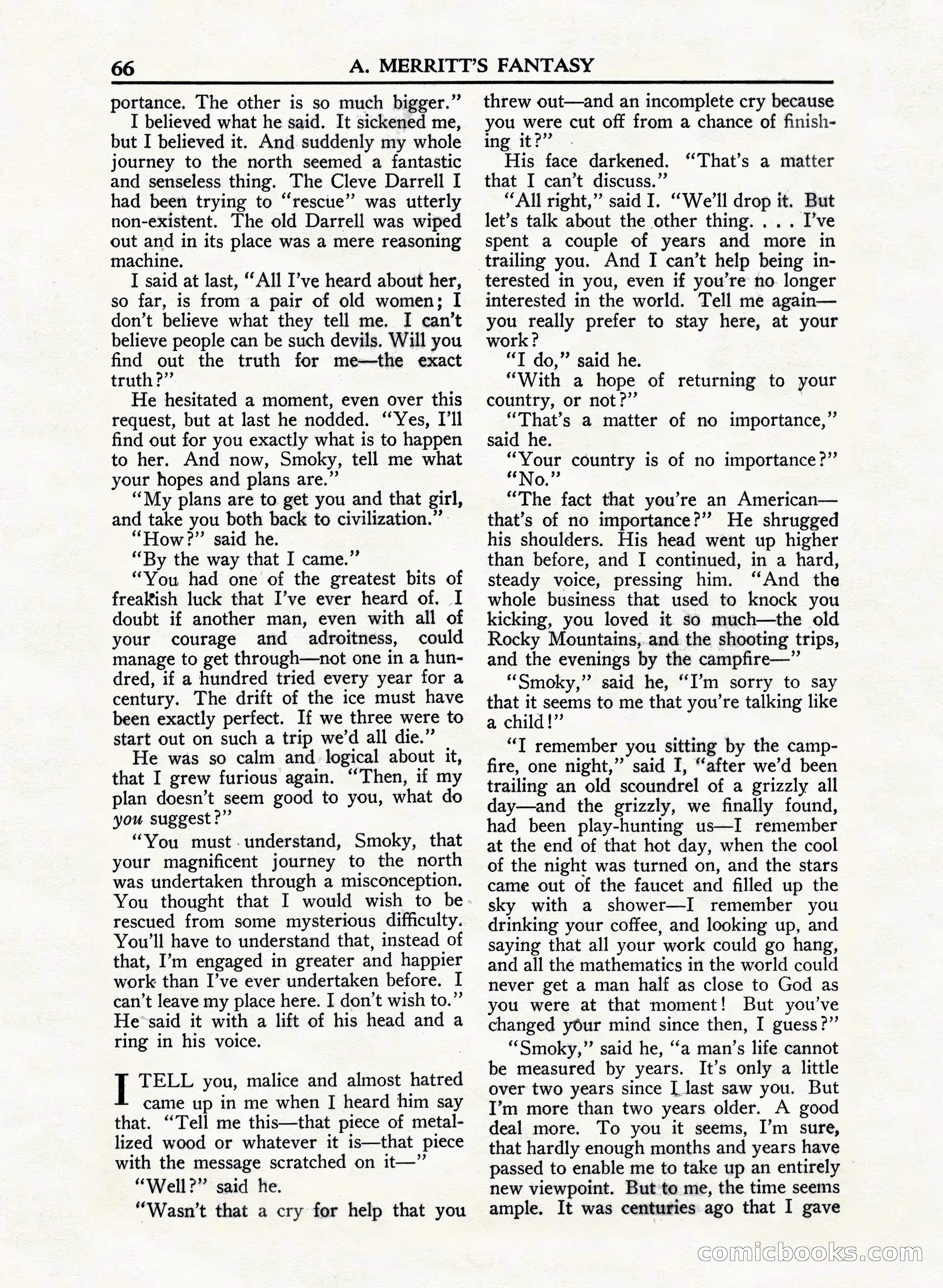
A restored page from Pulp Fiction, 1950. Page through the whole issue in the reader above.
📄 Transcribed text from this page (OCR, searchable)
Machine-transcribed from the original scan — historical spelling and the odd misread are preserved.
66 A. MERRITT’S FANTASY portance. The other is so much bigger.” I believed what he said. It sickened me, but I believed it. And suddenly my whole journey to the north seemed a fantastic and senseless thing. The Cleve Darrell I had been trying to “rescue” was utterly non-existent. The old Darrell was wiped out and in its place was a mere reasoning machine. I said at last, ‘All I’ve heard about her, so far, is from a pair of old women; I don’t believe what they tell me. I can’t believe people can be such devils. Will you find out the truth for me—the exact truth?” He hesitated a moment, even over this request, but at last he nodded. “Yes, I'll find out for you exactly what is to happen to her. And now, Smoky, tell me what your hopes and plans are.” “My plans are to get you and that girl, and take you both back to civilization.” “How?” said he. “By the way that I came.” “You had one of the greatest bits of freakish luck that I’ve ever heard of. I doubt if another man, even with all of your courage and adroitness, could manage to get through—not one in a hun- dred, if a hundred tried every year for a century. The drift of the ice must have been exactly perfect. If we three were to start out on such a trip we’d all die.” He was so calm and logical about it, that I grew furious again. “Then, if my plan doesn’t seem good to you, what do you suggest?” “You must-understand, Smoky, that your magnificent journey to the north was undertaken through a misconception. You thought that I would wish to be rescued from some mysterious difficulty. You’ll have to understand that, instead of that, I’m engaged in greater and happier work than I’ve ever undertaken before. I can’t leave my place here. I don’t wish to.”’ He said it with a lift of his head and a ring in his voice. I TELL you, malice and almost hatred came up in me when I heard him say that. “Tell me this—that piece of metal- lized wood or whatever it is—that piece with the message scratched on it—” “Well?” said he. “Wasn’t that a cry for help that you threw out—and an incomplete cry because you were cut off from a chance of finish- ing it?” His face darkened. that I can’t discuss.” “All right,” said I. “We'll drop it. But let’s talk about the other thing. ... I’ve spent a couple of years and more in trailing you. And I can’t help being in- terested in you, even if you’re no longer interested in the world. Tell me again— you really prefer to stay here, at your work? “T do,” said he. “With a hope of returning to your country, or not?” “That’s a matter of no importance,” said he. “Your country is of no importance?” fe o,”’ “The fact that you’re an American— that’s of no importance?” He shrugged his shoulders. His head went up higher than before, and I continued, in a hard, steady voice, pressing him. “And the whole business that used to knock you kicking, you loved it so much—the old Rocky Mountains, and the shooting trips, and the evenings by the campfire—”’ “Smoky,” said he, “I’m sorry to say that it seems to me that you're talking like a child!” “T remember you sitting by the camp- fire, one night,” said I, “‘after we’d been trailing an old scoundrel of a grizzly all day—and the grizzly, we finally found, had been play-hunting us—I remember at the end of that hot day, when the cool of the night was turned on, and the stars came out of the faucet and filled up the sky with a shower—I remember you drinking your coffee, and looking up, and saying that all your work could go hang, and all the mathematics in the world could never get a man half as close to God as you were at that moment! But you’ve changed your mind since then, I guess?” “Smoky,” said he, “‘a man’s life cannot be measured by years. It’s only a little over two years since I last saw you. But I’m more than two years older. A good deal more. To you it seems, I’m sure, that hardly enough months and years have “That’s a matter passed to enable me to take up an entirely © new viewpoint. But to me, the time seems ample. It was centuries ago that I gave GOMIIGooOoO S © iin