
Pulp Fiction, 1950 · page 69 of 132
A. Merritt's Fantasy Magazine, February 1950 — page 69: what you’re looking at
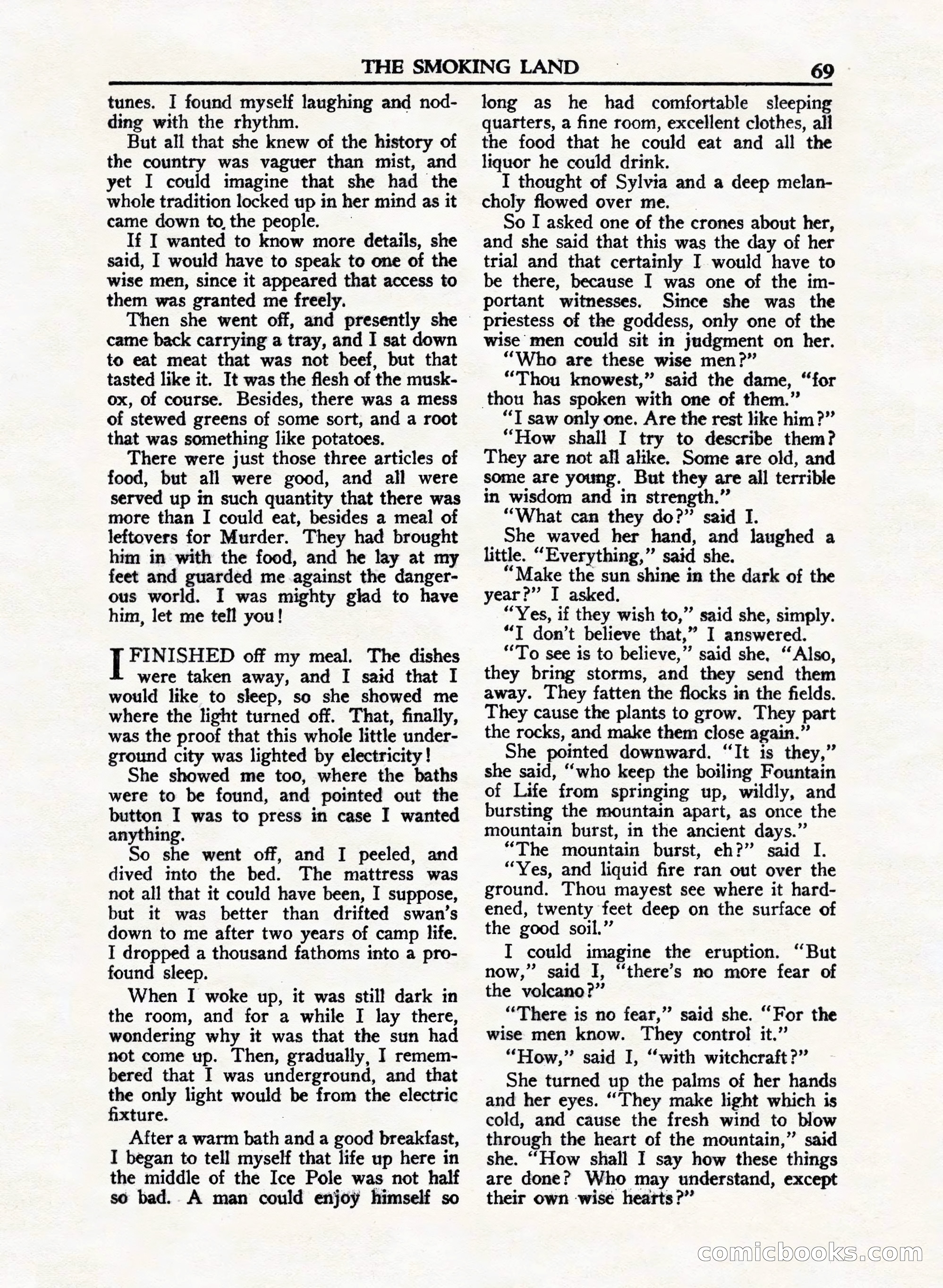
A restored page from Pulp Fiction, 1950. Page through the whole issue in the reader above.
📄 Transcribed text from this page (OCR, searchable)
Machine-transcribed from the original scan — historical spelling and the odd misread are preserved.
THE SMOKING LAND 69 tunes. I found myself laughing and nod- ding with the rhythm. But all that she knew of the history of the country was vaguer than mist, and yet I could imagine that she had the whole tradition locked up in her mind as it came down to, the people. If I wanted to know more details, she said, I would have to speak to one of the wise men, since it appeared that access to them was granted me freely. Then she went off, and presently she ~ came back carrying a tray, and I sat down to eat meat that was not beef, but that tasted like it. It was the flesh of the musk- ox, of course. Besides, there was a mess of stewed greens of some sort, and a root that was something like potatoes. There were just those three articles of food, but all were good, and all were served up mn such quantity that there was more than I could eat, besides a meal of leftovers for Murder. They had brought him in with the food, and he lay at my feet and guarded me against the danger- ous world. I was mighty glad to have him, let me tell you! Co off my meal. The dishes were taken away, and I said that I would like to sleep, so she showed me where the light turned off. That, finally, was the proof that this whole little under- ground city was lighted by electricity! She showed me too, where the baths were to be found, and pointed out the button I was to press in case I wanted anything. So she went off, and I peeled, and dived into the bed. The mattress was not all that it could have been, I suppose, but it was better than drifted swan’s down to me after two years of camp life. I dropped a thousand fathoms into a pro- found sleep. When I woke up, it was still dark in the room, and for a while I lay there, wondering why it was that the sun had not come up. Then, gradually, I remem- bered that I was underground, and that the only light would be from the electric fixture. After a warm bath and a good breakfast, I began to tell myself that life up here in the middle of the Ice Pole was not half so bad. A man could enjoy himself so long as he had comfortable sleeping quarters, a fine room, excellent clothes, all the food that he could eat and all the liquor he could drink. I thought of Sylvia and a deep melan- choly flowed over me. So I asked one of the crones about her, and she said that this was the day of her trial and that certainly I would have to be there, because I was one of the im- portant witnesses. Since she was the priestess of the goddess, only one of the wise’ men could sit in judgment on her. “Who are these wise men?” “Thou knowest,” said the dame, “for thou has spoken with one of them.” “T saw only one. Are the rest like him?” “How shall I try to describe them? They are not all alike. Some are old, and some are young. But they are all terrible in wisdom and in strength.” “What can they do?” said I. She waved her hand, and laughed a little. “Everything,” said she. “Make the sun shine in the dark of the year?” I asked. “Yes, if they wish to,” said she, simply. “TI don’t believe that,” I answered. “To see is to believe,” said she, “Also, they bring storms, and they send them away. They fatten the flocks in the fields. They cause the plants to grow. They part the rocks, and make them close again.” She pointed downward. “It is they,” she said, “who keep the boiling Fountain of Life from springing up, wildly, and bursting the mountain apart, as once the mountain burst, in the ancient days.” “The mountain burst, eh?” said I. “Yes, and liquid fire ran out over the ground. Thou mayest see where it hard- ened, twenty feet deep on the surface of the good soil.” I could imagine the eruption. “But now,” said J, ‘‘there’s no more fear of the volcano?” “There is no fear,”’ said she. “For the wise men know. They control it.” “How,” said I, “with witchcraft?” She turned up the palms of her hands and her eyes. “They make light which is cold, and cause the fresh wind to blow through the heart of the mountain,” said she. “How shall I say how these things are done? Who may understand, except their own wise hearts?” COMmicaoo® S C@ in