
Pulp Fiction, 1950 · page 75 of 132
A. Merritt's Fantasy Magazine, February 1950 — page 75: what you’re looking at
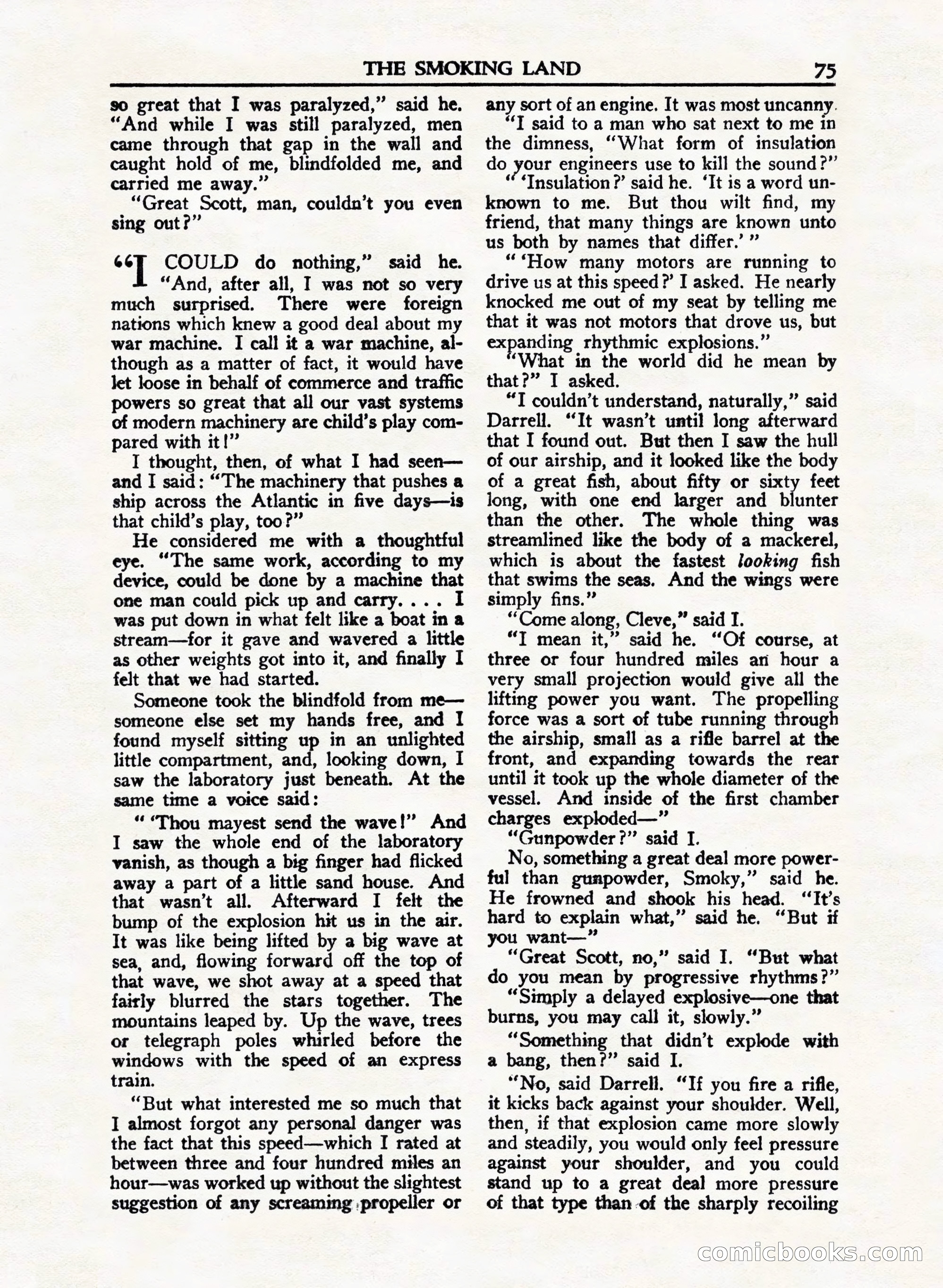
A restored page from Pulp Fiction, 1950. Page through the whole issue in the reader above.
📄 Transcribed text from this page (OCR, searchable)
Machine-transcribed from the original scan — historical spelling and the odd misread are preserved.
THE SMOKING LAND Y fo, so great that I was paralyzed,” said he. “And while I was still paralyzed, men came through that gap in the wall and caught hold of me, blindfolded me, and carried me away.” “Great Scott, man, couldn’t you even sing out?” “T COULD do nothing,” said he. “And, after all, I was not so very much surprised. There were foreign nations which knew a good deal about my war machine. I call it a war machine, al- though as a matter of fact, it would have let loose in behalf of commerce and traffic powers so great that all our vast systems of modern machinery are child’s play com- pared with it!” I thought, then, of what I had seen— and I said: “The machinery that pushes a ship across the Atlantic in five days—is that child’s play, too?” He considered me with a thoughtful eye. “The same work, according to my device, could be done by a machine that one man could pick up and carry.... was put down in what felt like a boat in a stream—for it gave and wavered a little as other weights got into it, and finally I felt that we had started. Someone took the blindfold from me— someone else set my hands free, and I found myself sitting up in an unlighted little compartment, and, looking down, I saw the laboratory just beneath. At the same time a voice said: “ ‘Thou mayest send the wave!” And I saw the whole end of the laboratory vanish, as though a big finger had flicked away a part of a little sand house. And that wasn’t all. Afterward I felt the bump of the explosion hit us in the air. It was like being lifted by a big wave at sea, and, flowing forward off the top of that wave, we shot away at a speed that fairly blurred the stars together. The mountains leaped by. Up the wave, trees or telegraph poles whirled before the windows with the speed of an express train. “But what interested me so much that I almost forgot any personal danger was the fact that this speed—which I rated at between three and four hundred miles an hour—was worked up without the slightest suggestion of any screaming propeller or any sort of an engine. It was most uncanny. “TI said to a man who sat next to me in the dimness, ‘‘What form of insulation do your engineers use to kill the sound?” “ “Insulation ?’ said he. ‘It is a word un- known to me. But thou wilt find, my friend, that many things are known unto us both by names that differ.’ ” “*How many motors are running to drive us at this speed?’ I asked. He nearly knocked me out of my seat by telling me that it was not motors that drove us, but expanding rhythmic explosions.” “What in the world did he mean by that?” I asked. “I couldn’t understand, naturally,” said Darrell. “It wasn’t until long afterward that I found out. But then I saw the hull of our airship, and it looked like the body of a great fish, about fifty or sixty feet long, with one end larger and blunter than the other. The whole thing was streamlined like the body of a mackerel, which is about the fastest looking fish that swims the seas. And the wings were simply fins.” “Come along, Cleve,” said I. “TI mean it,” said he. “Of course, at three or four hundred miles an hour a very small projection would give all the lifting power you want. The propelling force was a sort of tube running through the airship, small as a rifle barrel at the front, and expanding towards the rear until it took up the whole diameter of the vessel. And inside of the first chamber charges exploded—” “Gunpowder ?” said I. No, something a great deal more power- ful than gunpowder, Smoky,” said he. He frowned and shook his head. “‘It’s hard to explain what,” said he. “But if you want—” “Great Scott, no,” said I. “But what do you mean by progressive rhythms?” “Simply a delayed explosive—one that burns, you may call it, slowly.” “Something that didn’t explode with a bang, then?” said I. ‘No, said Darrell. “If you fire a rifle, it kicks back against your shoulder. Well, then, if that explosion came more slowly and steadily, you would only feel pressure against your shoulder, and you could stand up to a great deal more pressure of that type than of the sharply recoiling COMic soo S © in