
Pulp Fiction, 1950 · page 90 of 132
A. Merritt's Fantasy Magazine, February 1950 — page 90: what you’re looking at
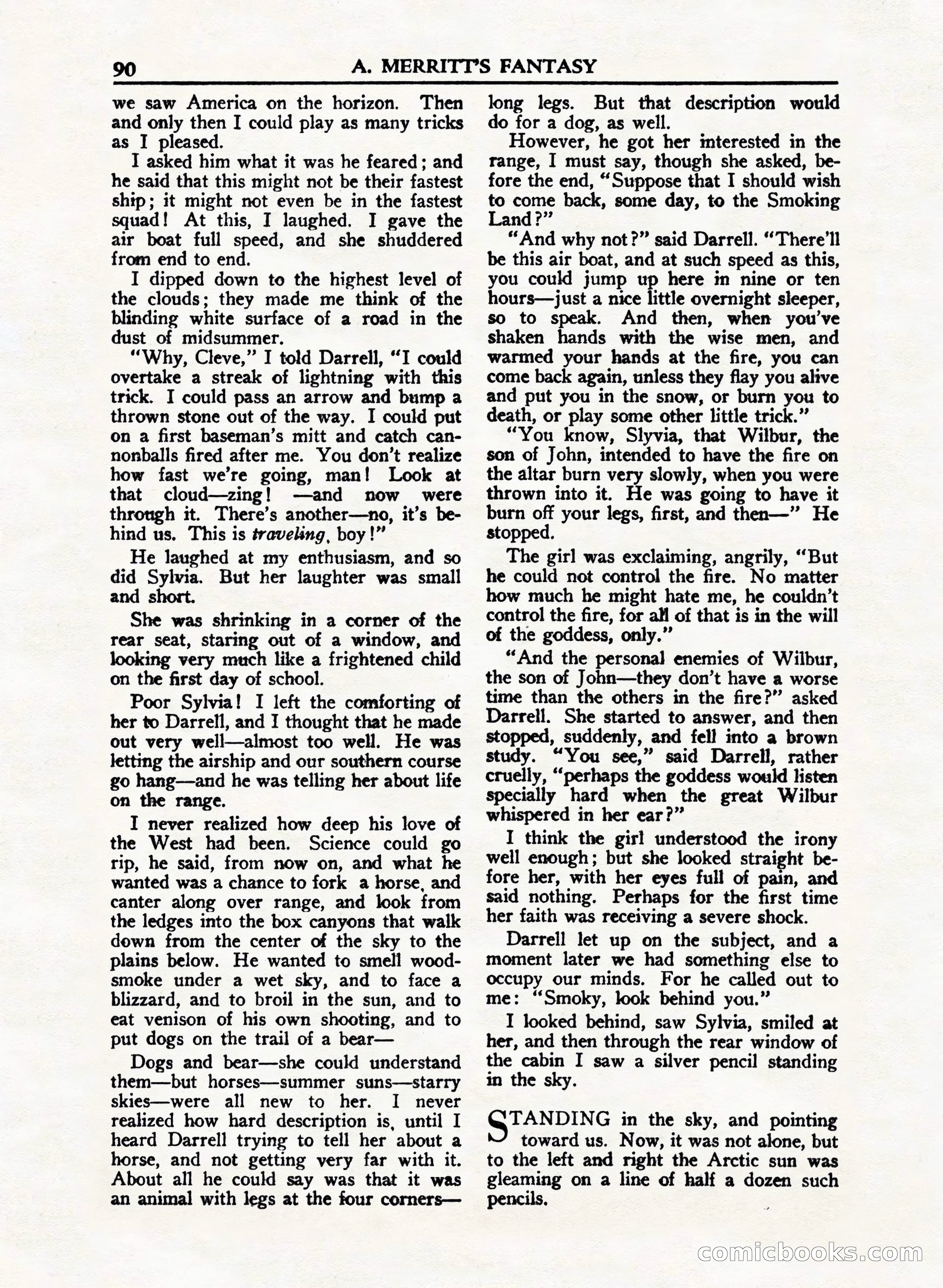
A restored page from Pulp Fiction, 1950. Page through the whole issue in the reader above.
📄 Transcribed text from this page (OCR, searchable)
Machine-transcribed from the original scan — historical spelling and the odd misread are preserved.
90 A. MERRITT’S FANTASY we saw America on the horizon. Then and only then I could play as many tricks as I pleased. I asked him what it was he feared; and he said that this might not be their fastest ship; it might not even be in the fastest squad! At this, I laughed. I gave the air boat full speed, and she shuddered from end to end. I dipped down to the highest level of the clouds; they made me think of the blinding white surface of a road in the dust of midsummer. “Why, Cleve,” I told Darrell, “I could overtake a streak of lightning with this trick. I could pass an arrow and bump a thrown stone out of the way. I could put on a first baseman’s mitt and catch can- nonballs fired after me. You don’t realize how fast we’re going, man! Look at that cloud—zing! —and now _ were through it. There’s another—no, it’s be- hind us. This is traveling, boy!” He laughed at my enthusiasm, and so did Sylvia. But her laughter was small and short. She was shrinking in a corner of the rear seat, staring out of a window, and looking very much like a frightened child on the first day of school. Poor Sylvia! I left the comforting of her to Darrell, and I thought that he made out very well—almost too well. He was letting the airship and our southern course go hang—and he was telling her about life on the range. I never realized how deep his love of the West had been. Science could go rip, he said, from now on, and what he wanted was a chance to fork a horse, and canter along over range, and look from the ledges into the box canyons that walk down from the center of the sky to the plains below. He wanted to smell wood- smoke under a wet sky, and to face a blizzard, and to broil in the sun, and to eat venison of his own shooting, and to put dogs on the trail of a bear— Dogs and bear—she could understand them—but horses—summer suns—starry skies—were all new to her. I never realized how hard description is, until I heard Darrell trying to tell her about a horse, and not getting very far with it. About all he could say was that it was an animal with legs at the four corners— long legs. But that description would do for a dog, as well. However, he got her imterested in the range, I must say, though she asked, be- fore the end, “Suppose that I should wish to come back, some day, to the Smoking Land?” “And why not?” said Darrell. “There'll be this air boat, and at such speed as this, you could jump up here in nine or ten hours—just a nice little overnight sleeper, so to speak. And then, when you've shaken hands with the wise men, and warmed your hands at the fire, you can come back again, unless they flay you alive and put you in the snow, or burn you to death, or play some other little trick.” “You know, Slyvia, that Wilbur, the son of John, intended to have the fire on the altar burn very slowly, when you were thrown into it. He was going to have it burn off your legs, first, and then—” He stopped. The girl was exclaiming, angrily, “But he could not control the fire. No matter how much he might hate me, he couldn’t control the fire, for all of that is in the will of the goddess, only.” “And the personal enemies of Wilbur, the son of John—they don’t have a worse time than the others in the fire?” asked Darrell. She started to answer, and then stopped, suddenly, and fell into a brown study. “You see,” said Darrell, rather cruelly, “perhaps the goddess would listen specially hard when the great Wilbur whispered in her ear?” I think the girl understood the irony well enough; but she looked straight be- fore her, with her eyes full of pain, and said nothing. Perhaps for the first time her faith was receiving a severe shock. Darrell let up on the subject, and a moment later we had something else to occupy our minds. For he called out to me: “Smoky, look behind you.” I looked behind, saw Sylvia, smiled at her, and then through the rear window of the cabin I saw a silver pencil standing in the sky. Salen G in the sky, and pointing toward us. Now, it was not alone, but to the left and right the Arctic sun was gleaming on a line of half a dozen such pencils, GOMIIGoOO S (© iin