
Pulp Fiction, 1949 · page 24 of 133
A. Merritt's Fantasy Magazine, December 1949 — page 24: what you’re looking at
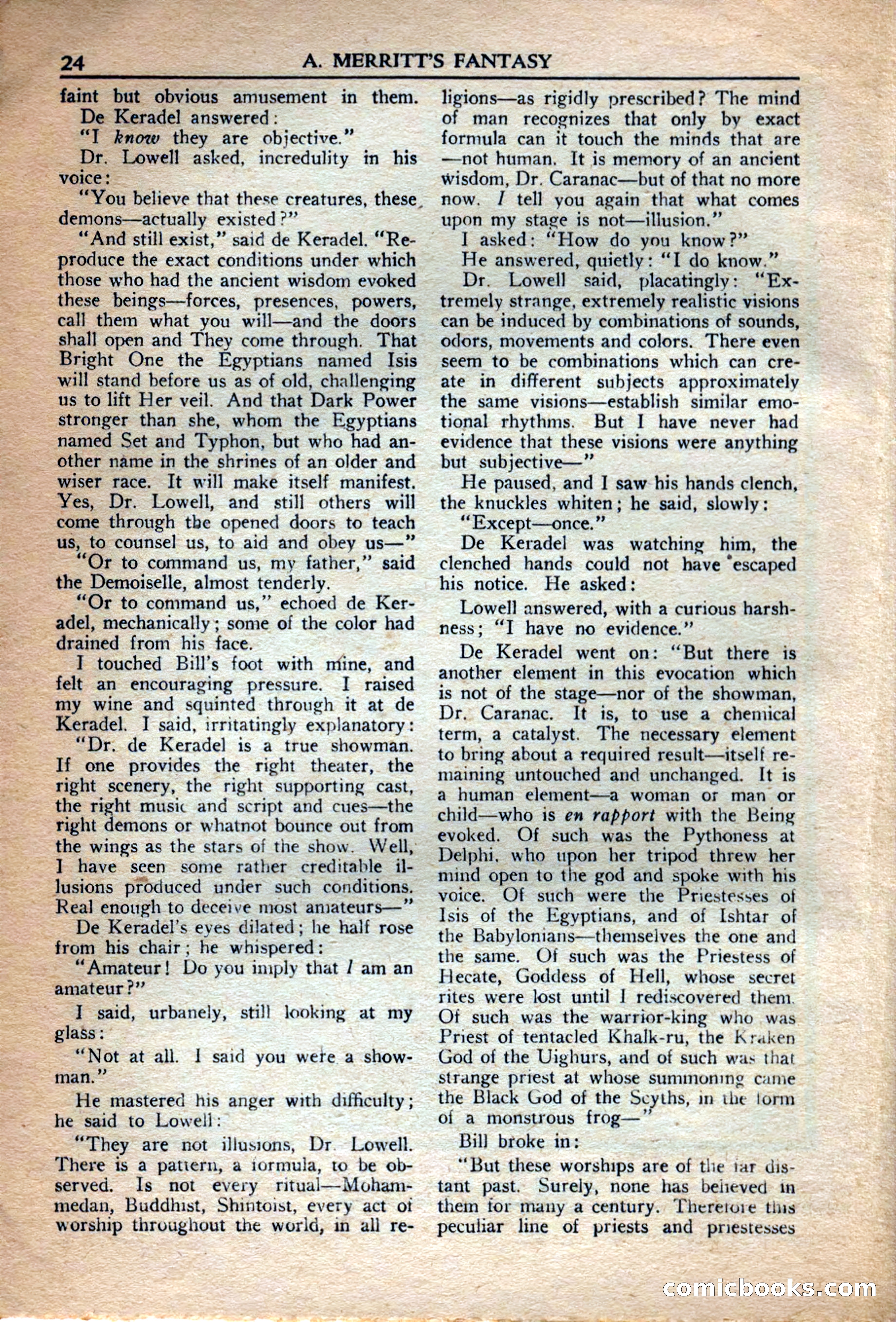
A restored page from Pulp Fiction, 1949. Page through the whole issue in the reader above.
📄 Transcribed text from this page (OCR, searchable)
Machine-transcribed from the original scan — historical spelling and the odd misread are preserved.
iy e >< e et oe = a a Sa —— ae al = ms SS Din nt ie e VANev ys a ne ie =. = SS 7 oe al set Ole rh LARD. me ey i ey) ii Pt ‘ 7 : ‘ar : — 9 ~ a a nm py eg > ~~ act > oe Sunt A. MERRITT’S FANTASY faint but. obvious amusement in them. De Keradel answered : = “T know they are objective.” =e Lowell asked, incredulity in his oy >s me =< owe: Es ae #V oy believe that these creatures, these. Diswees __ demons—actually existed ?”’ a = - “And still exist,” said de Keradel. “Re- produce the exact conditions under which __ those who had the ancient wisdom evoked these beings—forces, presences, powers, call them what you will—and the doors _ shall open and They come through. That Bright One the Egyptians named Isis will stand before us as of old, challenging us to lift Her veil. And that Dark Power stronger than she, whom the Egyptians named Set and Typhon, but who had an- — other name in the shrines of an older and wiser race. It will make itself manifest. Yes, Dr. Lowell, and still others will come through the opened doors to teach us, to counsel us, to aid and obey us—” “Or to command us, my father,” said _ the Demoiselle, almost tenderly. “Or to command us,’ echoed de Ker- = =x adel, mechanically; some of the color had hae > - drained from his face. I touched Bill’s foot with ntine, and ‘felt an encouraging pressure. I raised == my wine and squinted through it at de Ss “Amateur! Do you imply that / am an amateur?” ct > — - served. _Keradel. I said, irritatingly explanatory : “Dr. de Keradel is a true showman. If one provides the right theater, the right scenery, the right supporting cast, the right music and script and cues—the right demons or whatnot bounce out from ‘the wings as the stars of the show. Well, J have seen some rather creditable il- -lusions produced under such conditions, Real enough to deceive most aniateurs—” De Keradel’s eyes dilated; he half rose from his chair; he whispered : I said, urbanely, stil! looking at my glass: “Not at all. I said you were a show- man.” He mastered his anger with difficulty ; he said to Lowell: “They are not illusions, Dr. Lowell. There is a patiern, a iormula, to be ob- | Is not every ritual—Moham- medan, Buddhist, Shintoist, every act ot worship throughout the world, in all re- ligions—as rigidly prescribed? The mind of man recognizes that only by exact formula can it touch the minds that are —not human, I[t is memory of an ancient wisdom, Dr. Caranac—but of that no more now. / tell you again that what comes upon my stage is not—illusion.” I asked: “How do you know?” He answered, quietly: “I do know.” Dr. Lowell said, placatingly: “Ex- tremely strange, extremely realistic visions can be induced by combinations of sounds, odors, movements and colors. There even seem to be combinations which can cre- ate in different subjects approximately the same visions—establish similar emo- tional rhythms. But I have never had evidence that these visions were anything but subjective—”’ He paused, and I saw his hands clench, the knuckles whiten; he said, slowly: “Except—once.” De Keradel was watching him, the clenched hands could not have “escaped his notice. He asked: Lowell answered, with a curious harsh- ness; “I have no evidence.” De Keradel went on: “But there is another element in this evocation which is not of the stage—nor of the showman, Dr. Caranac. It is, to use a chemical term, a catalyst. The necessary element to bring about a required result—itself re- maining untouched and unchanged. It is a human element—a woman or man or child—who is en rapport with the Being evoked. Of such was the Pythoness at Delphi, who upon her tripod threw her mind open to the god and spoke with his voice. Of such were the Priestesses of Isis of the Egyptians, and of Ishtar of the Babylonians—themselves the one and the same. Of such was the Priestess of Hecate, Goddess of Hell, whose secret rites were lost until | rediscovered them. Of such was the warrior-king who was Priest of tentacled Khalk-ru, the Kraken God of the Uighurs, and of such was that strange priest at whose summoning came the Black God of the Scyths, in the form of a monstrous frog—”’ Bil] broke in: “But these worships are of tlie iar dis- tant past. Surely, none has believed in them for many a century. Theretore this peculiar line of priests and priestesses a Ss Eomichoo ‘com . ——- —s i i a ee ee ee ee a - “ - =, a. =| “ow — a ~ *, 2 lense > a LS. eae, Sei eel) abe a. tS