
Pulp Fiction, 1949 · page 45 of 133
A. Merritt's Fantasy Magazine, December 1949 — page 45: what you’re looking at
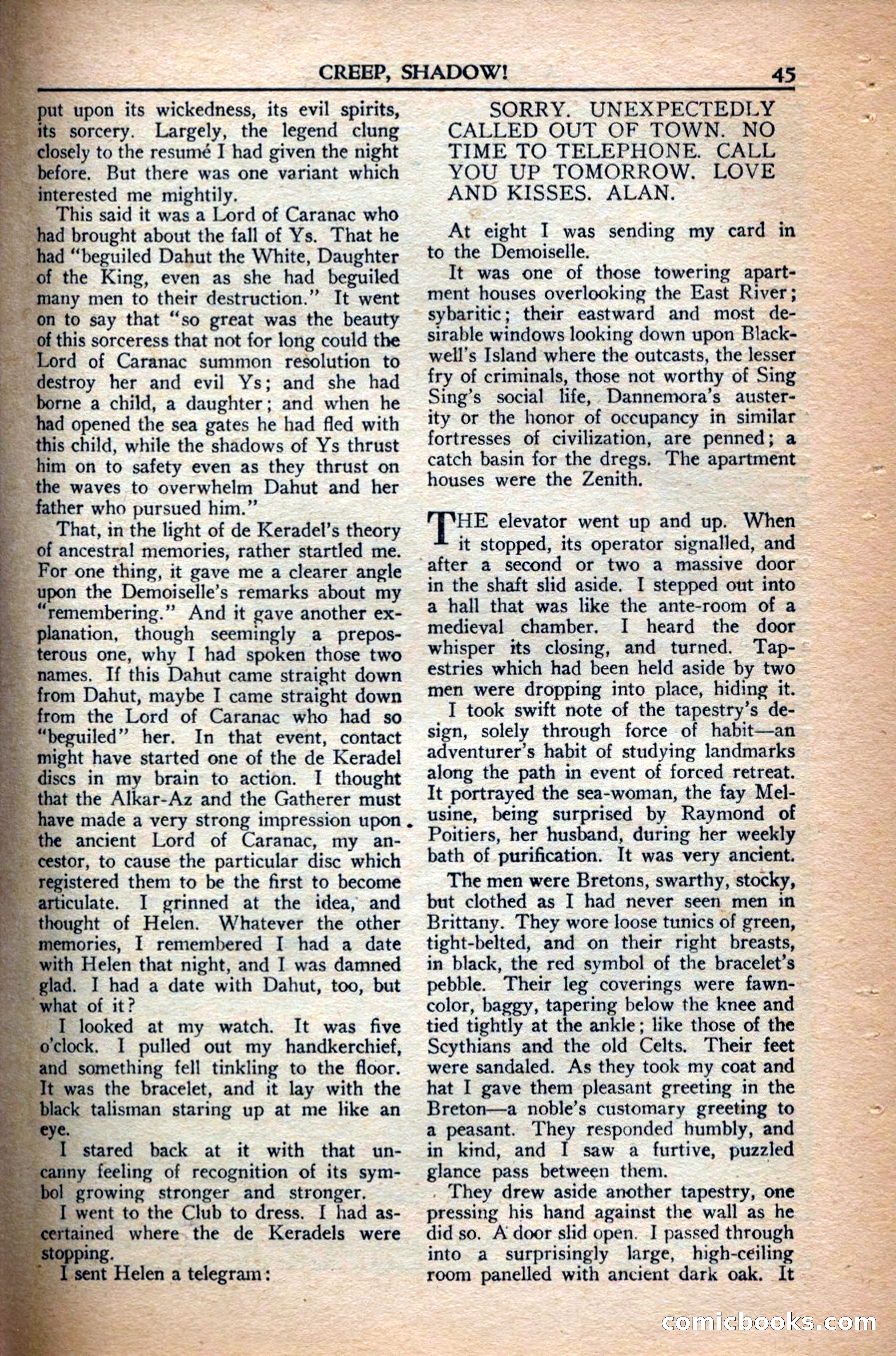
A restored page from Pulp Fiction, 1949. Page through the whole issue in the reader above.
📄 Transcribed text from this page (OCR, searchable)
Machine-transcribed from the original scan — historical spelling and the odd misread are preserved.
pl yut ‘upon its wickedness, its evil spirits, . ts sorcery. Largely, the legend clung closely to the resumé I had given the night before. But there was one variant which interested me mightily. E This said it was a Lord of Caranac who had brought about the fall of Ys. That he had “beguiled Dahut the White, Daughter a o the King, even as she had beguiled ee many men to their destruction.” It went 3 * on to say that “so great was the beauty _ of this sorceress that not for long could the ‘ 1 ord of Caranac summon resolution to es - destroy her and evil Ys; and she had _ borne a child, a daughter; and when he Ry had opened the sea gates he had fled with thi s child, while the shadows of Ys thrust him on to safety even as they thrust on Es 1e waves to overwhelm Dahut and her eeeather who pursued him.” - That, in the light of de Keradel’s theory # Si ancestral memories, rather startled me. For one thing, it gave me a clearer angle apen the Demoiselle’ s remarks about my “remembering.” And it gave another ex- _ planation, though seemingly a prepos- _terous one, why I had spoken those two ¥ ne es. If this Dahut came straight down tom Dahut, maybe I came straight down f om the Lord of Caranac who had so - “beguiled” her. In that event, contact on pent have started one of the de Keradel _ discs in my brain to action. I thought et hat the Alkar-Az and the Gatherer must _ have made a very strong impression upon the ancient Lord of Caranac, my an- r¢ -cestor, to cause the particular disc which registered them to be the first to become late. I grinned at the idea, and ight of Helen. Whatever the other mer ories, | remembered I had a date with Helen that night, and I was damned I had a date with Dahut, too, but what of it? | By I looked at my watch. It was five o'clock I pulled out my handkerchief, anc Siucthing fell tinkling to the floor. was the bracelet, and it lay with the *k talisman staring up at me like an ; = 5 a Did a4 aS ” ~ glad. It blac stared back at it with that un- car nny feeling of recognition of its sym- growing stronger and stronger. =] [ went to the Club to dress. I had as- Se med where. the de Keradels were a a telegram R Mo in 5 ~~ CREEP, SHADOW! ‘after a second SORRY. UNEXPECTEDLY CALLED OUT OF TOWN. NO — TIME TO TELEPHONE. CALL _ YOU UP TOMORROW. LOVE AND KISSES. ALAN. At eight I was sending my card in ~ to the Demoiselle. It was one of those towering apart- ment houses overlooking the East River; sybaritic; their eastward and most de- sirable windows looking down upon Black- well’s Island where the outcasts, the lesser fry of criminals, those not worthy of Sing ~ Sing’s social life, Dannemora’s auster- ity or the honor of occupancy in similar ~ fortresses of civilization, are penned; a catch basin for the dregs. The apartment houses were the Zenith. aeae elevator went up and up. When — it stopped, its operator signalled, and - or two a massive door in the shaft slid aside. I stepped out into a hall that was like the ante-room of a medieval chamber. I heard the door whisper its closing, and turned. Tap- estries which had been held aside by two men were dropping into place, hiding it. I took swift note of the tapestry’s de- sign, solely through force of habit—an adventurer’s habit of studying landmarks along the path in event of forced retreat. It portrayed the sea-woman, the fay Mel- usine, being surprised by Raymond of Poitiers, her husband, during her weekly bath of purification. It was very ancient. The men were Bretons, swarthy, stocky, but clothed as I had never seen men in Brittany. They wore loose tunics of green, | tight-belted, and on their right breasts, in black, the red symbol of the bracelet’s pebble. color, baggy, tapering below the knee and tied tightly at the ankle; like those of the Scythians and the old Celts. Their feet were sandaled. As they took my coat and hat I gave them pleasant greeting in the Breton—a noble’s customary greeting to a peasant. They responded humbly, and in kind, and I saw a furtive, puzzled glance pass between them. . They drew aside another tapestry, one pressing his hand against the wall as he did so. A door slid open. I passed through into a surprisingly large, high-ceéiling room panelled with ancient dark oak. It oO Eomichoo Their leg coverings were fawn-