
Pulp Fiction, 1949 · page 93 of 133
A. Merritt's Fantasy Magazine, December 1949 — page 93: what you’re looking at
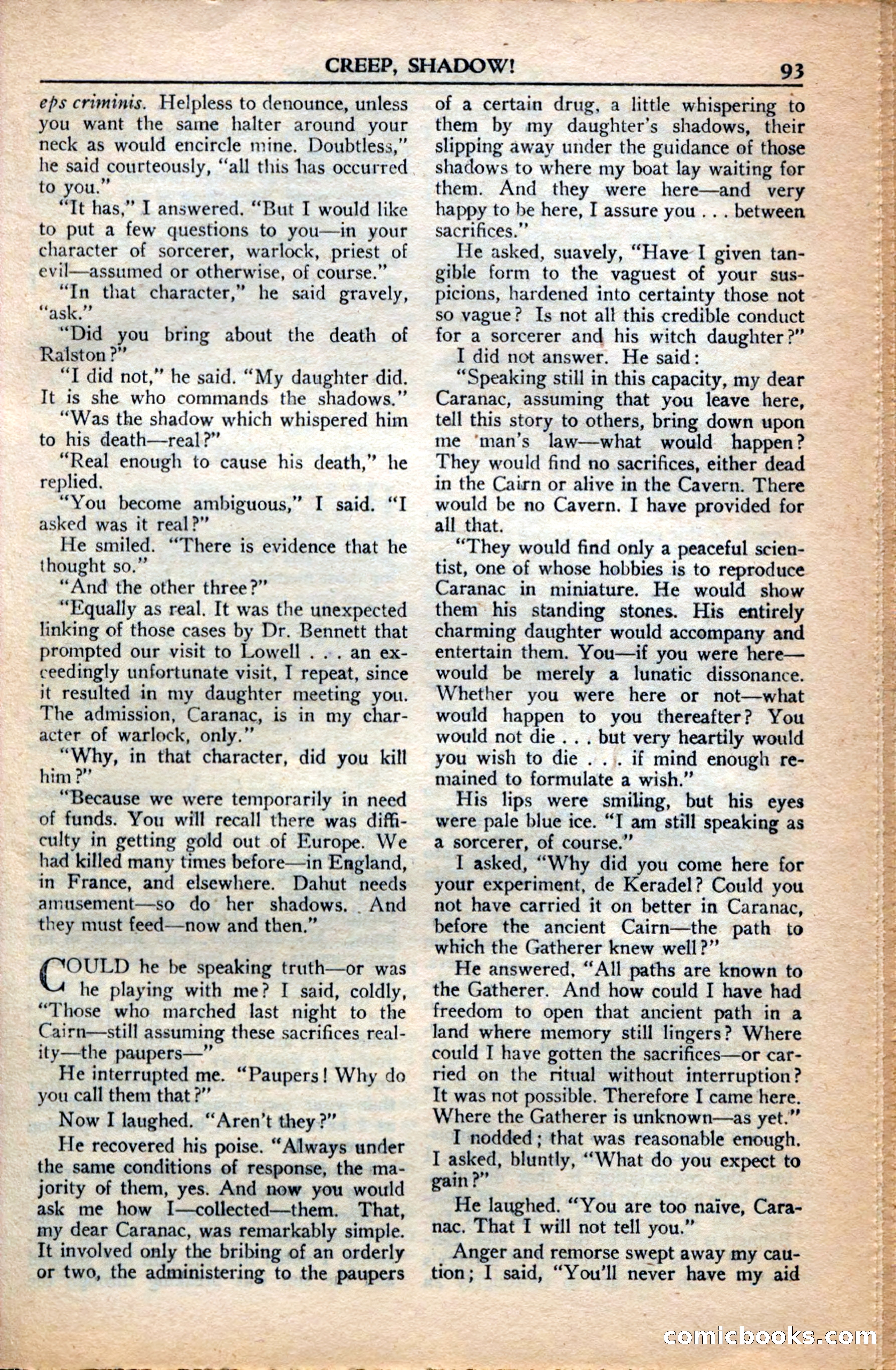
A restored page from Pulp Fiction, 1949. Page through the whole issue in the reader above.
📄 Transcribed text from this page (OCR, searchable)
Machine-transcribed from the original scan — historical spelling and the odd misread are preserved.
CREEP, SHADOW! LL a . eps criminis. Helpless to denounce, unless you want the same halter around your neck as would encircle mine. Doubtless,” he said courteously, “all this has occurred to you.” “It has,” I answered, “But I would like to put a few questions to you—in your character of sorcerer, warlock, priest of evil—assumed or otherwise, of course.” “In that character,” he said gravely, “ask.” “Did you bring about the death of Ralston ?” “I did not,” he said. “My daughter did. It is she who commands the shadows.” “Was the shadow which whispered him to his death—real ?” “Real enough to cause his death,” he replied. “You become ambiguous,” I said. “I asked was it real?” He smiled. “There is evidence that he thought so.” “And the other three?” “Equally as real. It was the unexpected linking of those cases by Dr. Bennett that prompted our visit to Lowell . .. an ex- ceedingly unfortunate visit, I repeat, since it resulted in my daughter meeting you. The admission, Caranac, is in my char- acter of warlock, only.” “Why, in that character, did you kill him ?” “Because we were temporarily in need of funds. You will recall there was diffi- culty in getting gold out of Europe. We had killed many times before—in England, in France, and elsewhere. Dahut needs amusement—so do’ her shadows. . And they must feed—now and then.” RPS gn he be speaking truth—or was he playing with me? I said, coldly, “Those who marched last night to the Cairn—still assuming these sacrifices real- ity—the paupers—” He interrupted me. “Paupers! Why do you call them that?” Now I laughed. “Aren’t they?” He recovered his poise. “Always under the same conditions of response, the ma- jority of them, yes. And now you would ask me how I—collected—them. That, my dear Caranac, was remarkably simple. It involved only the bribing of an orderly or two, the administering to the paupers of a certain drug, a little whispering to them by my daughter’s shadows, their slipping away under the guidance of those shadows to where my boat lay waiting for them. And they were here—and very happy to be here, I assure you. . . between sacrifices.” He asked, suavely, “Have-I given tan- gible form to the vaguest of your sus- picions, hardened into certainty those not - so vague? Is not all this credible conduct for a sorcerer and his witch daughter?” I did not answer. He said: “Speaking still in this capacity, my dear Caranac, assuming that you leave here, tell this story to others, bring down upon me ‘man’s law—what would happen? They would find no sacrifices, either dead in the Cairn or alive in the Cavern. There would be no Cavern. I have provided for all that. “They would find only a peaceful scien- tist, one of whose hobbies is to reproduce Caranac in miniature. He would show them his standing stones. His entirely charming daughter would accompany and entertain them. You—if you were here— would be merely a lunatic dissonance. Whether you were here or not—what would happen to you thereafter? You would not die .. . but very heartily would you wish to die ... if mind enough re- mained to formulate a wish.” His lips were smiling, but his eyes were pale blue ice. “I am still speaking as a sorcerer, of course.” I asked, “Why did you come here for your experiment, de Keradel? Could you not have carried it on better in Caranac, before the ancient Cairn—the path to which the Gatherer knew well?” He answered, “All paths are known to the Gatherer. And how could I have had freedom to open that ancient path in a land where memory still lingers? Where 93 could I have gotten the sacrifices—or car- ried on the mtual without interruption? It was not possible. Therefore I came here. Where the Gatherer is unknown—as yet.” I nodded ; that was reasonable enough. I asked, bluntly, ““What do you expect to He laughed. “You are too naive, Cara- nac, That I will not tell you.” Anger and remorse swept away my cau- tion; I said, “You’ll never have my aid Eomicbooks:co . « ‘ f F ; . PS ab ee Fonte yyy Mag ee 4 ty i } ES SY es ohn. 44 rn aren a be fre Chena ne aide 4, hanes Pre. ” S14) fa f ~feiz?s d rbabae be eT ‘ yew LPT aed? « “in* a . ' 4 : ‘ eS 4) \ errr foe 1 n ‘eg .- A FORA hb eke Ley LA GG we ae