
Pulp Fiction, 1949 · page 121 of 132
A. Merritt's Fantasy Magazine, December 1949 — page 121: what you’re looking at
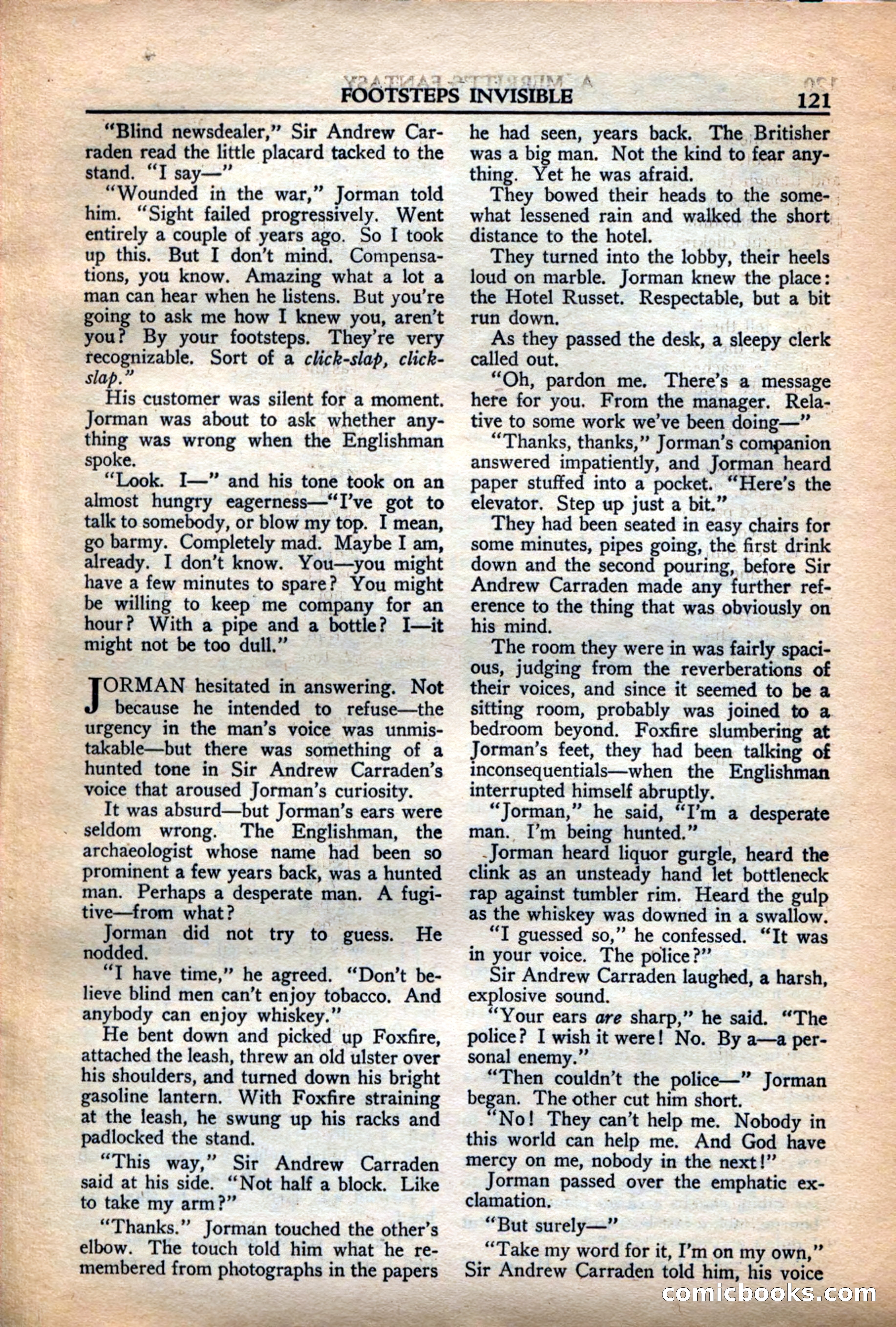
A restored page from Pulp Fiction, 1949. Page through the whole issue in the reader above.
📄 Transcribed text from this page (OCR, searchable)
Machine-transcribed from the original scan — historical spelling and the odd misread are preserved.
ote Oe eae. rl by - 1 Re (g J FOOTSTEPS INVISIBLE — se 121 “Blind newsdealer,” Sir Andrew Car- raden read the little placard tacked to the stand. “I say—” “Wounded in the war,” Jorman told him. “Sight failed progressively. Went entirely a couple of years ago. So I took up this. But I don’t mind, Compensa- tions, you know. Amazing what a lot a man can hear when he listens. But you’re going to ask me how I knew you, aren’t you? By your footsteps. They’re very recognizable. Sort of a click-slap, click- slap.” His customer was silent for a moment. Jorman was about to ask whether any- thing was wrong when the Englishman spoke, : “Look. I—” and his tone took on an almost hungry eagerness—“I’ve got to talk to somebody, or blow my top. I mean, go barmy. Completely mad. Maybe I am, already. I don’t know. You—you might have a few minutes to spare? You might be willing to keep me company for an hour? With a pipe and a bottle? I—it might not be too dull.” ee oi hesitated in answering. Not because he intended to refuse—the urgency in the man’s voice was unmis- takable—but there was something of a hunted tone in Sir Andrew Carraden’s voice that aroused Jorman’s curiosity. It was absurd—but Jorman’s ears were - seldom wrong. The Englishman, the . a Ey a. ea Oe? fa f. “p>! ? Pevgey) rh pF yee . he Tete ® 4 als ; r , ‘ . rt +. Oe . ‘ ? a ents — gs 2 at archaeologist whose name had been so prominent a few years back, was a hunted man. Perhaps a desperate man. A fugi- tive—from what? = e _ Jorman did not try to guess. nodded. “T have time,” he agreed. “Don’t be- lieve blind men can’t enjoy tobacco. And anybody can enjoy whiskey.” He bent down and picked up Foxfire, attached the leash, threw an old ulster over his shoulders, and turned down his bright gasoline lantern. With Foxfire straining at the leash, he swung up his racks and padlocked the stand. “This way,” Sir Andrew Carraden said at his side. “Not half a block. Like to take my arm?” : “Thanks.” Jorman touched the other’s elbow. The touch told him what he re- membered from photographs in the papers ; a >= : - . 4 e << bE ~ et ee ee a a ty es . ee ee ee i o.. a =< he had seen, years back. The Britisher was a big man. Not the kind to fear any- thing. Yet he was afraid. se They bowed their heads to the some- . what lessened rain and walked the short distance to the hotel. They turned into the lobby, their heels loud on marble. Jorman knew the place: the Hotel Russet. Respectable, but a bit run down. As they passed the desk, a sleepy clerk called out, “Oh, pardon me. There’s a message here for you. From the manager. Rela- tive to some work we’ve been doing—” “Thanks, thanks,” Jorman’s companion answered impatiently, and Jorman heard paper stuffed into a pocket. “Here’s the elevator. Step up just a bit.” They had been seated in easy chairs for some minutes, pipes going, the first drink down and the second pouring, before Sir Andrew Carraden made any further ref- erence to the thing that was obviously on his mind. The room they were in was fairly spaci- ous, judging from the reverberations of their voices, and since it seemed to be a sitting room, probably was joined to a bedroom beyond. Foxfire slumbering at Jorman’s feet, they had been talking of inconsequentials—when the Englishman interrupted himself abruptly. “Jorman,” he said, “I’m a desperate man. I’m being hunted.” -Jorman heard liquor gurgle, heard the clink as an unsteady hand let bottleneck rap against tumbler rim. Heard the gulp as the whiskey was downed in a swallow. “TI guessed so,” he confessed. “It was in your voice. The police?” Sir Andrew Carraden laughed, a harsh, explosive sound. “Your ears are sharp,” he said. “The police? I wish it were! No. By a—a per- sonal enemy.” . “Then couldn’t the police—” Jorman began. The other cut him short. ‘No! They can’t help me. Nobody in this world can help me. And God have mercy on me, nobody in the next!” Jorman passed over the emphatic ex- clamation, : “But surely—” “Take my word for it, I’m on my own,” Sir Andrew Carraden told him, his voice