
Pulp Fiction, 1949 · page 69 of 132
A. Merritt's Fantasy Magazine, December 1949 — page 69: what you’re looking at
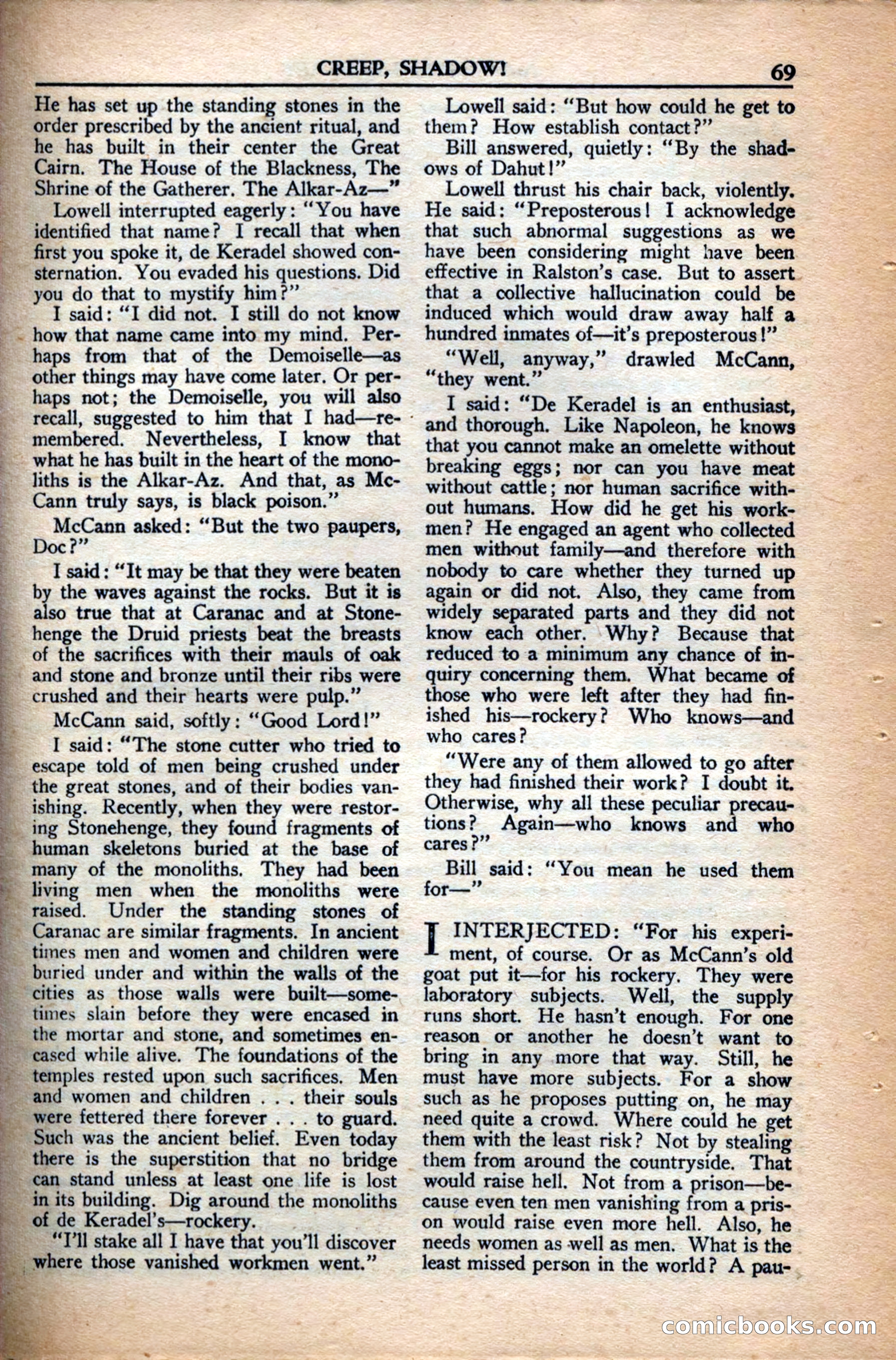
A restored page from Pulp Fiction, 1949. Page through the whole issue in the reader above.
📄 Transcribed text from this page (OCR, searchable)
Machine-transcribed from the original scan — historical spelling and the odd misread are preserved.
“a's <_< Se = _ He has set up the standing stones in the _ order prescribed by the ancient ritual, and he has built in their center the Great _ Cairn. The House of the Blackness, The _ Shrine of the Gatherer. The Alkar-Az—” _ Lowell interrupted eagerly: “You have _ identified that name? I recall that when first you spoke it, de Keradel showed con- _ sternation. You evaded his questions. Did you do that to mystify him?” I said: “I did not. I still do not know how that name came into my mind. Per- haps from that of the Demoiselle—as other things may have come later. Or per- haps not; the Demoiselle, you will also a 3 oF oe i member Nevertheless, I know that __ what he has built in the heart of the mono- liths is the Alkar-Az. And that, as Mc- - Cann truly says, is black poison.” _ McCann asked: “But the two paupers, = » Doc?” | I said: “It may be that they were beaten by the waves against the rocks. But it is - also true that at Caranac and at Stone- _ henge the Druid priests beat the breasts of the sacrifices with their mauls of oak _ and stone and bronze until their ribs were _ crushed and their hearts were pulp.” : McCann said, softly: “Good Lord!” _ I said: “The stone cutter who tried to escape told of men being crushed under _ the great stones, and of their bodies van- ' ishing. Recently, when they were restor- _ ing Stonehenge, they found fragments of ' human skeletons buried at the base of _ many of the monoliths, They had been ' living men when the monoliths were ' raised. Under the standing stones of _ Caranac are similar fragments. In ancient | times men and women and children were _ buried under and within the walls of the _ Cities as those walls were built—some- _ times slain before they were encased in _ the mortar and stone, and sometimes en- eased while alive. The foundations of the _ temples rested upon such sacrifices. Men and women and children . . . their souls _ were fettered there forever . . . to guard. - Such was the ancient belief. Even today _ there is the superstition that no bridge can stand unless at least one life is lost _ inits building. Dig around the monoliths _ of de Keradel’s—rockery. ; _ “Pl stake all I have that you’ll discover ___ where those vanished workmen went.” ae CREEP, SHADOW! recall, eagEeae to him that I had—re- - 69 - Lowell said: “But how could he get to them? How establish contact?” Bill answered, quietly: “By the shad- ows of Dahut!” Lowell thrust his chair back, violently. He said: “Preposterous! I acknowledge that such abnormal suggestions as we have been considering might have been effective in Ralston’s case. But to assert. that a collective hallucination could be induced which would draw away half a hundred inmates of—it’s preposterous!” “Well, anyway,” drawled McCann, “they went.” I said: “De Keradel is an enthusiast, and thorough. Like Napoleon, he knows that you cannot make an omelette without breaking eggs; nor can you have meat without cattle; nor human sacrifice with- out humans. How did he get his work- men? He engaged an agent who collected men without family—and therefore with nobody to care whether they turned up again or did not. Also, they came from widely ed parts and they did not know each other. Why? Because that reduced to a minimum any chance of in- quiry concerning them. What became of those who were left after they had fin- ished his—rockery? Who knows—and who cares? “Were any of them allowed to go after they had finished their work? I doubt it. Otherwise, why all these peculiar precau- tions? Again—who knows and who cares ?”’ Bill said: “You mean he used them or—’’ - I INTERJECTED: “For his experi- ment, of course. Or as McCann’s old goat put it—for his rockery. They were laboratory subjects. Well, the supply runs short. He hasn’t enough. For one reason or another he doesn’t want to. bring in any more that way. Still, he must have more subjects. For a show such as he proposes putting on, he may need quite a crowd. Where could he get — them with the least risk? Not by stealing _ them from around the countryside. That would raise hell. Not from a prison—be- cause even ten men vanishing from a pris- on would raise even more hell. Also, he needs women as well as men. What is the - least missed person in the world? A pau-. LI Ecomichbook o a ee, > Se - = <<